
Merz pledges €1.3bn aid package in Kyiv as Russian strikes intensify
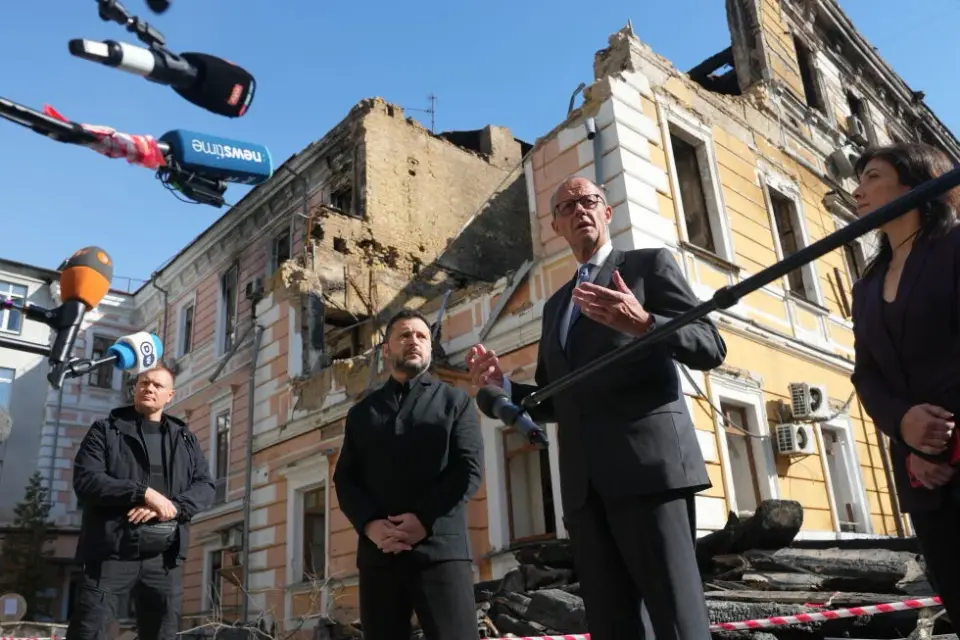
German Chancellor Friedrich Merz announced a €1.3 billion aid package for Ukraine during a surprise visit to Kyiv on Sunday, coinciding with intensified Russian strikes on the capital's infrastructure. The package includes €1 billion for military equipment, specifically joint production of anti-drone interceptors, and €350 million for energy sector repairs. Merz and President Zelenskyy visited a damaged National Academy of Sciences building, condemning Russian attacks as war crimes. The visit occurred as Russia targeted Kyiv's Northern Bridge for the fourth consecutive day, causing injuries and service disruptions, while Moscow warned of further massive airstrikes.
Key points
- German Chancellor Friedrich Merz announced a €1.3 billion aid package for Ukraine during a surprise visit to Kyiv on Sunday, October 4, 2026.
- The package includes €1 billion for military aid, focusing on joint production of drones and anti-jet interceptors, and €350 million for repairs to Ukraine's energy sector ahead of winter.
- Merz and President Zelenskyy visited the National Academy of Sciences, damaged by a Russian drone attack on September 28 that killed two people, with Merz calling the strikes 'daily war crimes.'
- Russian attacks on Kyiv's Northern Bridge continued for a fourth consecutive day, injuring two people and disrupting hot water and road access, as Moscow warned of further massive airstrikes.
- Merz stated that support for Ukraine is vital for European security, warning that Russia's war machine could turn against Europe if not stopped, while Zelenskyy noted US-proposed peace talks by month's end.
Background
Germany has been a key supporter of Ukraine since the 2022 invasion, signing a military pact worth over $4 billion in April 2026. Recent months have seen escalating Russian strikes on Ukrainian infrastructure, including data centers and bridges, prompting Germany to close its consulate in St. Petersburg in September 2026. Earlier in October, Germany and Ukraine agreed to share data on Ukrainian refugees to facilitate voluntary returns of fighting-age men, reflecting broader EU coordination on support and security.
How outlets are covering it
AP News and France 24 emphasize the symbolic nature of Merz's visit amid active air raids, highlighting his condemnation of Russian attacks as war crimes and his focus on European security. The Guardian details the specific corporate agreements signed, including deals with Diehl Defence and Hensoldt, and notes Zelenskyy's speculation about Russia sharing jet-drone technology with North Korea. Al Jazeera focuses on the immediate impact of the Northern Bridge strike and the broader context of Russia's warning to foreigners to leave Kyiv. All sources agree on the aid package's value but differ in emphasis: AP and France 24 stress the political messaging, while The Guardian provides more granular details on the commercial and technological aspects of the agreement.
Why it matters
The aid package signals Germany's continued commitment to Ukraine despite escalating Russian aggression, reinforcing European security concerns. The focus on joint drone production and energy repairs addresses immediate Ukrainian needs while countering Russian hybrid warfare tactics. The timing, amid intensified strikes and peace talk proposals, underscores the ongoing deadlock in the conflict and the strategic importance of Western support in sustaining Ukraine's defense capabilities.
What to watch
Germany and Ukraine are expected to finalize the joint production deal for long-range weapons and drones, with production ramping up in the coming weeks. Russia has promised to intensify strikes on Ukrainian military-industrial facilities, potentially leading to further infrastructure damage. US-proposed peace talks between Ukraine and Russia are expected by the end of October, though no concrete progress has been reported. Germany may take further steps to defend against Russian cyber-attacks and drone incursions, as indicated by Merz.
- Germany’s Merz announces new aid for Ukraine in Kyiv as Russia steps up attacks AP News
- Merz unveils fresh military aid in Kyiv, says Germany won't be intimidated Reuters
- Ukraine war briefing: Germany’s Merz pledges €1bn in military aid to Kyiv as Russia ramps up attacks The Guardian
- Russia hits Kyiv bridge as Germany’s Merz visits Ukraine’s capital Al Jazeera
- Merz unveils new aid for Ukraine as Russia strikes Kyiv during German leader's visit France 24
Want the full story? Read the original reporting
Read on AP News