
Solomon Islands swaps Chinese security pact for Australian treaty, barring foreign bases
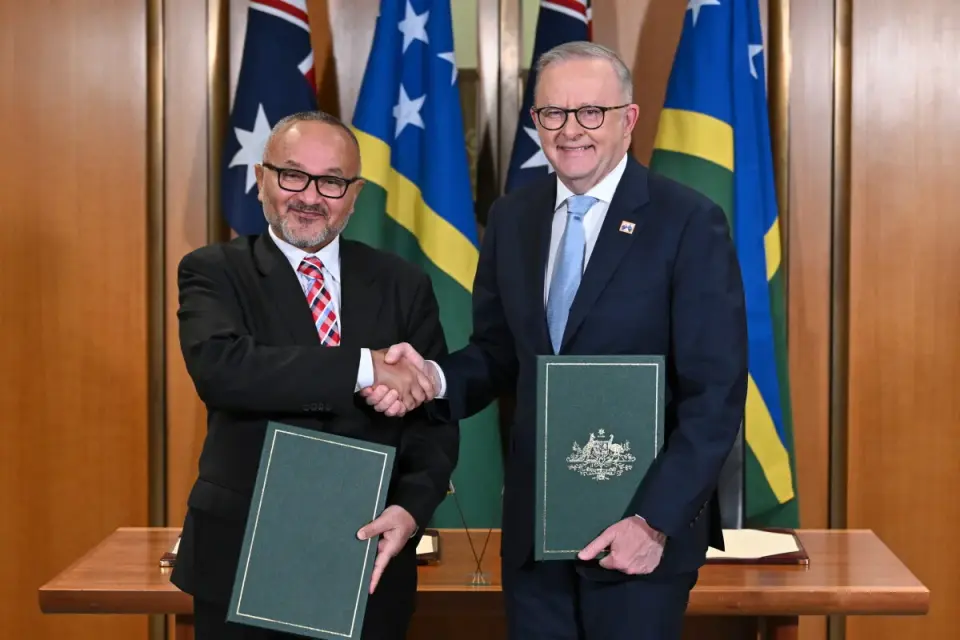
Australia and Solomon Islands signed a new security treaty on November 25, 2026, designating Canberra as the archipelago’s primary security partner. The agreement explicitly prohibits foreign military bases on Solomon Islands soil, effectively replacing a controversial 2022 defense pact with China that raised fears of a Beijing naval foothold. While Prime Minister Matthew Wale declined to confirm the termination of the Chinese deal due to non-disclosure clauses, Australian media reported that Honiara has decided not to renew the agreement, which expires in early 2027. The new treaty includes significant Australian investment in infrastructure, education, and renewable energy, marking a strategic shift in the Pacific region.
Key points
- Australia and Solomon Islands signed a bilateral security pact in Canberra on November 25, 2026, elevating their relationship to an unprecedented level.
- The treaty designates Australia as the Solomon Islands’ primary security partner and explicitly states that no foreign military or security base will be established on the islands.
- The deal includes Australian funding for infrastructure, education, renewable energy, and sports, along with improved visa arrangements for Solomon Islanders.
- Solomon Islands Prime Minister Matthew Wale cited a non-disclosure clause to avoid confirming reports that the 2022 security pact with China would not be renewed when it expires in early 2027.
- The 2022 Chinese pact, signed under former leader Manasseh Sogavare, had raised alarms in Washington and Canberra over potential Chinese military influence in the South Pacific.
Background
This development follows a series of Australian security agreements with Pacific neighbors, including Fiji, Tuvalu, Vanuatu, and Papua New Guinea, aimed at countering Chinese influence since 2022. The Solomon Islands’ strategic location on the sea route between the United States and Australia has made it a focal point in the broader U.S.-China competition for regional influence. Recent Quad summits and U.S.-led AI supply chain pacts have also emphasized the importance of securing the Indo-Pacific against Chinese expansion.
How outlets are covering it
AP News and CNN highlight the treaty as a decisive victory for Australia in its regional security strategy, noting that the new pact replaces a secretive Chinese deal that had caused alarm in the West. BBC emphasizes the 'historic' nature of the treaty and the significant financial package, citing leaked reports of over A$980 million in additional funding. While all sources agree on the strategic shift, Wale’s refusal to confirm the end of the Chinese pact due to non-disclosure terms creates a gap in official confirmation, though Chinese Foreign Ministry spokesperson Guo Jiakun denied any geopolitical rivalry in the cooperation. Lowy Institute analysts describe the move as a 'massive coup' for Beijing previously, now reversed, and a 'blow' to Chinese security ambitions in the Pacific.
Why it matters
The treaty reshapes the security architecture of the South Pacific, reducing Chinese influence in a strategically vital region. It reinforces Australia’s role as a key security partner for Pacific nations and signals a broader trend of Pacific states aligning with Western-aligned security frameworks. The explicit ban on foreign military bases addresses long-standing concerns about Chinese naval expansion, potentially stabilizing regional dynamics and strengthening ties between Australia and its Pacific neighbors.
What to watch
Observers will watch for the formal expiration of the Chinese security pact in early 2027 and any subsequent diplomatic responses from Beijing. Australia is expected to begin implementing the infrastructure and education funding outlined in the treaty. Further bilateral agreements with other Pacific nations may follow, as Canberra continues to consolidate its security partnerships in the region.
- Solomon Islands names Australia as its primary security partner in a new treaty that excludes China AP News
- This nation had a security pact with China. It’s just signed a deal with a US ally instead CNN
- China’s Military Ambitions in the Pacific Suffer Setback WSJ
- Solomon Islands Enters Security Treaty With Australia, in a Blow to China The New York Times
- Solomon Islands ends controversial security pact with China for Australian treaty BBC
Want the full story? Read the original reporting
Read on AP News