
Trump rejects Iran deal terms, vows to repeat strikes despite midterm losses
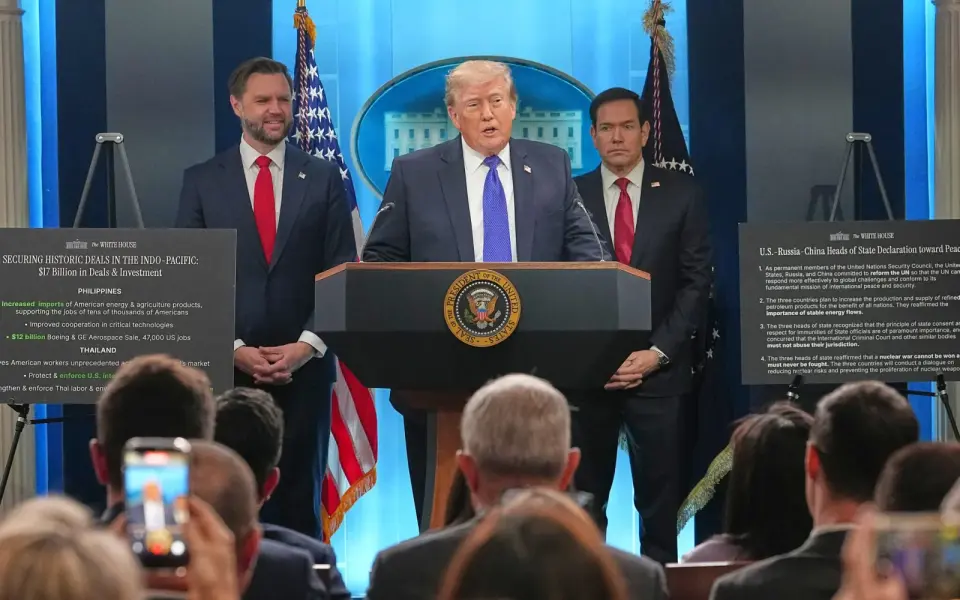
President Donald Trump stated on November 20 that Iran seeks a deal but offers terms he deems unacceptable, while Vice President JD Vance refused to confirm personal approval of the war. Trump acknowledged the conflict cost Republicans the midterms but insisted he would repeat the strikes to prevent Iran from acquiring nuclear weapons. The US maintains a naval blockade of Iran, and analysts note that while both sides avoid full-scale war, tensions remain high due to recent Iranian attacks on Gulf neighbors.
Key points
- Trump told reporters at the White House that Iran wants a 'real deal' but has not offered acceptable terms, accusing Tehran of misleading the US for 51 years.
- Vance declined to say if he would have authorized the strikes, stating his role is to support the president, though he previously suggested the war contributed to Republican losses in the November 3 midterms.
- Iranian Foreign Minister Abbas Araghchi reiterated that enriched uranium must remain in Iran and that Tehran seeks guarantees of US seriousness before resuming negotiations.
- The US Navy maintains a blockade of the Strait of Hormuz to restrict Iranian oil exports, while Iran has recently targeted US facilities in Kuwait and Bahrain.
- Trump met with Chinese President Xi Jinping and Russian President Vladimir Putin in Shenzhen, where they issued a joint declaration opposing nuclear war and affirming that Iran must not possess nuclear weapons.
Background
The conflict began in late February 2026, leading to a naval blockade and soaring global energy prices. Following the November 3 midterms, where Democrats won both chambers of Congress, Trump halted diplomatic efforts and redirected Vance to domestic issues. Recent polling shows Trump’s approval rating at 32%, with 63% of voters wanting the war to end immediately. Prior to the current standoff, Vance had brokered a short-lived truce that collapsed, and Trump had previously declared the war 'militarily over' while retaining the option to resume strikes.
How outlets are covering it
The Times of Israel and AP News highlight the diplomatic stalemate, noting that while Trump claims Iran is uncooperative, analysts suggest neither side desires a return to all-out war. AP reports that Gulf Arab states are seeking a partial solution involving shipping freedom in exchange for sanctions relief. The Hill emphasizes Trump’s dismissal of Russian and Chinese mediation, claiming the US has defeated Iran’s military capabilities. The Jerusalem Post focuses on Trump’s assertion that fuel prices have stabilized near $80 per barrel, contrasting with earlier fears of $300 barrels. Outlets differ on the likelihood of escalation: AP and The Times of Israel cite expert views that the current 'strategic patience' is the most sustainable path, while The Hill notes Trump’s confidence in unilateral US leverage.
Why it matters
The ongoing standoff threatens global energy markets and regional stability. The US naval blockade and Iranian retaliatory strikes on Gulf neighbors create a volatile environment that could escalate into broader conflict. Domestically, the war’s economic impact has significantly influenced US politics, contributing to Republican losses and shaping the administration’s approach to foreign policy. The lack of a clear diplomatic path forward leaves the situation in a precarious limbo, with potential for sudden escalation or a fragile, unverified ceasefire.
What to watch
Trump has indicated he will defer a decision on resuming major strikes until early 2027, stating 'we’ve got time.' Meanwhile, Iranian Foreign Minister Araghchi is seeking confidence-building measures from the US. Analysts expect continued low-level tit-for-tat strikes, with Iran targeting weaker Gulf states to signal reluctance for full-scale war. The US will likely maintain its naval blockade and economic pressure campaign while monitoring Iranian nuclear activities. Diplomatic channels remain open, but progress is stalled by mutual distrust and the absence of a clear off-ramp for either side.
- Trump says Iran wants deal but terms unacceptable; Vance sidesteps question on his approval of war The Times of Israel
- Trump insists Iran won’t make an ‘acceptable’ deal as concerns grow about next steps AP News
- Trump says he doesn’t need help from Russia, China to end Iran war The Hill
- Trump Pushes for Nobel Prize Again, Slams Iran Over ‘Fake’ Deal to End War Newsweek
- Donald Trump blasts Iran over fuel prices, says regime doesn't want 'acceptable deal' The Jerusalem Post
Want the full story? Read the original reporting
Read on The Times of Israel