
US Carrier Withdrawal from Asia Exposes Strategic Gaps Amid Iran War
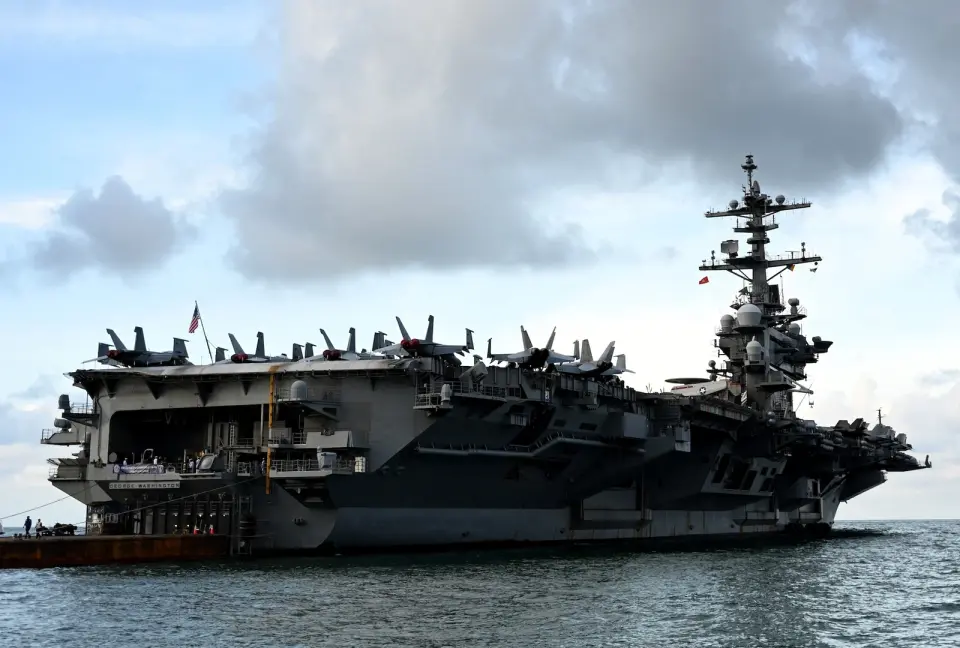
The US has withdrawn its last aircraft carrier from the Asia-Pacific region to relieve a ship in the Middle East, creating a significant security vacuum. This move, combined with reduced joint drills with South Korea, has alarmed Asian allies and analysts who fear it emboldens China and North Korea. While the US maintains substantial forces in the region, the shift raises questions about its ability to deter threats in the Pacific while fighting a prolonged war in Iran.
Key points
- The USS George Washington, the US Navy’s last carrier in Asia, was redeployed to the Middle East to relieve the USS Abraham Lincoln, which has been deployed for over 260 days.
- President Trump ordered a substantial reduction in joint military exercises with South Korea, citing a 'good relationship' with North Korea’s Kim Jong Un and Seoul’s refusal to join US actions against Iran.
- China has moved to fill the diplomatic void, with Foreign Minister Wang Yi meeting South Korean President Lee Jae Myung to discuss regional issues.
- The US 2026 National Defense Strategy calls for allies to increase defense spending to 3.5% of GDP by the 2030s, reflecting a shift toward burden-sharing.
- Analysts warn that the US is depleting munitions stockpiles in the Iran war, potentially weakening its ability to deter China in the Western Pacific.
Background
This development follows a series of recent US actions that have strained alliances in Asia. In August 2026, Trump’s decision to scale back the Ulchi Freedom Shield drills with South Korea sparked bipartisan alarm in the US and concern among allies. Additionally, South Korean President Lee Jae Myung had proposed talks with North Korea to formally end the Korean War, a move that complicated US denuclearization efforts. The current carrier withdrawal is seen as part of a broader pattern of US retrenchment in the region amid the ongoing Iran conflict.
How outlets are covering it
Salon frames the US pullback as a 'gift to China and North Korea,' arguing that the reduction in US military presence sacrifices decades of American dominance and may encourage nuclear proliferation. Al Jazeera highlights the anxiety among US allies, noting that while the US retains a large footprint in the region, the symbolic and operational impact of losing its last carrier is significant. Fox News focuses on the strategic dilemma, arguing that the US is making a necessary tradeoff but must ensure that its deterrence against China remains credible despite the resource drain from the Iran war. All three sources agree that the US is facing a difficult balancing act, but they differ on whether this constitutes a strategic failure or a necessary adjustment.
Why it matters
The US withdrawal of its last carrier from Asia signals a potential shift in the global balance of power. If the US cannot maintain a strong presence in the Pacific while fighting in the Middle East, it may embolden China and North Korea to test US resolve. This could lead to increased instability in the region and a reordering of alliances, with Asian nations seeking greater autonomy in their defense strategies. The long-term implications for US hegemony and global security are significant.
What to watch
The US is expected to continue its war in Iran, which may further strain its military resources. Asian allies are likely to increase their defense spending and deepen security cooperation among themselves. China may continue to test US resolve in the Western Pacific, while North Korea could leverage the US pullback to advance its nuclear program. The US will need to decide how to balance its commitments in the Middle East and Asia in the coming months.
- Trump’s Asia pullback is a gift to China and North Korea Salon.com
- US allies in Asia wary as Trump moves military assets for Iran war Al Jazeera
- As China Pushes to Expand in Asia, Trump Focuses on Iran The New York Times
- Iran war forces America to confront the strategic cost of deterring China Fox News
- How US Navy Conditions Compare to China’s Newsweek
Want the full story? Read the original reporting
Read on Salon.com