
US, China, Russia pledge oil expansion and UN reform in historic Shenzhen trilateral
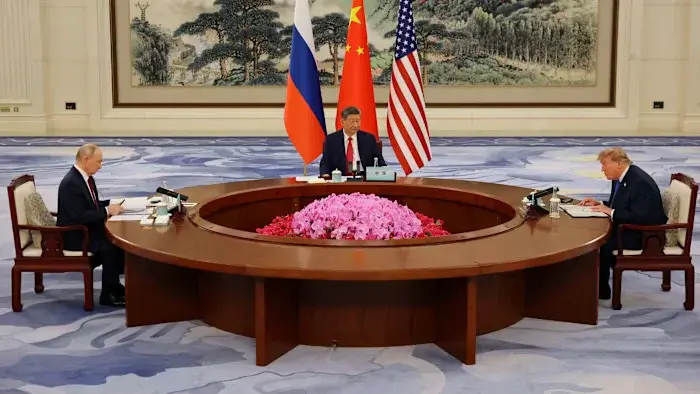
US President Donald Trump, Chinese President Xi Jinping, and Russian President Vladimir Putin held the first-ever trilateral meeting in Shenzhen, China, on the sidelines of the APEC summit. The leaders issued a joint statement pledging to increase refined petroleum production, reform the United Nations, and uphold state official immunities, effectively challenging the jurisdiction of the International Criminal Court. While the meeting lasted less than 90 minutes and produced no US readout, it was framed by participants as a historic shift toward multipolar diplomacy. European allies, excluded from the talks, convened separately in Berlin to reaffirm support for Ukraine, while critics noted the absence of concrete agreements on the war in Ukraine or artificial intelligence regulation.
Key points
- The trilateral meeting took place at the Kylin Villa in Shenzhen, concluding with a joint statement released by Beijing and Moscow but not Washington.
- The statement affirmed commitments to UN reform, increased supply of refined petroleum products, and the principle that state officials must not face abuse of jurisdiction by bodies like the ICC.
- Xi Jinping proposed a framework for 'peaceful coexistence' among major powers, emphasizing non-interference and economic integration rather than decoupling.
- Trump described the meeting as 'making history' and highlighted the unique position of the three largest nuclear powers to discuss arms reduction, though he admitted the difficulty of giving up weapons.
- Putin characterized the talks as a 'page in diplomatic history' and expressed hope for future meetings, noting shared interests in resolving regional conflicts including Ukraine.
- European leaders, including those from the UK, France, and Germany, held a 'Coalition of the Willing' meeting in Berlin to coordinate support for Ukraine, with US envoys Jared Kushner and Steve Witkoff attending.
Background
This meeting follows a series of bilateral encounters in Shenzhen, including a rare airport greeting by Xi for Trump and a 40-minute one-on-one session between Trump and Putin. Previous coverage noted that analysts expected limited concrete outcomes due to conflicting interests regarding the wars in Ukraine and Iran, as well as trade tensions. The trilateral was widely compared to the 1945 Yalta Conference, with some experts dubbing it 'Yalta 2.0' due to its potential to reshape the post-war international order.
How outlets are covering it
The Financial Times and CNN emphasized the symbolic nature of the meeting, noting that while the joint statement included broad commitments to stability and energy supply, it lacked specific details on Ukraine or AI. CNN highlighted that the Kremlin and Chinese state media readouts were nearly identical, omitting references to the war in Ukraine and the Nvidia scandal. The Hill offered a critical perspective, arguing that Trump entered the talks from a position of weakness due to domestic cyber outages and internal administration conflicts over chip exports, potentially ceding leverage to Xi and Putin. NBC News focused on the diplomatic protocol, noting Xi's rare tarmac greeting for Trump, and reported that cybersecurity experts dismissed the recent US tech outages as mundane failures rather than attacks, contrasting with Trump's suggestion of foreign malice. European officials, as reported by CNN, expressed concern that the trilateral excluded Ukraine and Europe, with Polish PM Donald Tusk criticizing Trump's 'friend' remarks toward Putin and Xi.
Why it matters
The trilateral meeting signals a potential shift in global power dynamics, with China and Russia positioning themselves as equal partners to the US in shaping international norms. The joint statement's defense of state official immunities directly challenges the ICC's authority, potentially shielding leaders like Putin from prosecution for alleged war crimes. The pledge to increase petroleum supply may benefit Russian oil exports, while the lack of concrete outcomes on Ukraine suggests the conflict may continue without a US-brokered peace deal. The event also highlights the growing divergence between US and European foreign policy priorities, as Europe seeks to maintain support for Ukraine while the US pursues engagement with authoritarian regimes.
What to watch
US envoys Jared Kushner and Steve Witkoff are expected to brief European leaders in Berlin on the outcomes of the Shenzhen talks. The US has yet to release its own readout of the trilateral, leaving the specifics of the discussions unclear. Future meetings between the three leaders may be scheduled, as suggested by Putin, but Kremlin aide Yuri Ushakov indicated it was too early to determine if the format would continue. The US-China trade truce, extended until January 10, remains in effect, with further talks expected at the G20 in Miami in December.
- Apec summit live: Trump hails historic meeting with Putin and Xi Financial Times
- Trump joins historic talks with ‘friends’ Xi and Putin: APEC live CNN
- Catch up: President Trump arrives in China; Nvidia rules out return of Jensen Huang The Economist
- Escaping chaos at home, Trump’s Asia tour is shaping up to be a disaster The Hill
- Xi embraces Trump ahead of historic summit and experts explain the recent tech outages: Morning Rundown NBC News
Want the full story? Read the original reporting
Read on Financial Times