
Pew Projections: Islam to Surpass Christianity by 2035 as Fertility Gaps Reshape Global Faith
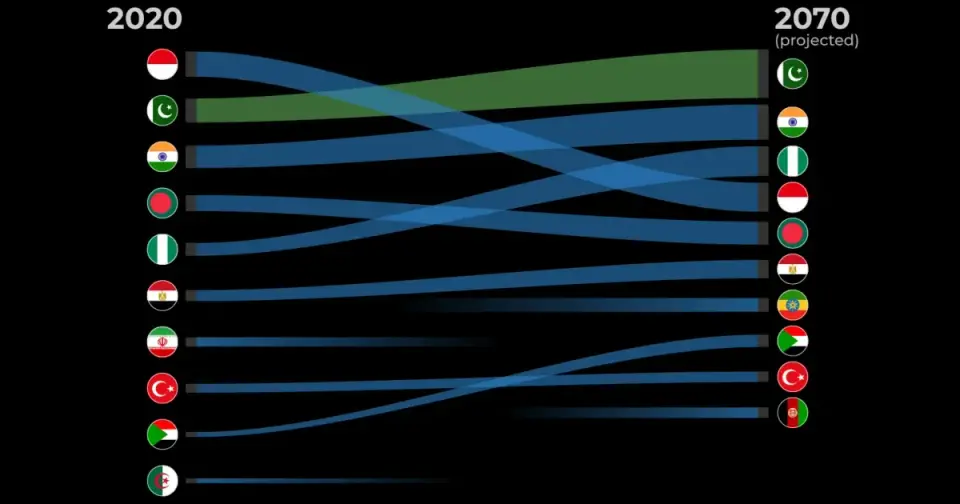
The Pew Research Center projects that Muslims will become the world's largest religious group by 2035, surpassing Christians. By 2070, the global Muslim population is expected to reach 3.64 billion, up from 2.02 billion in 2020, while Christians are projected to number just under 3 billion. This shift is driven primarily by higher fertility rates and younger age structures among Muslims, not mass conversions. Pakistan is expected to overtake Indonesia as the country with the largest Muslim population, while India will rank second. In the US, Christians will lose their majority status by 2065, though they will remain the largest single group. The report also notes a geographic shift in Christianity toward sub-Saharan Africa, with the Democratic Republic of Congo potentially overtaking the US as the country with the largest Christian population by 2070.
Key points
- Muslims are projected to outnumber Christians globally by 2035, with the Muslim population growing by 80% between 2020 and 2070 to reach 3.64 billion.
- Christians are expected to grow by 30% to 2.96 billion by 2070, roughly in step with the world population, while Hindus and Jews are projected to grow more slowly than the global population.
- Pakistan is projected to overtake Indonesia as the country with the largest Muslim population by 2070, with its Muslim population doubling to 461 million, while Indonesia's grows by 15%.
- India is projected to have the second-largest Muslim population by 2070, with 334 million Muslims, up from 213 million in 2020, while the Hindu share of India's population is expected to decline from 79% to 76%.
- The US is projected to lose its Christian majority by 2065, with Christians declining to just under 48% of the population by 2070, while the religiously unaffiliated rise to 41%.
- Sub-Saharan Africa is expected to become the center of gravity for Christianity, with the Democratic Republic of Congo potentially overtaking the US as the country with the largest Christian population by 2070.
Background
This story builds on earlier coverage from our archive (2026-11-19) that first reported the Pew Research Center's projections of Islam becoming the world's largest religion by 2035, driven by fertility rates and younger age structures among Muslims. The archive also noted the geographic shift of Christianity toward sub-Saharan Africa and the US losing its Christian majority. The current sources provide additional details on specific country-level projections, such as Pakistan overtaking Indonesia, India's religious composition changes, and the decline of Buddhism in East Asia.
How outlets are covering it
Al Jazeera emphasizes the global shift in religious populations, highlighting the growth of Muslims and the decline of other groups like Buddhists and the religiously unaffiliated. It notes that most of the growth will happen in Muslim-majority countries, with Pakistan overtaking Indonesia as the country with the largest Muslim population. NPR focuses on the fertility rate differences between Muslims and other religious groups, noting that Muslim women have an average of 3.1 children compared to 2.5 for Christian women and 1.6 for all other women. It also highlights the geographic shift of Christianity toward sub-Saharan Africa, with the Democratic Republic of Congo potentially overtaking the US as the country with the largest Christian population. BBC provides a detailed analysis of India's changing religious composition, noting that the Hindu share of the population is projected to decline from 79% to 76% by 2070, while the Muslim share rises from 15% to 20%. It also notes that the fertility gap between Muslims and Hindus in India has narrowed considerably, from more than one child per woman in 1992 to about half a child in recent years. All three sources agree that the shift is driven primarily by demographic factors, not mass conversions, and that the projections assume current trends in fertility, mortality, and religious switching continue.
Why it matters
These projections have significant implications for global politics, economics, and social dynamics. The growth of the Muslim population and the decline of other religious groups could shift the balance of power in international relations, particularly in regions where religious demographics are closely tied to political and economic stability. The geographic shift of Christianity toward sub-Saharan Africa could reshape the global landscape of religious influence and development aid. The decline of Buddhism in East Asia could have cultural and social implications for countries like China, Japan, and South Korea. The loss of the Christian majority in the US could impact domestic politics and social policies, as religious affiliation often influences voting patterns and public opinion. These demographic shifts also highlight the importance of understanding the drivers of population growth, such as fertility rates and age structures, in predicting future religious and social trends.
What to watch
The next steps will involve monitoring the actual demographic trends to see if they align with the Pew projections. Researchers will likely update their models as new data becomes available, particularly in regions where fertility rates and religious switching patterns are changing rapidly. Policymakers and social scientists will need to consider the implications of these demographic shifts for issues such as education, healthcare, and social cohesion. Religious leaders and organizations may also need to adapt to the changing religious landscape, particularly in regions where the balance of power between different religious groups is shifting. The report also notes that the projections could change with wars, disasters, or economic shifts, so it will be important to monitor these factors as they develop.
- Islam set to be the largest religion by 2035: Where will most Muslims live? Al Jazeera
- The Future of World Religions: Population Growth Projections, 2020-2070 Pew Research Center
- Muslims will outnumber Christians worldwide by 2035, report says NPR
- Pew survey: What India's changing Hindu and Muslim populations tell us BBC
- How Pew's projections for Christianity and Islam worldwide changed — and why Religion News Service
Want the full story? Read the original reporting
Read on Al Jazeera