
Istanbul Summit Formalizes Mecca Defence Pact as Turkey Denies Anti-Israel Targeting
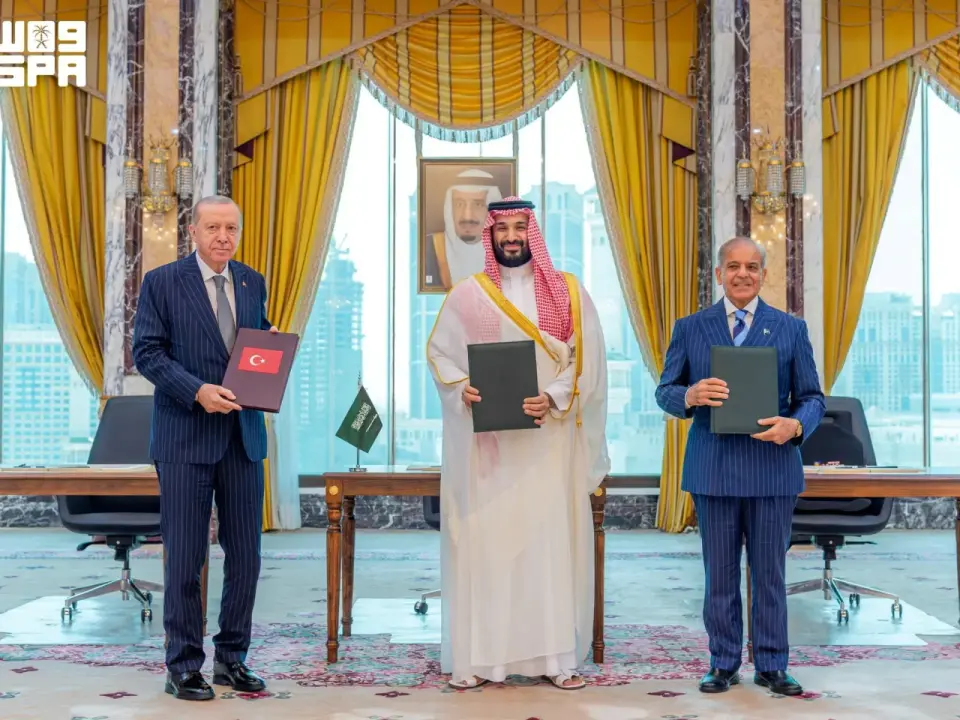
Foreign ministers, defence ministers, and military chiefs from Turkiye, Saudi Arabia, and Pakistan met in Istanbul on August 31 to establish a 'political and defence strategic committee' under the Mecca Joint Defence Agreement. Signed on August 7, the pact mirrors NATO’s collective security principle, stipulating that an attack on one member is an attack on all. Turkish Foreign Minister Hakan Fidan asserted the alliance is not directed against any specific country, despite accusations regarding Israel. The meeting focused on enhancing military cooperation, interoperability, and regional stability, with discussions on expanding membership to include Egypt and Bangladesh.
Key points
- The first high-level meeting since the August 7 signing took place in Istanbul, involving foreign ministers, defence ministers, and chiefs of staff from the three nations.
- The summit formally established a 'political and defence strategic committee' to oversee the implementation of the Mecca Joint Defence Agreement.
- Turkish Foreign Minister Hakan Fidan stated the pact is a 'reciprocal alliance' open to expansion and not targeted at any specific nation, while simultaneously condemning Israeli Prime Minister Benjamin Netanyahu as an 'enemy of security and humanity.'
- The agreement complements existing alliances like NATO and aims to reduce regional uncertainty by improving military capabilities and cooperation among the three signatories.
- Egypt and Bangladesh are currently evaluating potential membership in the pact, with India monitoring the expansion closely due to security concerns.
Background
The Mecca Joint Defence Agreement was signed on August 7, 2026, by Turkish President Recep Tayyip Erdogan, Saudi Crown Prince Mohammed bin Salman, and Pakistani Prime Minister Shehbaz Sharif. This trilateral pact emerged in the context of a new Gulf security architecture following the US-Israel war on Iran. Previous analyses suggested the pact could challenge US influence in the Gulf and complicate Arab-Israeli normalization, while Iran dismissed the move as speculative. Bangladesh had previously indicated it was considering joining the alliance, a move that would require balancing relations with India and China.
How outlets are covering it
Al Jazeera emphasizes the structural establishment of the strategic committee and the potential for expansion, noting that Egypt and Bangladesh are considering joining. It highlights the military significance of the alliance, citing Turkiye’s large NATO military, Pakistan’s nuclear status, and Saudi Arabia’s oil dominance. The Jerusalem Post focuses on the diplomatic rhetoric of Turkish Foreign Minister Hakan Fidan, who denied the pact targets Israel while simultaneously labeling Netanyahu an 'enemy of humanity' and accusing him of genocide. While Al Jazeera frames the meeting as a step toward regional stability and capability improvement, The Jerusalem Post highlights the tension between Turkey’s claim of neutrality and its aggressive rhetoric toward Israel. Both sources agree that the pact is intended to complement, not replace, existing security frameworks like NATO.
Why it matters
The formalization of the Mecca Joint Defence Agreement signals a shift toward regional autonomy in Middle Eastern security, potentially reducing reliance on US guarantees. The establishment of a strategic committee indicates a move from symbolic signing to operational military cooperation. The potential expansion to include Egypt and Bangladesh could reshape the geopolitical balance in the region, particularly concerning India’s security interests and the broader dynamics of the Abraham Accords. This alliance represents a concrete step in building a non-Western security architecture in the Gulf and Eastern Mediterranean.
What to watch
The newly formed political and defence strategic committee will likely draft a roadmap for the accession of new members, including Egypt and Bangladesh. Further discussions on military interoperability and joint capabilities are expected. India’s response to the potential expansion of the alliance will be a key indicator of regional tensions. The alliance’s effectiveness in deterring conflict or managing crises will be tested in the coming months, particularly regarding its relationship with existing US and NATO security structures.
- Top officials from Turkiye, Saudi Arabia, Pakistan to meet in Istanbul Al Jazeera
- Turkey, Saudi Arabia, Pakistan to hold first defence pact meeting, source says Reuters
- Turkish FM Fidan denounces Benjamin Netanyahu, denies Mecca pact targets specific country The Jerusalem Post
- Pakistan, Saudi Arabia, Turkiye meet: What’s next for their defence pact? Al Jazeera
- Turkish FM: Netanyahu is a criminal who poses a threat to the region and the international community i24NEWS
Want the full story? Read the original reporting
Read on Al Jazeera