
UK Foreign Secretary Confronts Iran at UN Over Domestic Threats and Strait of Hormuz
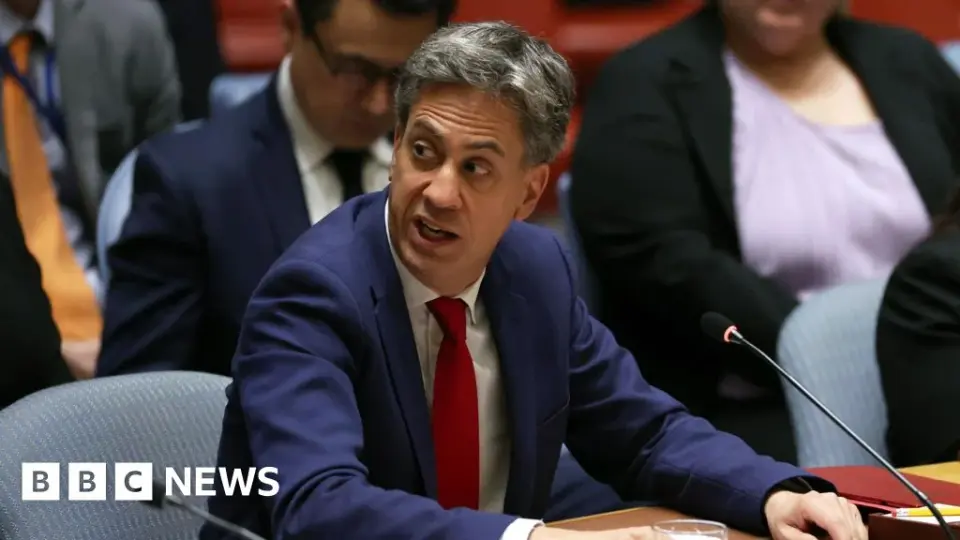
UK Foreign Secretary Ed Miliband met with Iranian Foreign Minister Abbas Araghchi at the UN General Assembly in New York to demand an end to hostile activities on British soil. The meeting addressed threats against the Jewish community, recent cyberattacks, and the ongoing conflict in the Middle East, with London urging Tehran to pursue diplomacy and reopen the Strait of Hormuz.
Key points
- Miliband and Araghchi met face-to-face at the UN General Assembly in New York.
- The UK warned it will not tolerate intimidation or hostile activity by Iranian-linked groups on its soil.
- Discussions covered the Middle East war, the reopening of the Strait of Hormuz, and the detention of British couple Lindsay and Craig Foreman.
- Iranian President Masoud Pezeshkian rejected US threats of annihilation, stating Iran will never 'bend the knee' to pressure.
- The UK urged Iran to choose de-escalation and diplomacy over prolonging the conflict.
Background
This meeting follows a series of security incidents in 2026, including an arson attack on Jewish community ambulances in Golders Green in March and a cyberattack on a UK power plant in July attributed to Iranian-linked hackers. In September, the UK also announced expanded sanctions against Iran to curb its nuclear program and hostile activities.
How outlets are covering it
While the BBC and The Jerusalem Post both report on the meeting, they emphasize different aspects. The BBC highlights the UK's intelligence conclusion that Iran or its proxies were involved in attacks against Jewish communities, as well as the detention of the Foreman couple. The Jerusalem Post focuses on the cyber dimension, noting that the UK's National Cyber Security Center identified Iranian state-linked actors using a spyware tool called 'CHOSEN BRICK' for spear-phishing campaigns. The Yahoo source appears to be a technical error page and provides no substantive news content.
Why it matters
The confrontation underscores the escalating tensions between the UK and Iran, linking domestic security threats to broader geopolitical conflicts in the Middle East. The UK's stance signals a firm commitment to protecting its citizens and infrastructure while attempting to de-escalate the regional war through diplomatic channels.
What to watch
The outcome of the negotiations will depend on Iran's response to the UK's demands for de-escalation and the release of the detained British couple. The status of the Strait of Hormuz and the ongoing US-Iran conflict will also influence future diplomatic engagements.
- Miliband tells Iran minister UK will not tolerate 'hostile activity' on British soil BBC
- Britain warns Iran it will not tolerate hostile activity on UK soil, Sky News reports Reuters
- UK will not ‘tolerate intimidation,’ foreign secretary tells Iran Yahoo
- Miliband presses Iran on threats, cyber activity and Strait of Hormuz The Jerusalem Post
- Iranian FM meets UK counterpart on the sidelines of the 81st session of the United Nations General Assembly news.cgtn.com
Want the full story? Read the original reporting
Read on BBC