
U.S.-South Korea alliance faces turbulence as trade, military, and intelligence disputes deepen
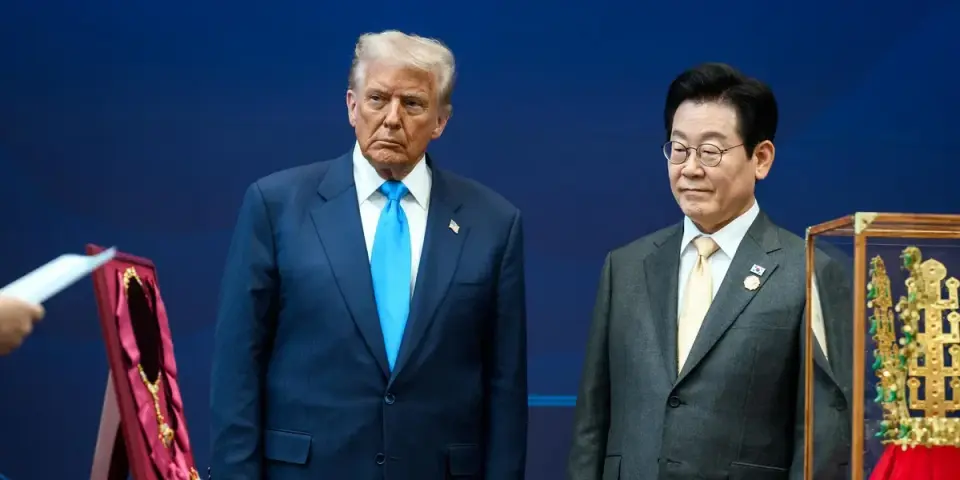
The strategic alliance between the United States and South Korea has deteriorated significantly since President Lee Jae Myung’s August 2025 summit with Donald Trump. While initial agreements on trade and defense spending appeared successful, subsequent months have seen rising friction over intelligence sharing, investment delays, and military cooperation. U.S. Ambassador Michelle Steel described the relationship as experiencing 'turbulence,' citing Seoul’s slow decision-making on a $350 billion investment package and a $54 billion Alaska LNG project. Disputes also arose after South Korean officials publicly identified a North Korean uranium facility, leading Washington to restrict satellite intelligence sharing. Additionally, disagreements over the location of nuclear submarine construction and the scope of joint military drills have strained the partnership, with South Korea seeking greater strategic autonomy in missile defense.
Key points
- U.S. Ambassador Michelle Steel publicly labeled the bilateral relationship as experiencing 'turbulence' in October 2026, marking a sharp decline from the cordial August 2025 summit.
- South Korea’s delayed decisions on a pledged $350 billion investment package, including a $54 billion stake in the Alaska LNG pipeline, have angered the Trump administration, which has threatened to resume 25% tariffs.
- Washington restricted satellite-derived intelligence on North Korea after South Korean Unification Minister Chung Dong-young publicly identified a uranium enrichment facility, a move Seoul claims was already public information.
- Disputes over the construction of nuclear-powered submarines remain unresolved, with the U.S. preferring Hanwha’s Philadelphia shipyard while Seoul argues for domestic facilities and requires exemptions for enriched fuel transfers.
- The Trump administration shortened annual joint military drills, a move Seoul accepted publicly but privately opposed, as President Lee prefers enhanced deterrence before engaging in diplomatic talks with North Korea.
- A $423 million fine imposed on U.S.-listed e-commerce firm Coupang for a data breach was condemned by Washington as discrimination against American companies, despite Seoul’s justification for consumer privacy protection.
Background
The current tensions follow a period of significant cooperation in 2025, including a reduction in U.S. tariffs from 25% to 15% and a $150 billion shipbuilding investment. However, the relationship has been complicated by broader geopolitical shifts, including the 2026 Iran war, which exposed vulnerabilities in U.S. missile defense systems and diverted resources from the Asia-Pacific. The 2026 U.S. midterm elections, which resulted in a Democratic majority in Congress, have introduced new dynamics, with lawmakers like Chris Coons and Adam Smith now overseeing defense and foreign affairs committees. These new leaders are expected to scrutinize the alliance more closely, particularly regarding the transfer of wartime operational control and nuclear submarine agreements.
How outlets are covering it
Responsible Statecraft emphasizes that the 'turbulence' is a result of unforced errors by Seoul, such as intelligence leaks and slow investment decisions, but also notes that the Trump administration shares blame for unpredictable tariff threats and unilateral changes to military drills. Asia Times argues that the alliance’s uncertainty necessitates South Korea to accelerate its indigenous missile defense programs, such as the Low Altitude Missile Defense (LAMD) system, to reduce reliance on U.S. support, which was strained during the 2026 Iran conflict. The Korea Economic Institute of America suggests that while the new Democratic Congress will defend the alliance’s structure, the White House retains the power to disrupt it, and Seoul must engage with Congress proactively to protect its interests. Chosun Ilbo highlights the political fallout in South Korea, where some officials celebrated the defeat of pro-Korea Republican congresswoman Young Kim, but warns that such actions undermine long-term diplomatic relationships and the stability of parliamentary diplomacy.
Why it matters
The deterioration of the U.S.-South Korea alliance could have significant implications for regional security in the Asia-Pacific, particularly regarding North Korea and China. If the alliance weakens, South Korea may be forced to accelerate its own defense capabilities, potentially altering the regional balance of power. Additionally, trade disputes and investment delays could impact economic growth in both countries, while intelligence sharing restrictions could compromise security against North Korean threats. The outcome of these tensions will also influence how other U.S. allies in the region perceive the reliability of American commitments.
What to watch
South Korea is expected to engage with the new Democratic Congress to protect the alliance and address concerns over the transfer of wartime operational control and nuclear submarine agreements. The Trump administration may continue to threaten tariff increases if investment deals remain stalled, while Seoul may accelerate its indigenous missile defense programs to reduce reliance on U.S. support. Diplomatic engagements between President Lee and President Trump are expected to continue, but the next two years may prove turbulent as both nations navigate trade, military, and foreign policy disagreements.
- Trump’s honeymoon with South Korea is over Responsible Statecraft
- With US alliance less certain, Seoul needs to fix missile defense Asia Times
- The Midterms Gave the U.S.-South Korea Alliance New Defenders in Congress Korea Economic Institute of America -
- Is Celebrating Pro-Korea Defeats Justified? 조선일보
- Why the midterms matter for the US-South Korea alliance Brookings
Want the full story? Read the original reporting
Read on Responsible Statecraft