
UN Geneva talks fail to bind autonomous weapons, deferring rules to 2028
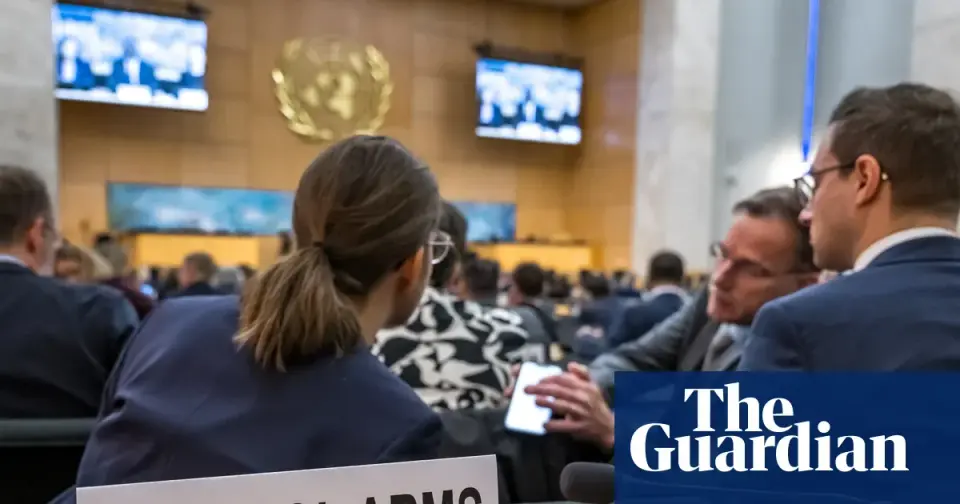
Week-long UN negotiations in Geneva collapsed on Saturday, failing to agree on a mandate for a legally binding treaty on lethal autonomous weapons. The Convention on Certain Conventional Weapons (CCW) instead adopted a weaker resolution to 'elaborate' on an instrument by 2028. While over 100 states pushed for immediate binding rules, major military powers including the US, Russia, and Israel blocked the measure, citing existing humanitarian laws or technical concerns. Critics and humanitarian groups condemned the outcome as a missed opportunity, noting that AI-enabled weapons are already in use in conflict zones.
Key points
- Negotiations at the UN Convention on Certain Conventional Weapons (CCW) in Geneva ended without a binding mandate, opting for a weaker 'elaboration' process by 2028.
- Over 100 states, including European nations, China, and Iran, supported a binding treaty, but the consensus requirement allowed Russia and the US to block progress.
- Russia used obstructive tactics to stall talks, while the US and other military powers like South Korea and Japan advocated for non-binding agreements.
- Humanitarian organizations and UN Secretary-General António Guterres criticized the outcome, arguing that current international humanitarian law is insufficient for regulating AI weapons.
- The CCW has failed to pass new weapon regulations in 30 years due to its unanimous consent requirement, leading some states to seek alternative treaty pathways.
Background
This failure follows years of stalled progress on autonomous weapons regulation. In October 2026, Pope Leo XIV urged nations to ban lethal autonomous weapons at the Geneva talks, aligning with his call for AI 'disarmament.' Earlier in November, UN delegates faced deadlock as superpowers blocked binding rules, with 163 states supporting the move but facing resistance from the US, Russia, Israel, and others. Experts at the Munich Security Conference in November also warned that current AI capabilities could enable autonomous killing systems within the decade, highlighting the urgency of international coordination.
How outlets are covering it
The Guardian and Al Jazeera emphasize the obstructionist tactics of Russia and the reluctance of the US and other military powers to commit to binding protocols, noting that the US cited discussions between President Trump and President Xi Jinping as justification for non-binding approaches. NPR highlights the broader diplomatic difficulty, framing the outcome as a 'glass half full or half empty' scenario, with UN officials calling it a significant achievement while activists like Beatrice Fihn describe it as pushing the issue down the road. All sources agree that the consensus-based nature of the CCW, requiring unanimous agreement from 128 parties, is a primary structural barrier to progress. Critics, including Max Tegmark and Human Rights Watch, argue that the delay is dangerous given the active deployment of AI weapons in Gaza and Iran, while supporters of the outcome, like Swiss chair Julien Thoeni, view the 'elaboration' mandate as a concrete step in a divided world.
Why it matters
The failure to establish binding international rules for lethal autonomous weapons leaves a regulatory vacuum as AI technology advances rapidly. Without clear legal frameworks, the use of AI in warfare could escalate, potentially leading to mass casualties and the erosion of the distinction between combatants and civilians. The delay to 2028 allows military powers to continue developing and deploying these systems without international oversight, raising concerns about the safety of civilians and the future of humanitarian law in conflict zones.
What to watch
The 128 CCW parties will now enter a two-year 'elaboration' phase to determine which weapons can be banned or regulated under international humanitarian law. Advocacy groups and supportive states will likely continue to push for binding norms through alternative forums, while major military powers may accelerate the development of AI-enabled weapons. The outcome will be closely watched at future UN sessions, with pressure from humanitarian organizations and UN Secretary-General António Guterres to ensure that the 2028 deadline leads to concrete regulatory measures.
- International talks on controlling use of autonomous weapons collapse The Guardian
- Nations at UN talks on AI killer robots agree to more talks but no firm commitment to rein them in NPR
- States agree to UN talks aiming to regulate 'killer robots' by 2028 Reuters
- UN talks on 'killer robots' end with no legally binding ban, further talks pledged DW.com
- Nations agree to ‘elaborate’ on rules for AI-run ‘killer robots’ by 2028 Al Jazeera
Want the full story? Read the original reporting
Read on The Guardian