
IAEA confirms North Korea’s new Yongbyon uranium plant can hold 28 centrifuge cascades
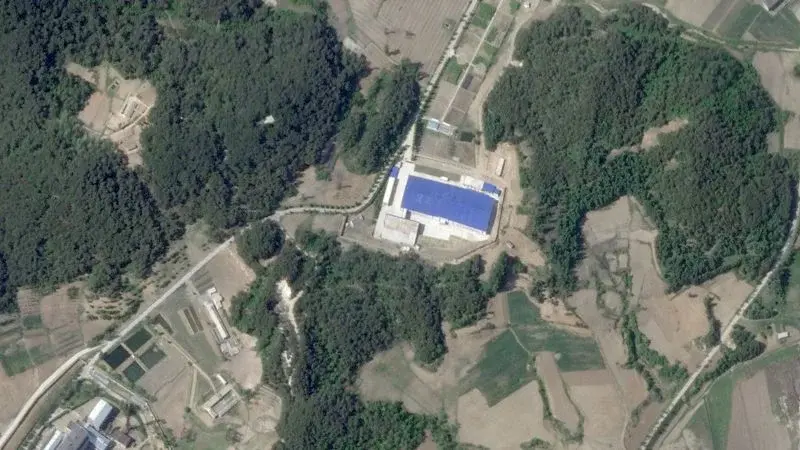
The International Atomic Energy Agency (IAEA) confirmed that North Korea has constructed a new uranium enrichment facility at its main Yongbyon nuclear complex, capable of housing up to 28 centrifuge cascades. The agency also reported expanded operations at the Kangson site near Pyongyang. These developments, identified through satellite imagery and state media photos, suggest a significant increase in the regime’s capacity to produce weapons-grade highly enriched uranium. IAEA Director General Rafael Grossi expressed 'serious concern,' labeling the expansion a clear violation of UN Security Council resolutions. While estimates vary on the exact output, analysts suggest the new facilities could yield enough material for several additional nuclear warheads annually, accelerating Pyongyang’s nuclear arsenal despite international sanctions.
Key points
- IAEA report released September 7, 2026, identifies a new uranium enrichment annex at Yongbyon.
- The new Yongbyon facility can accommodate up to 28 centrifuge cascades, comprising approximately 4,592 centrifuges.
- Construction began in December 2024, with the exterior completed in May 2025; operations began in early 2026.
- Kangson enrichment site near Pyongyang also expanded, with operations starting in January 2026.
- IAEA Director General Rafael Grossi called the expansion a 'clear violation' of UN Security Council resolutions.
- South Korean defense minister Ahn Gyu-back estimated North Korea holds 80 to 120 nuclear warheads, higher than the 57 cited by US President Donald Trump in August 2026.
Background
This development follows a series of recent IAEA actions regarding non-compliance in other regions, including referrals of Iran and Syria to the UN Security Council in September 2026. It also occurs amid broader US nonproliferation policy shifts, such as the 2026 US-Saudi nuclear cooperation agreement, which raised concerns about weakened global safeguards standards. North Korea’s last nuclear test was in 2017, but its missile and nuclear programs have advanced rapidly since then, with the regime demanding recognition as a legitimate nuclear state.
How outlets are covering it
CNN and The Guardian emphasize the IAEA’s 'serious concern' and the violation of UN resolutions, highlighting the political implications of the expansion. The Guardian notes the discrepancy in warhead estimates between South Korea (80-120) and the US (57). Dong-A Ilbo provides more granular technical details, such as the specific timeline of construction (Dec 2024–May 2025) and the estimated annual warhead output (six total from both sites). All sources agree on the factual existence of the new facilities but differ in emphasis: Western outlets focus on the diplomatic and security implications, while the South Korean outlet focuses on the technical capacity and production rates. The IAEA’s reliance on satellite imagery and open-source material, rather than on-site inspections (since inspectors were expelled in 2009), is a key methodological point across all reports.
Why it matters
The confirmed expansion of North Korea’s uranium enrichment capabilities directly undermines the global nonproliferation regime and UN Security Council resolutions. It signals a shift from plutonium-based weapons to a more diversified and potentially more efficient uranium-based arsenal. The discrepancy in warhead estimates between US and South Korean officials highlights the uncertainty in assessing North Korea’s true nuclear threat. This development may pressure the US and its allies to reconsider their nonproliferation strategies, potentially leading to stricter sanctions or diplomatic isolation of Pyongyang, while also raising questions about the effectiveness of current IAEA monitoring mechanisms in the absence of on-site inspectors.
What to watch
The IAEA is expected to continue monitoring the Yongbyon and Kangson sites via satellite imagery, as it lacks on-site inspection access. The UN Security Council may face pressure to impose new sanctions or take diplomatic action in response to the IAEA’s report. South Korea and the US may coordinate on enhanced intelligence sharing and defense postures in response to the expanded nuclear threat. North Korea may use this expansion as leverage in future negotiations or to justify further missile tests. The discrepancy in warhead estimates may lead to further diplomatic discussions between Washington and Seoul to align their assessments and response strategies.
- North Korea has built a new uranium enrichment facility, UN’s nuclear watchdog says CNN
- N Korea has built two-storey uranium enrichment facility, says watchdog BBC
- North Korea has built new uranium facility to expand nuclear arsenal, UN agency says The Guardian
- Russia slams U.N. watchdog for reporting on North Korean nuclear facility NK News
- North Korea expands Yongbyon, Kangson nuclear sites donga.com
Want the full story? Read the original reporting
Read on CNN