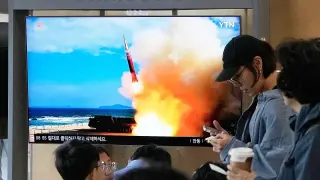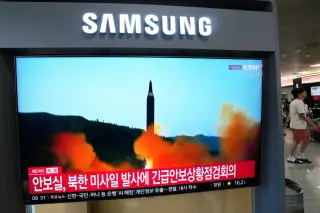
North Korea fired a short-range ballistic missile and other projectiles toward the Yellow Sea, the latest in a string of weapons demonstrations this year, with South Korea and the United States keeping a high readiness to deter provocations.
North Korea fired ballistic missiles and other weapons toward the sea in its latest display of military capability, signaling continued pressure and heightening regional security concerns.
North Korea's Naegohyang women's team won the Asian Champions League in South Korea, earning a spot at next year's FIFA Women's Champions Cup; the final had no away fans due to travel restrictions, though about 1,200 civic-group supporters attended, and coach Ri and scorer Kim celebrated before walking out of the post-match press conference after a reporter referred to the team as the 'north side.' Officials said the victory could set a positive precedent for inter-Korean relations, though the Koreas remain technically at war and Seoul's president is seeking to improve ties.
In Suwon, North Korea defeated South Korea 2-1 in a rare inter-Korean women’s match, with players remaining stone-faced despite the victory, illustrating the limits of sports diplomacy amid eight years since the teams last met on southern soil.
North Korea’s Naegohyang Women’s FC arrived in Incheon for the AFC Women’s Champions League semifinal against Suwon FC Women, marking the first time NK athletes have visited the South in more than seven years. The 39 players and staff were greeted by media and security, traveled by bus under police escort, and will stay a week if they advance to the final in Suwon. The visit occurs amid subdued inter-Korean ties even as Seoul pursues diplomacy, with tickets for the match selling out and civil groups organizing a 3,000-seat joint supporters event.
North Korea’s Naegohyang Women’s FC touched down at Incheon Airport ahead of the AFC Women’s Champions League semifinals in Incheon, South Korea, with South Korean activists welcoming the team—highlighting cross-border sports diplomacy during a regional competition.
Spanish investigators say the sunken Russian cargo ship Ursa Major was carrying components for two submarine nuclear reactors likely bound for North Korea, with the captain revealing that declared hatch covers were actually reactor parts. The vessel, operated by a state-owned company under sanctions, sank in the Mediterranean after an engine explosion in December 2024. The probe hints at Western efforts to block the delivery and notes ongoing geopolitical tensions around Moscow’s alleged support for Pyongyang’s nuclear program.
A Russian cargo ship, Ursa Major (also known as Sparta 3), sank about 60 miles off Spain on December 23, 2024 after explosions. Investigators say the ship carried what the captain described as components for two nuclear reactors—similar to submarine reactors—and new details imply Moscow may have been shipping sensitive military cargo toward North Korea. The vessel, tied to Russia’s defense sector and involved previously in operations in Syria, had various suspected cargoes and was escorted by Russian and Portuguese forces throughout its journey. Two crew members died and 14 were rescued; no radioactive contamination has been found. US surveillance aircraft monitored the wreck area, and Spanish authorities noted the data recorder recovery would be technically challenging. The wreck lies about 2,500 meters deep, and investigators are considering whether the cargo was intended for North Korea’s port of Rason.
Spanish authorities probe the sinking of the Russian cargo ship Ursa Major off Murcia after explosions; while listed as carrying non-dangerous goods, investigators are examining undeclared loads—including two large blue containers and manhole-cover-like pieces described as nuclear reactor components for submarines—raising the possibility it was bound for North Korea’s port of Rason, though no nuclear fuel was aboard. CNN and local reports cite seismic signatures and potential torpedo-like damage, with U.S. reconnaissance aircraft monitoring the site and a Russian warship involved in the rescue; two crew members died and 14 were rescued as the vessel sank, and the investigation is ongoing.
A Russian cargo ship named Ursa Major sank about 60 miles off eastern Spain after a series of explosions on December 23, 2024. Investigators say the vessel was carrying components for two submarine nuclear reactors allegedly bound for North Korea, with the cargo later described by the captain as “components for two nuclear reactors” rather than manhole covers. Two crew members were killed and 14 survived; the ship had departed St. Petersburg on December 11 and was escorted by Russian military vessels. Spanish authorities and CNN cite the cargo, and investigators are exploring whether the damage could have been caused by a high-speed torpedo or explosive device. The wreck site drew attention from Western intelligence, including a Yantar reconnaissance ship visiting the area and US WC-135R flights monitoring for nuclear material.
CNN reports that the Russian cargo ship Ursa Major sank off the coast of Spain in December 2024 after a series of explosions while likely carrying two submarine-nuclear reactor components—potentially bound for North Korea. Spanish investigators cited the captain’s statements about the cargo, U.S. nuclear-sniffer aircraft monitored the scene, and the full contents and destination remain unconfirmed amid questions about a possible covert transfer of nuclear technology.
South Korea’s intelligence estimates North Korea earned about $13 billion in the past three years by supplying Russia with weapons, manpower, and other support for the Ukraine war, in exchange for hard currency, energy and tech that help Pyongyang sidestep sanctions; 2025 shipments to Russia are estimated at $7–13.8 billion, with Russia paying over $600 million for NK troop deployments since late 2024, as the two nations deepen ties, including a 2024 mutual-defense treaty.
South Korean intelligence, cited by Nikkei Asia, says Russia has paid North Korea up to about $13.8 billion through 2025 for weapons and thousands of North Korean troops aiding its war in Ukraine, including KN-23 missiles and 152-mm artillery rounds. Reports estimate roughly 10,000 NK soldiers and 10,000 engineers on the ground with plans to send as many as 30,000 more, and Seoul notes that earlier transfers valued at over $20 billion were for weapons technology rather than cash. North Korea is also reportedly assisting Russia with drones and submarines, and Pyongyang marked the fighting by inaugurating a museum for fallen soldiers.
North Korea updated its nuclear-policy law to automatically launch a nuclear strike if Kim Jong Un is killed by a foreign power or if its nuclear command system is threatened, and revised Article 2 to redefine borders with China and Russia while removing reunification language. The changes, reportedly approved by the Supreme People’s Assembly, were publicized during a South Korean intelligence briefing and seen as a response to the effectiveness of decapitation-style attacks elsewhere, such as Iran.
North Korea revised its constitution to require an automatic nuclear strike if Kim Jong Un is assassinated or his leadership is otherwise incapacitated, approved by the Supreme People’s Assembly. The change comes amid heightened tensions after the killing of Iran’s leader in an Israeli operation, with the policy outlining immediate retaliation if the state’s nuclear-command system is threatened.