
325 Arrests in London Mark Escalation Ahead of Supreme Court Ruling on Palestine Action Ban
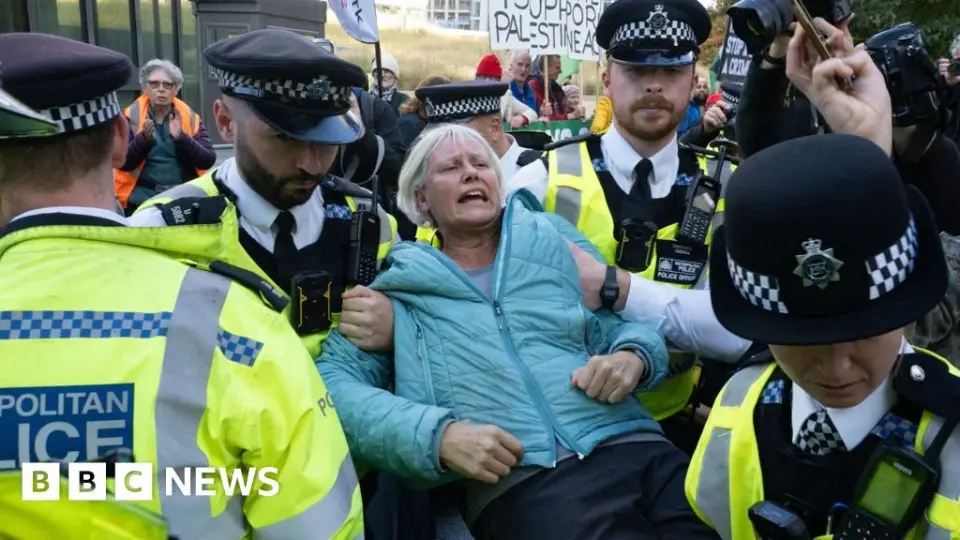
London police arrested 325 people on Saturday during a protest supporting the proscribed group Palestine Action outside the US embassy. The demonstration, organized by Defend Our Juries, brought the total number of arrests related to the group since its July 2025 ban to over 4,000. The event precedes a critical UK Supreme Court appeal scheduled for November 4, which challenges the group's designation as a terrorist organization. While authorities maintain that supporting a proscribed group is a criminal offense, critics argue the ban violates free speech and civil liberties.
Key points
- Metropolitan Police reported 325 arrests on Saturday, with 320 specifically for expressing support for a proscribed organization under the Terrorism Act.
- The protest took place at Nine Elms in London, with demonstrators holding signs reading 'I oppose genocide, I support Palestine Action.'
- Defend Our Juries, the coordinating activist group, stated that total arrests have now exceeded 4,000 since the ban took effect in July 2025.
- A UK Supreme Court appeal challenging the proscription is scheduled for November 4, following permission granted to the group's co-founder.
- The Home Office has stated it will robustly defend the ban against the appeal, while Amnesty International UK has called for the government to drop the proscription.
- Parallel demonstrations occurred in Edinburgh outside the US consulate, where no arrests were reported, but Police Scotland is reviewing evidence for potential further action.
Background
Palestine Action, founded in 2020, was proscribed as a terrorist organization in July 2025 under the UK government. The group campaigns against UK military support for Israel, claiming it enables genocide, and has previously conducted direct actions against defense facilities, including Elbit Systems and Royal Air Force bases. The ban has sparked significant controversy, with critics arguing it suppresses political dissent and pro-Palestine voices, while supporters of the ban emphasize the group's history of property damage and disruption. Recent events, including the withdrawal of Sally Rooney's books from UK retailers due to her support for the group, have highlighted the tension between anti-terrorism legislation and artistic or political expression. The upcoming Supreme Court hearing represents a pivotal moment in determining the legality of the proscription and its impact on civil liberties in the UK.
How outlets are covering it
The Metropolitan Police and the Home Office maintain that the arrests are necessary to enforce the law against supporting a proscribed organization, emphasizing that the group's actions constitute a security threat. In contrast, Defend Our Juries, Amnesty International UK, and various protesters, including retired lawyer Charles Allison, argue that the ban is an 'absurd law' that violates free speech and civil liberties, describing the mass arrests as 'dystopian.' Al Jazeera and AP News highlight the broader context of the ban as part of a crackdown on pro-Palestine voices, with some critics suggesting it appeases US and Israeli interests. The Jerusalem Post focuses on the legal implications and the potential prison sentences for supporting the group, while also noting the group's history of direct actions. There is a clear divergence between the government's stance on national security and the activists' emphasis on political expression and civil rights.
Why it matters
The outcome of the Supreme Court appeal will set a precedent for the application of terrorism laws to political protest groups in the UK. The mass arrests and public outcry highlight the growing tension between state security measures and civil liberties, particularly regarding the right to protest and express political views. The case also has international implications, as it involves the US embassy and reflects broader geopolitical tensions regarding the Israel-Palestine conflict. The ruling could influence future proscription decisions and the balance between security and freedom of expression in the UK and potentially other jurisdictions.
What to watch
The UK Supreme Court is expected to hear the appeal against Palestine Action's proscription on November 4. The Home Office has indicated it will defend the ban, while the group's co-founder has been granted permission to appeal. Further enforcement actions may follow in Edinburgh, where Police Scotland is reviewing evidence from the demonstration. The outcome of the Supreme Court case will likely determine whether the proscription remains in place or is overturned, potentially leading to a significant shift in how political protest groups are treated under UK terrorism laws.
- More than 300 arrests at Palestine Action support protest outside US embassy BBC
- London police arrest 139 people outside US Embassy for supporting banned pro-Palestinian group AP News
- Over 130 arrested over Palestine Action terror designation protest outside US Embassy in London The Jerusalem Post
- London police arrest 139 as hundreds protest Palestine Action ban Al Jazeera
- Dozens arrested outside U.S. Embassy in London for supporting pro-Palestinian group CBS News
Want the full story? Read the original reporting
Read on BBC