
EU Summit Ends in Deadlock Over Budget and Ukraine Aid
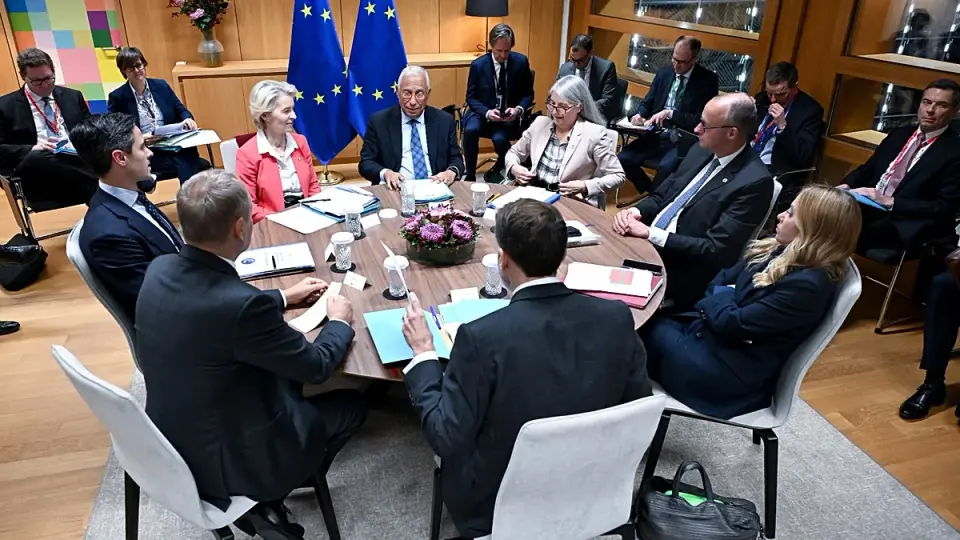
A special EU summit concluded without agreement on the bloc’s 2028-2034 budget or a €45 billion loan for Ukraine. European Council President António Costa’s compromise proposal failed to bridge deep divisions between net contributors and beneficiaries. While leaders will reconvene in December, the primary source notes no progress was made, and the secondary sources highlight ongoing friction over a proposed digital tax and Ukraine funding.
Key points
- The special EU summit ended in disarray after 14 hours of talks, with leaders failing to reach a deal on the €1.78 trillion budget proposal or the €45 billion Ukraine loan.
- The 'frugals' (Germany, Netherlands, Sweden, Denmark, Austria, Finland, Belgium) demanded deeper cuts and a shift toward defense spending, while 17 'Friends of Cohesion' sought to protect agricultural and regional funds.
- Hungary, Slovakia, and the Czech Republic refused to participate in the Ukraine loan, with German Chancellor Friedrich Merz threatening to veto the entire budget if all 27 states do not contribute.
- Pablo Hernández de Cos was confirmed as the next European Central Bank president, becoming the first Spaniard to hold the role.
- The US administration warned against an EU-wide digital tax, which European Council President Costa proposed to help fund the budget, citing discrimination against US tech companies.
Background
The EU has been negotiating its next multi-annual financial framework since the European Commission proposed a €2 trillion plan. Previous archive coverage noted that Italian Prime Minister Giorgia Meloni described a deal as 'light years away' prior to the summit. The budget must be operational by January 2028, and the 2027 electoral cycle, including French presidential elections where Marine Le Pen is a frontrunner, is expected to complicate negotiations.
How outlets are covering it
Euronews emphasizes the 'spectacular dysfunction' and the lack of progress, noting that the summit was 'practically doomed' and that leaders went home no closer to a deal. The Guardian focuses on the specific clash over Ukraine aid, highlighting Merz’s threat to veto the budget and the opposition from net beneficiary states like Slovakia and the Czech Republic. POLITICO highlights the external pressure from the US, which warned against a digital tax to fund the budget, a move supported by France and Italy but opposed by Ireland, Germany, and the Netherlands.
Why it matters
The failure to agree on the budget and Ukraine aid threatens the financial stability of the EU and its support for Ukraine. A lack of consensus could delay the operational start of the budget in 2028 and expose the bloc to further political fragmentation, particularly as 2027 elections approach. The US opposition to a digital tax also complicates the EU’s ability to find new revenue sources without risking trade retaliation.
What to watch
EU leaders are scheduled to reconvene on December 17 to attempt to resolve the deadlock. The budget must be approved by the European Parliament and operational by January 2028. The US is expected to continue opposing the EU digital tax, and the 2027 electoral cycle, including French presidential elections, will likely influence the political arithmetic of the negotiations.
- The art of no deal: An EU summit of spectacular dysfunction Euronews.com
- EU leaders wrestle over Ukraine aid as potential Le Pen victory sparks fear The Guardian
- 'A lot of political theatre': EU summit ends in disarray as leaders cling to red lines Euronews.com
- US warns EU leaders against Big Tech tax POLITICO.eu
- Why EU leaders are struggling to Le Pen-proof the bloc’s €1.6 trillion budget Reuters
Want the full story? Read the original reporting
Read on Euronews.com