
German Protests Surge as AfD Seeks First Post-War State Government
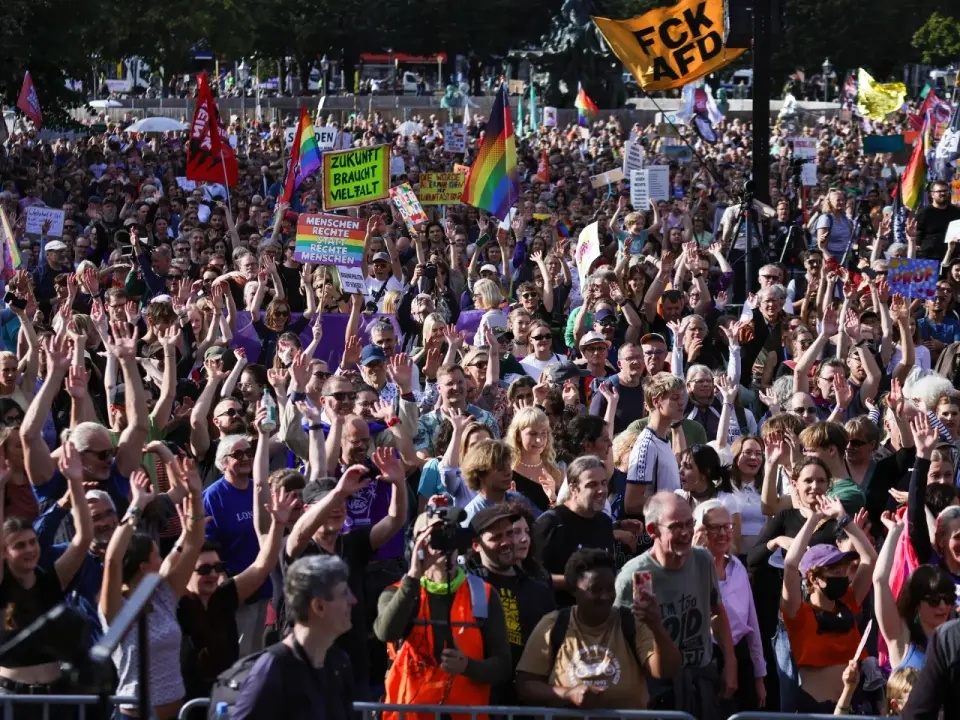
Approximately 150,000 people demonstrated across 20 German cities on September 12, 2026, demanding a ban on the Alternative for Germany (AfD) following its landslide victory in Saxony-Anhalt. The party secured 44% of the vote, falling just short of an outright majority, and is now negotiating coalition partners to form a state government. While organizers like Pruef and Campact emphasize democratic defense, analysts argue that economic decline and global trade shifts, rather than immigration alone, are driving the far-right’s rise.
Key points
- Demonstrators in Berlin, Hamburg, and Munich carried signs demanding the immediate banning of the AfD, with police estimating several thousand in Berlin and organizers citing 25,000 in Hamburg and 12,000 in Munich.
- The AfD won 44% of the vote in Saxony-Anhalt on September 6, 2026, far ahead of Chancellor Friedrich Merz’s CDU, which received roughly 17%.
- The party is projected to win 39 of 83 seats in the state parliament, three short of a majority, and is currently in talks to form a coalition, as mainstream parties refuse to govern with them under the 'firewall' policy.
- Ulrich Siegmund, the AfD state leader, has signaled openness to coalition talks after previously expressing a desire to govern alone, calling the result historic.
- Chancellor Merz has remained reluctant to pursue a legal ban on the AfD, which is considered difficult under German law, despite growing public pressure.
Background
This development follows a series of earlier warnings about the AfD’s potential to gain governing power in eastern Germany. Previous coverage highlighted the party’s strategic 100-day program for restructuring the civil service and its potential to use Saxony-Anhalt as a launchpad for national influence. Earlier protests in late August and early September had already signaled deep public anxiety, with polls showing the AfD around 35% in Mecklenburg-Vorpommern and fluid results in Berlin, raising concerns about destabilizing governing arrangements across multiple states.
How outlets are covering it
Al Jazeera focuses on the immediate political crisis, highlighting the scale of the protests and the legal and political hurdles surrounding a potential ban on the AfD. It emphasizes the historical significance of the party potentially leading a state government for the first time since 1945. In contrast, The American Prospect, through Robert Kuttner, frames the AfD’s rise as a symptom of deeper economic failures. Kuttner argues that the party’s success is driven by 'pocketbook grievances' resulting from the collapse of East German industries after reunification and the current threat posed by China’s dominance in the global auto industry, which is causing massive layoffs at Volkswagen. While Al Jazeera centers on immigration and constitutional defense, The American Prospect contends that immigration is a secondary factor, and that without better economic strategies and fair trade policies, the far-right will continue to gain ground in both eastern and western Germany.
Why it matters
The AfD’s near-majority victory in Saxony-Anhalt represents a potential breach in the post-war political consensus in Germany. If the party forms a government, it would mark the first time a far-right party has led a German state since the end of the Nazi era. This could normalize extremist policies at the state level and provide a platform for national expansion, challenging the 'firewall' policy that has prevented the AfD from governing. Furthermore, the protests indicate a deep societal fracture, with civil society mobilizing to defend democratic norms, while economic anxieties continue to fuel support for radical alternatives.
What to watch
The immediate next step is the outcome of coalition negotiations in Saxony-Anhalt. If mainstream parties continue to refuse cooperation, the AfD may struggle to form a government, potentially leading to a political deadlock or new elections. Simultaneously, the debate over banning the AfD will intensify, with legal experts noting the high bar for such a move in Germany. In the broader context, upcoming regional elections in Berlin and Mecklenburg-Vorpommern will be critical tests of the AfD’s momentum. Additionally, the economic situation in Germany, particularly in the automotive sector, will likely remain a focal point, as the party’s support may continue to grow if economic grievances are not addressed by mainstream parties.
- Tens of thousands march across Germany to protest far-right party AfD Al Jazeera
- Far-Right Win Puts Germany’s Economic Renewal on Shakier Ground Bloomberg.com
- Germany’s Far Right, China, and Trump The American Prospect
- Politics The Economist
- Chartbook 474: The state is the problem - the AfD’s anti-systemic diagnosis of contemporary Germany. Adam Tooze | Substack
Want the full story? Read the original reporting
Read on Al Jazeera