
India's 'Cockroach' Success Sparks New Ethanol Protests Against Modi
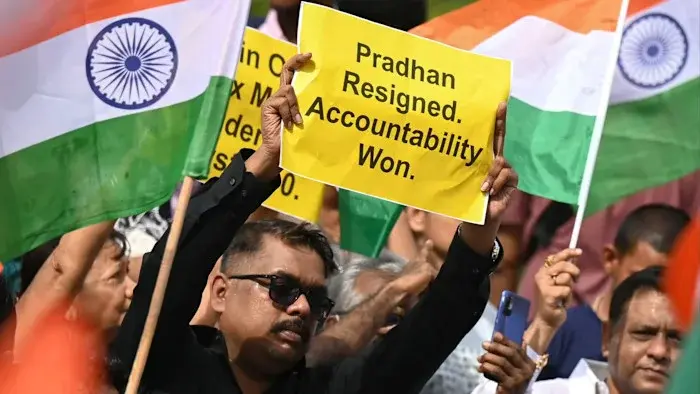
The success of the student-led Cockroach Janta Party (CJP) in forcing the resignation of Education Minister Dharmendra Pradhan has emboldened critics of Prime Minister Narendra Modi. A new movement, the E20 Janta Party, has emerged to oppose the government's mandatory 20% ethanol fuel blend, targeting Transport Minister Nitin Gadkari. Analysts suggest this marks a shift in Indian dissent, moving from ideological battles to demands for administrative accountability and policy transparency.
Key points
- The Cockroach Janta Party (CJP) mobilized hundreds of thousands of students over 36 days, forcing the resignation of Education Minister Dharmendra Pradhan and securing concessions on exam reforms.
- A new group, the E20 Janta Party, gained 34,000 followers in 24 hours to protest the government's imposition of a 20% ethanol fuel blend, citing concerns over engine damage and fuel consumption.
- The E20 movement targets Transport Minister Nitin Gadkari, whose sons operate an ethanol business, though Gadkari denies a conflict of interest, claiming his family holds less than 0.5% of the market.
- The CJP’s victory has inspired copycat movements, with analysts noting that formal institutional channels are viewed with skepticism, leading citizens to use public protest to demand policy changes.
- The BJP faces internal unease, with some members shocked by police violence against peaceful protesters and others, including a minister's daughter, publicly criticizing Modi in videos.
Background
This development follows the July 2026 resignation of Dharmendra Pradhan, which marked the first significant concession by the Modi government to street protests in a decade. The CJP movement, sparked by exam paper leaks and student suicides, had already broken the narrative of BJP invincibility. The current E20 protests represent the next phase of this unrest, shifting focus from education to energy policy.
How outlets are covering it
The Financial Times emphasizes the strategic template the CJP provides for future protests, noting that the E20 movement is a direct copycat effort targeting a specific minister. The BBC highlights the non-ideological nature of the CJP, arguing that its focus on administrative failure in exams makes it harder for the BJP to rally its base compared to previous ideological disputes. The Guardian focuses on the cultural shift, noting that protesters have used humor and social media to mock Modi, breaking the party's control over the narrative. While the FT and BBC focus on the political mechanics and governance failures, the Guardian underscores the psychological and cultural impact of the protests on public perception of the ruling party.
Why it matters
The emergence of the E20 Janta Party signals that the CJP's success has created a viable model for bypassing traditional political channels. If the BJP cannot effectively manage policy grievances like fuel mandates, it risks further erosion of support among middle-class voters. This could influence the political landscape ahead of the next general election, as the government faces increasing pressure to engage in public deliberation rather than imposing policies unilaterally.
What to watch
The E20 Janta Party is planning a 'car march' to Nitin Gadkari's residence, while Delhi taxi drivers have announced a march to parliament. The CJP is evaluating whether to support the fuel protests as it regroups. The government faces the challenge of managing multiple simultaneous grievances without appearing weak, while the BJP must decide whether to suppress or accommodate the growing wave of public dissent.
- Success of India’s ‘cockroach’ protests energises critics of Narendra Modi’s government Financial Times
- India’s Young Protesters Are Bloodied but Unbowed The New York Times
- CJP protests at Jantar Mantar: The youth movement India's Modi didn't see coming BBC
- Why India’s ‘Cockroach’ Movement Is a Worry for Modi Bloomberg
- Monday briefing: How the Cockroach protests have exposed the cracks in India’s government The Guardian
Want the full story? Read the original reporting
Read on Financial Times