
Israel Election: Record Arab Turnout Leaves Netanyahu and Eisenkot in Deadlock
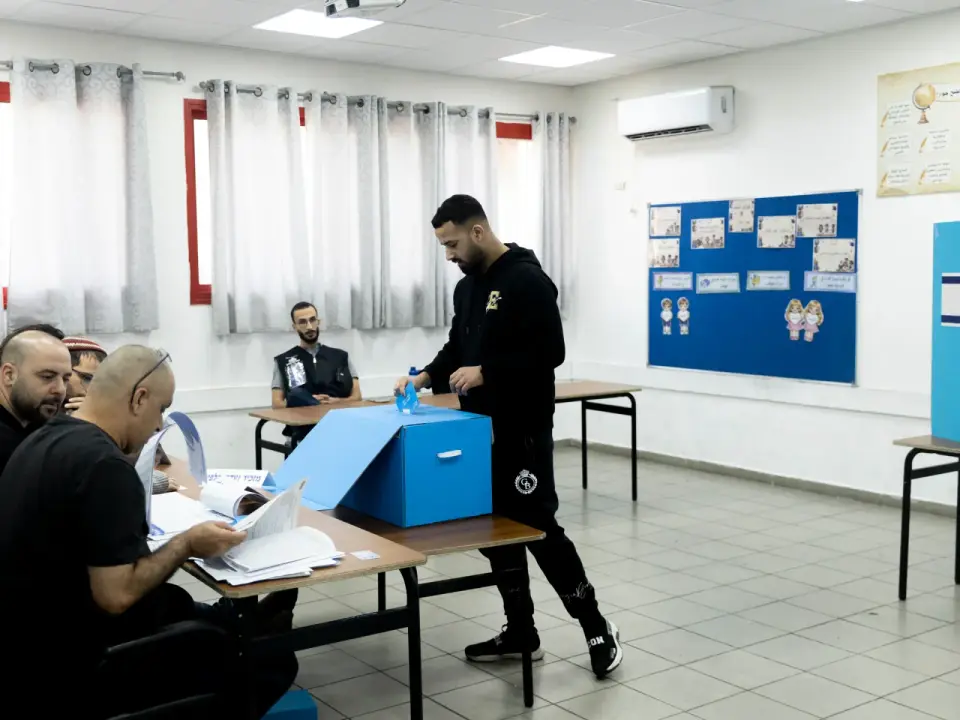
Israel’s October 27 election resulted in a political stalemate, with exit polls showing neither Benjamin Netanyahu’s coalition nor Gadi Eisenkot’s opposition bloc securing the 61 seats needed for a majority. Arab-led parties are projected to win a record 19 seats, making them pivotal kingmakers. Voter turnout reached a historic 77.7% overall, with Palestinian citizens of Israel participating at approximately 80%, the highest level in decades. President Isaac Herzog must now decide which leader receives the first mandate to form a government, a process that could extend for weeks.
Key points
- Exit polls indicate a tie between Netanyahu’s bloc and Eisenkot’s opposition, with both sides projected at 51 seats, short of the 61-seat majority required to govern.
- Arab-led parties, including the Joint List and Ra’am, are projected to win a combined 19 seats, a record high that positions them as decisive factors in coalition formation.
- Voter turnout reached 77.7% nationally, the highest since 1999, with Palestinian citizens of Israel participating at approximately 80%, breaking previous records from 1999.
- Netanyahu declared Likud the largest party and vowed to form a right-wing government, while Eisenkot called for Netanyahu’s retirement, claiming voters chose change.
- President Isaac Herzog will consult with parties to select a candidate to form a government, with official results scheduled for November 4 and potential negotiations lasting weeks.
Background
Pre-election polls from October 19 to 25 consistently predicted a deadlock between the two main blocs, with Arab parties identified as likely kingmakers. Netanyahu’s campaign utilized AI tools to target Arab voters, while Palestinian citizens of Israel viewed voting as a primary mechanism to counter systemic discrimination and demand political change.
How outlets are covering it
Al Jazeera emphasizes the historic nature of Arab voter turnout and the potential for Arab parties to influence government formation, noting that both major blocs reached out to Ra’am leader Mansour Abbas. The Guardian highlights the political deadlock and the difficulty of forming a coalition, noting that Netanyahu and Eisenkot have both opposed governing with Arab parties. The New York Times focuses on the strong showing of Arab parties as a reflection of voter frustration and hope, while Fox News stresses the uncertainty of the outcome and the potential for a prolonged political negotiation, noting that Likud emerged as the largest individual party despite the coalition shortfall.
Why it matters
The election outcome will determine Israel’s political direction amid ongoing conflicts in Gaza, the West Bank, and regional tensions with Iran. The strong showing of Arab parties may lead to a shift in policy regarding Palestinian citizens of Israel, who face systemic discrimination. The deadlock could result in a caretaker government or a snap election, impacting Israel’s stability and international relations.
What to watch
Official results are scheduled for November 4, with President Isaac Herzog to consult with parties to select a candidate to form a government. The candidate will have 28 days to negotiate a coalition, with a possible 14-day extension. If no government is formed, Israel may face a snap election or a prolonged caretaker government.
- Arab parties could win record 18 seats in Israel election, exit polls show Al Jazeera
- Israel’s voters deny Binyamin Netanyahu a majority The Economist
- Coalition talks loom as Israel exit polls suggest Netanyahu and Eisenkot blocs tied The Guardian
- Arab Parties’ Strong Showing May Bring Role in Formation of Israel’s Next Government The New York Times
- Israelis vote in record numbers in first national election since the Oct. 7 Hamas massacre Fox News
Want the full story? Read the original reporting
Read on Al Jazeera