
Israel’s 2026 Election Deadlock Forces Complex Coalition Negotiations or Repeat Vote
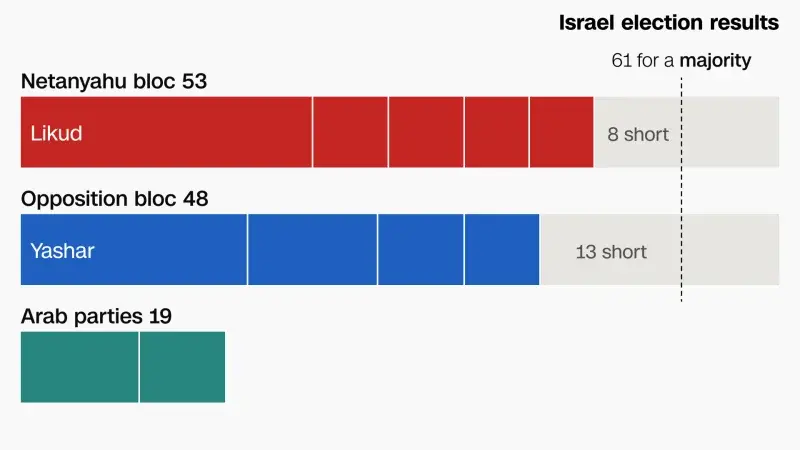
Israel’s 2026 election resulted in a deadlock, with neither Benjamin Netanyahu’s bloc nor Gadi Eisenkot’s opposition securing the 61-seat majority required to govern. Netanyahu’s coalition holds 53 seats, while the opposition has 48, aided by a record 19 seats for Arab-led parties. Four potential paths exist: an opposition government relying on Arab support, a national unity government, a Netanyahu-led bloc with defectors, or a repeat election. President Isaac Herzog will begin consultations to form a government, with a 28-day initial deadline. If no government is formed, a new election is likely, potentially marking the seventh in eight years.
Key points
- Neither Netanyahu’s Likud-led bloc (53 seats) nor Eisenkot’s opposition (48 seats) achieved the 61-seat majority needed to form a government.
- Arab-led parties won a record 19 seats, giving the opposition a parliamentary majority of 67, but opposition leaders Bennett and Liberman oppose allying with them.
- President Isaac Herzog will consult party leaders and assign a 28-day deadline to form a government, with possible extensions and a second candidate if the first fails.
- If no government is formed, a repeat election is likely, potentially the seventh in eight years, with Netanyahu remaining caretaker PM in the interim.
- Netanyahu’s bloc is eight seats short of a majority, making defections or a unity government difficult, as opposition leaders have ruled out sitting with him.
Background
Israel’s 2026 election, held on October 27, resulted in a fragmented Knesset where neither the incumbent Prime Minister Benjamin Netanyahu’s right-wing bloc nor the centrist opposition led by Gadi Eisenkot secured a majority. Arab-led parties achieved record turnout and won 19 seats, complicating coalition math. Netanyahu’s camp alleged fraud and foreign interference from Qatar to delegitimize the results, but the Central Elections Committee and police dismissed these claims. The deadlock has led to political limbo, with Netanyahu attempting to isolate Arab-led parties from the opposition bloc.
How outlets are covering it
CNN outlines four potential scenarios to resolve the deadlock: an opposition government relying on Jewish-Arab cooperation, a national unity government, a Netanyahu-led bloc with defectors, or a repeat election. It notes that opposition leaders Bennett and Liberman oppose allying with Arab parties, and Eisenkot has ruled out sitting with Netanyahu. The Jerusalem Post argues that any unity deal must start with the leaders who are actually in power, including Netanyahu, and proposes a specific coalition structure where Netanyahu remains PM, Eisenkot becomes defense minister, and Bennett-Lapid take finance and foreign affairs. It emphasizes the need for concrete agreements on military service and an independent October 7 inquiry, contrasting with CNN’s broader overview of scenarios. The Post also highlights the personal attachment of Likud voters to Netanyahu, making a leadership change unlikely, while CNN focuses on the structural challenges of coalition formation.
Why it matters
The deadlock threatens to prolong political instability in Israel, potentially leading to a repeat election or a fragile government. The inability to form a government could delay critical decisions on security, the Palestinian question, and regional diplomacy. The role of Arab-led parties in the opposition bloc adds a layer of complexity, as their support is essential for a majority but opposed by key opposition leaders. The outcome will influence Israel’s domestic stability and its ability to engage in regional negotiations, including potential diplomatic initiatives with Arab partners and the US.
What to watch
President Isaac Herzog will hold public consultations with party leaders and assign a 28-day deadline to form a government. If the first candidate fails, a second will be given 28 days, and a third may be tasked with 14 days. If no government is formed, a repeat election is likely, potentially in spring 2027. Netanyahu, as caretaker PM, is in a strong position to wait out the process, as he may be tasked with forming a government if Eisenkot fails. The outcome will depend on whether opposition leaders can overcome their objections to Arab party participation or if a unity government can be negotiated.
- Israel’s election ended in deadlock. Here are four ways out CNN
- Opinion | Raise your head high, it is time to end the Netanyahu era Haaretz
- Netanyahu, at risk of losing power, steps up attacks on Israel's Arab parties Reuters
- What Israeli Election Results Reveal About the Electorate The New York Times
- Editor's Notes: Any unity deal must start with the leaders who are here, including Netanyahu The Jerusalem Post
Want the full story? Read the original reporting
Read on CNN