
Israel’s 2026 Election: A Fragmented Right and a Rising Center
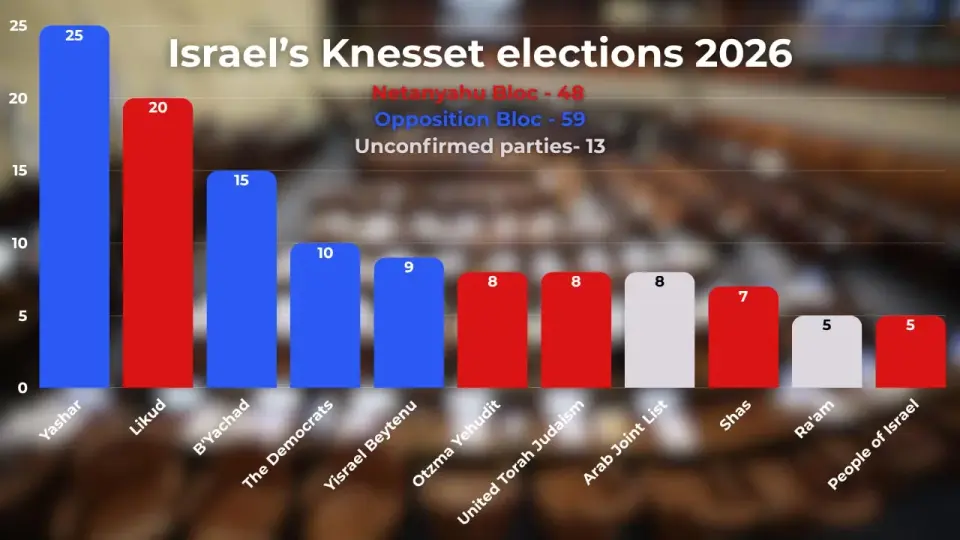
Israel’s October 27 election features a fragmented right-wing bloc and a rising centrist opposition led by Gadi Eisenkot. Key issues include haredi conscription, the October 7 commission of inquiry, and the fate of PM Netanyahu, whose Likud party is polling significantly lower than its current seat count.
Key points
- The election is the first since the October 7, 2023, Hamas attack, shifting focus to security, haredi conscription, and a state commission of inquiry.
- Benjamin Netanyahu’s Likud party is polling at approximately 22 seats, down from 32 in the previous Knesset, prompting calls for a 'broad national government.'
- Gadi Eisenkot’s centrist Yashar party is polling at around 26 seats, emerging as the largest opposition bloc and a key challenger to Netanyahu.
- The far-right field is crowded and increasingly extreme, with parties like Otzma Yehudit and Religious Zionist Party vying for a finite pool of right-wing votes.
- New 'third bloc' parties, including Zionist Home-The Reservists and Unity Party, are positioning themselves as kingmakers by demanding haredi conscription and universal service.
Background
This election follows a four-year 'full Right' coalition that implemented significant policy changes, including judicial reforms and haredi conscription legislation. The political landscape has shifted significantly since the 2022 vote due to the ongoing war and its aftermath.
How outlets are covering it
The Jerusalem Post emphasizes the strategic uncertainty facing Netanyahu, noting his shift from seeking victory to merely avoiding defeat, and highlights the potential for a transitional government if coalition talks fail. CNN focuses on the escalating extremity of the far-right, detailing provocative campaign tactics and the risk of vote fragmentation due to the 3.25% electoral threshold. While JPost frames the 'third bloc' as a potential alternative to the ruling right, CNN underscores the danger these new parties pose to Netanyahu’s coalition by siphoning votes from established right-wing factions.
Why it matters
The outcome will determine whether Netanyahu can form a coalition despite slipping polls, or if the opposition can assemble a majority. The election also sets the direction for Israel’s democracy, with key decisions on haredi conscription and judicial oversight likely to shape the country’s political and social fabric for years to come.
What to watch
Coalition negotiations will be critical, as the 'real fight' may occur after the vote, with the 'third bloc' potentially deciding the outcome. Netanyahu’s ability to assemble a coalition with himself at the helm, or the opposition’s success in forming a government, will hinge on these post-election haggles.
- Who is running in Israel’s 2026 election? A guide to the major parties The Jerusalem Post
- Israel’s crowded far-right grows more extreme as elections near CNN
- With only days left to submit slates, small parties are still jockeying for position The Times of Israel
- Opinion | Say it loud and clear: Israel's Arab citizens are worthy partners Haaretz
- Israel’s election season is entering a new phase economist.com
Want the full story? Read the original reporting
Read on The Jerusalem Post