
Israel’s October 27 Vote: Far-Right Surge and Mainstream Convergence on Palestinian Issues
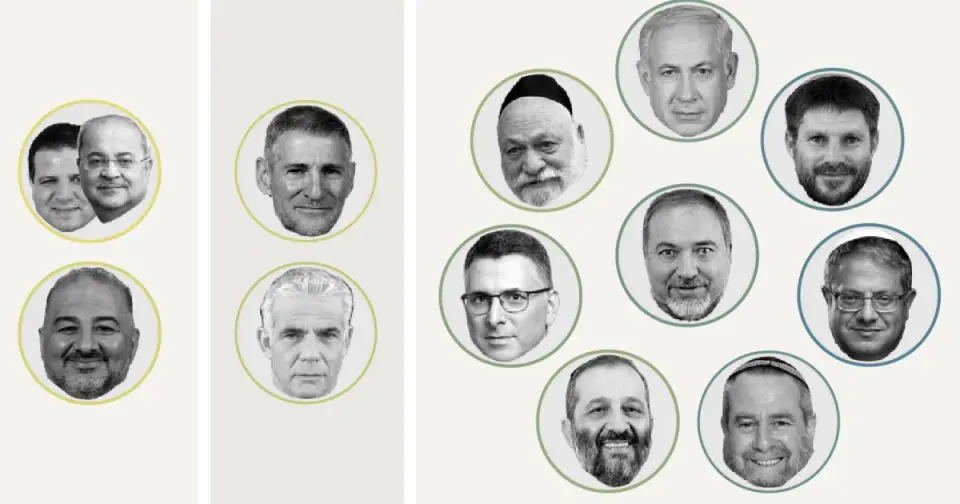
Israelis vote on October 27 in a closely contested election where the far right is gaining ground despite a decline in support for Prime Minister Benjamin Netanyahu. Analysis of recent Knesset votes reveals that mainstream centrist parties often align with the far right on issues concerning Palestinians, such as opposing statehood and supporting annexation. While the far-right leader Itamar Ben-Gvir is gaining popularity among young voters, the overall political landscape remains deadlocked, with Arab-led parties potentially serving as kingmakers despite recent disqualification attempts.
Key points
- Al Jazeera analysis shows that between July 2024 and March 2026, centrist parties like Yesh Atid and National Unity voted with the far right on 99% of key measures affecting Palestinians, including opposing Palestinian statehood and supporting UNRWA bans.
- Itamar Ben-Gvir’s Otzma Yehudit party is projected to increase its seats from six to nine, driven by strong support among first-time voters who identify as right-wing or center-right.
- The election is a deadlocked race; neither the Netanyahu-led coalition nor the opposition bloc led by Gadi Eisenkot is expected to secure the 61 seats needed for a majority, making Arab-led parties critical potential kingmakers.
- Public opinion has shifted sharply rightward, with only 17% of Israelis believing Israel and a Palestinian state can coexist peacefully, down from 50% in 2013.
- The Central Elections Committee disqualified major Arab parties, a move challenged in the Supreme Court, which could alter the coalition math in this tight race.
Background
This election follows the wars in Gaza, Lebanon, and Iran, and occurs amid a significant rightward shift in Israeli politics. Previous coverage noted that the Central Elections Committee disqualified the Joint List and Ra’am, major Arab parties, ahead of the vote, a decision likely to be reviewed by the Supreme Court. The current political landscape is characterized by a consensus against Palestinian statehood across most Jewish-led parties, with only the Democrats and Arab-led parties consistently opposing far-right measures in the Knesset.
How outlets are covering it
Al Jazeera emphasizes the structural convergence of voting patterns, arguing that the 'left' effectively does not exist in Knesset votes on Palestinian issues, as centrists often boycott or vote with the far right. The Guardian and BBC focus on the demographic shift, highlighting that young voters, socialized in an environment of conflict and fear, are driving the far-right surge. The Jewish Telegraphic Agency (JTA) highlights the polarizing nature of Ben-Gvir, noting that while he is gaining popularity through social media and simple messaging, he remains deeply divisive in mixed cities like Ramla, with supporters praising his 'strength' and opponents condemning his rhetoric as racist and dangerous.
Why it matters
The outcome of this election will determine whether Israel’s government continues its current trajectory of settlement expansion and annexation efforts. The convergence of mainstream and far-right parties on Palestinian issues suggests that a change in leadership may not alter the fundamental policy direction regarding the occupied territories. Furthermore, the disqualification of Arab parties and the potential for a fragmented Knesset could lead to prolonged political instability or a government reliant on extreme right-wing coalitions, impacting regional stability and international relations.
What to watch
The Supreme Court is expected to rule on the disqualification of Arab parties, which could change the balance of power. The election results on October 27 will determine if Netanyahu can form a new coalition or if the opposition, led by Gadi Eisenkot, can secure power, likely requiring support from Arab or ultra-Orthodox parties. The formation of the new government will hinge on whether the far-right surge translates into a governing majority or if the deadlocked blocs force a compromise.
- Far from fringe: How Israel’s mainstream parties vote with the far right Al Jazeera
- Israel's Ben-Gvir poised for election gains as young voters turn to far right Reuters
- ‘There’s a lot of racism, a lot of hatred’: Far right gains predicted as Israel heads to the polls The Guardian
- As Netanyahu drops in polls, Ben-Gvir’s star rises Jewish Telegraphic Agency
- Israel's far right find fertile ground among first-time voters BBC
Want the full story? Read the original reporting
Read on Al Jazeera