
Merz Warns Russia Escalating in Space and Europe as German Support for Ukraine Falls
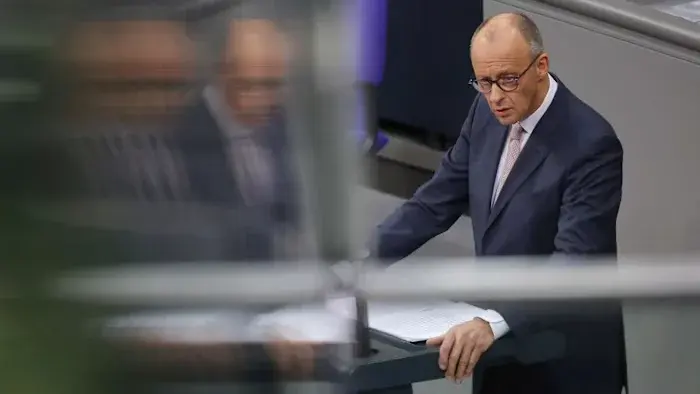
German Chancellor Friedrich Merz warned the Bundestag that Russia is escalating its conflict beyond Ukraine into European territory and space, defending a 30% increase in defense spending and €11.6bn in aid for Kyiv in 2027. This stance comes amid declining public support for Ukraine, with polls showing only 46% of Germans favoring military aid, down from 59% last year. Merz cited intelligence reports that Russia may launch a nuclear-armed satellite into orbit as soon as next month, a move NATO Secretary General Mark Rutte said the alliance would defend against. While Merz expressed cautious optimism about peace talks following a recent 40-nation summit in Berlin, he emphasized that Europe must set clear boundaries for Moscow, which he accused of pursuing goals extending far beyond the seizure of Ukraine.
Key points
- Merz defended a 30% increase in German defense spending and €11.6bn in aid for Ukraine for 2027, arguing Russia wants more than just Ukraine.
- Merz stated Russia is escalating in the Baltic region, Poland, the Black Sea, and space, including 'at the cost of human lives' within Germany.
- A Forsa poll showed for the first time since 2023 that fewer than half of Germans support military aid to Ukraine, with 46% in favor, down from 59% in 2024.
- Western intelligence agencies warn Russia may launch a nuclear-armed satellite, identified as Sputnik-S, into orbit within 60 days, potentially violating the 1967 Outer Space Treaty.
- NATO Secretary General Mark Rutte stated the alliance will defend itself against any threats in space, while German Defense Minister Boris Pistorius called for calm.
- Merz suggested 'cautious optimism' toward peace following a Coalition of the Willing meeting in Berlin attended by US special envoy Steve Witkoff and Jared Kushner.
Background
This warning follows a series of escalating tensions, including MI5 warnings in October 2026 about hybrid threats from Russia and Iran, and a November 23, 2026 report that Western intelligence assessed Russia could launch a nuclear-armed satellite within weeks. Merz previously rejected a 'Yalta 2.0' scenario after a US-Russia-China summit in Shenzhen in November 2026 that ignored Ukraine. The current speech occurs as Merz faces domestic pressure from the far-right Alternative for Germany, polling at 28%, and low approval ratings, while also navigating coalition disputes with the Social Democrats over social spending cuts.
How outlets are covering it
The Financial Times emphasizes Merz's domestic political struggle, highlighting the drop in public support for Ukraine and the pressure from the far-right AfD, while noting his efforts to secure long-term EU funding. Ukrainian Pravda, citing The Guardian, focuses on Merz's rhetorical framing of Russia's ambitions as extending beyond Ukraine into a broader threat to liberal values, and includes the reaction of German Defense Minister Boris Pistorius calling for calm regarding the space threat. Both sources agree on the core message of Merz's speech but differ in emphasis: the FT highlights the political and economic context, while Ukrainian Pravda highlights the geopolitical and security implications.
Why it matters
Merz's speech signals a shift in German defense policy toward a more assertive stance against Russia, both on the ground and in space, despite waning public support. The potential launch of a nuclear-armed satellite by Russia represents a new dimension of the conflict that could disrupt global communications and military operations, with US and German officials assessing that countering such a weapon once deployed is currently impossible. This development could force NATO to reconsider its defense strategies and accelerate European efforts to secure long-term funding for Ukraine and strengthen its own defense capabilities.
What to watch
Germany is expected to proceed with its planned 30% increase in defense spending and €11.6bn in aid for Ukraine in 2027. Berlin is seeking to secure multiyear EU funding for Ukraine from 2028-2034. NATO is expected to continue monitoring the potential launch of a nuclear-armed satellite by Russia, with Mark Rutte stating the alliance will defend itself against any threats in space. Merz has suggested 'cautious optimism' toward peace talks, but the outcome of negotiations with the US, Russia, and Ukraine remains uncertain. The German public's support for Ukraine aid may continue to decline, potentially impacting future policy decisions.
- Russia is escalating conflict in Europe and in space, warns Friedrich Merz Financial Times
- Ukraine: Industrial attacks and anger at Russia among Ukraine's allies Deutsche Welle
- Merz Warns Russia’s War Aims Go Far Beyond Ukraine, Vows Aid Bloomberg.com
- 'Russia wants more than Ukraine," says Germany's Merz as he defends aid for Kyiv Reuters
- German chancellor: Russia wants more than Ukraine Українська правда
Want the full story? Read the original reporting
Read on Financial Times