
Poland’s Constitutional Crisis Draws Russian Interference and Global Right-Wing Support
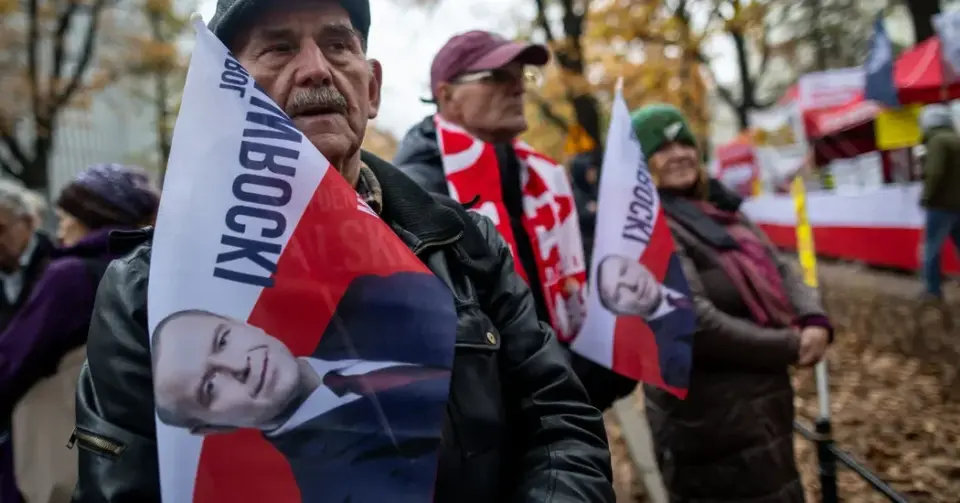
Poland faces a severe institutional crisis as Prime Minister Donald Tusk’s government moved to suspend the leadership of the Constitutional Tribunal, a body captured by the former Law and Justice (PiS) party. President Karol Nawrocki physically confronted police at the court, while Russia and global right-wing figures labeled the move a 'coup.'
Key points
- On October 30, 2026, Judge Anna Korwin-Piotrowska suspended Tribunal president Bogdan Święczkowski and his deputy, citing their unlawful appointments and obstruction of newly elected judges.
- Prime Minister Donald Tusk deployed riot police to secure the court, which President Karol Nawrocki described as a threat to national security and a 'coup d’état.'
- Russia’s Deputy Security Council Chairman Dmitry Medvedev and other officials amplified claims of a putsch, which Tusk accused of being an attempt to foment instability in Poland.
- The conflict stems from an 11-year struggle over the Tribunal’s independence, with the EU and European Court of Human Rights ruling that PiS-era appointments were illegal.
- France’s Marine Le Pen and other right-wing politicians abroad have framed the Polish government’s actions as an authoritarian takeover, complicating Tusk’s pro-European stance.
Background
This crisis is the culmination of a long-standing dispute over the independence of Poland’s Constitutional Tribunal. Since 2015, the PiS party has stacked the court with loyalists, leading to rulings that challenged EU law and resulting in frozen EU funds. Tusk’s government, elected in 2023, pledged to depoliticize the judiciary but has faced repeated vetoes from PiS-aligned presidents. Recent archive coverage highlights broader European political turmoil, including instability in the US administration and housing crises in Spain, but the Polish dispute is uniquely tied to judicial integrity and EU rule-of-law standards.
How outlets are covering it
The New York Times emphasizes the immediate confrontation, noting that Tusk’s deployment of police was framed by right-wing enemies as a 'coup d’état' and that Russia has actively fanned these claims. Reuters, via Yahoo, highlights Tusk’s direct accusation that Russia is seeking to fuel 'instability' by meddling in the dispute, while noting that both Tusk and Nawrocki are critics of Russia’s invasion of Ukraine. The Financial Times frames the event as a 'struggle to restore the rule of law,' criticizing Tusk for using extralegal methods like withholding publication of rulings, which could set dangerous precedents. Verfassungsblog offers a legal defense of Korwin-Piotrowska’s actions, arguing that the suspension was a necessary step to restore a lawfully constituted court, contrasting the 'cult of force' exhibited by Nawrocki and Święczkowski with the rule of law. The outlets differ on whether the government’s actions are a legitimate restoration of legality or a dangerous overreach, with the Financial Times and some liberal commentators expressing concern about the methods used, while Verfassungsblog and Tusk’s supporters view the intervention as essential to ending PiS’s 'state capture.'
Why it matters
The outcome of this standoff will determine whether Poland can restore its judicial independence and unblock billions of euros in EU funds. It also tests the resilience of European rule-of-law standards against domestic political obstruction and foreign interference. A resolution could set a precedent for how democratic governments handle institutional capture, while a failure could embolden right-wing populists across Europe to challenge judicial independence.
What to watch
The immediate next steps involve the mandatory judicial review of Korwin-Piotrowska’s suspension orders and the potential criminal prosecution of Święczkowski and Sochański. The Venice Commission’s opinion that the president has no discretion to veto judges’ oaths may force Nawrocki to accept the new judges. Tusk’s government must navigate the political fallout ahead of next year’s elections, while the EU may further pressure Warsaw to resolve the dispute to release frozen funds.
- Russia Senses Opportunity in Polish Political Turmoil The New York Times
- Russia trying to foment 'instability' in Poland, PM Tusk says Yahoo
- Poland’s struggle to restore the rule of law Financial Times
- Whose Coup?: Restoring the Legality of Poland’s Constitutional Tribunal Verfassungsblog
- The Guardian view on Poland’s political turmoil: an ominous portent of bigger battles to come | Editorial The Guardian
Want the full story? Read the original reporting
Read on The New York Times