
Poland’s Constitutional Crisis Peaks as Tusk Defends Court Overhaul Amid Nawrocki Standoff
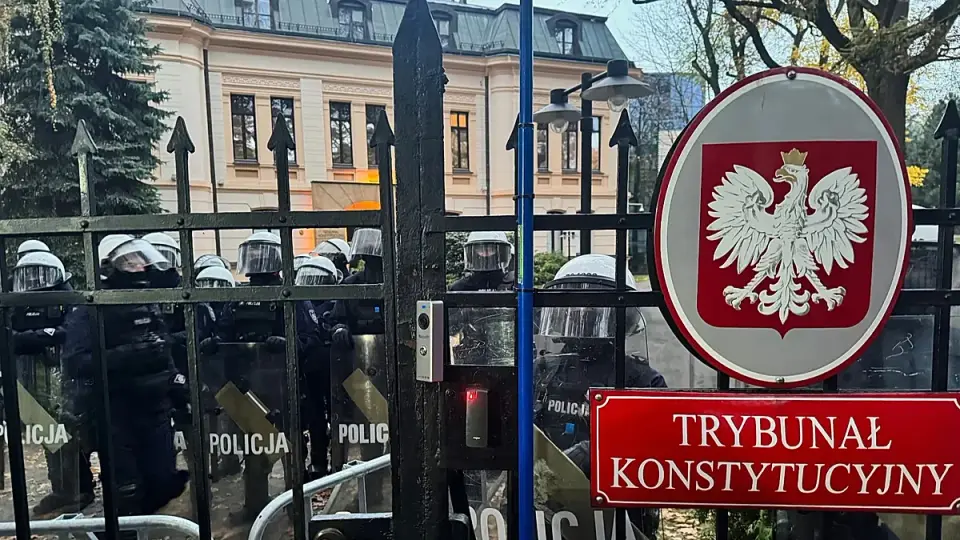
Poland faces a severe constitutional crisis after Prime Minister Donald Tusk’s government moved to suspend the Constitutional Tribunal’s leadership, triggering violent protests and a standoff with President Karol Nawrocki. The dispute centers on the appointment of new judges, with Tusk asserting the need to restore judicial independence from Law and Justice party influence, while the opposition and EU conservatives label the actions an unlawful coup. The European Commission has stated that parliament holds the constitutional power to appoint judges, citing recent rulings from the European Court of Human Rights that prohibit hindering the new appointments. Tusk vowed to enforce the rule of law despite the unrest, while Nawrocki and his allies condemned the government’s actions as a violation of constitutional safeguards. The crisis has intensified ahead of next year’s parliamentary elections, with experts divided on the legality of the government’s procedural moves.
Key points
- Prime Minister Donald Tusk defended the suspension of Tribunal President Bogdan Święczkowski and his deputy, stating that the government must restore the court’s independence after years of interference by the Law and Justice (PiS) party.
- The crisis escalated on Friday when President Karol Nawrocki attempted to enter the Tribunal building during a live broadcast, leading to clashes with police and the deployment of riot squads to secure the site.
- The European Commission affirmed that the Polish parliament (Sejm) has the constitutional right to appoint judges, referencing a May 2026 ruling by the European Court of Human Rights that required Polish authorities to refrain from obstructing the new appointments.
- Opposition leaders and the European Conservatives and Reformists (ECR) group condemned the government’s actions as a 'grave violation of the rule of law' and an attack on judicial independence, with Nawrocki’s aide calling Tusk a 'pathological liar'.
- Tusk’s government argues that the current Tribunal was illegitimate due to PiS-era appointments, while critics, including legal experts and the US ambassador, warn that the government’s methods risk escalating violence and undermining democratic norms.
Background
The dispute over the Polish Constitutional Tribunal has been ongoing since 2015, when the Civic Platform and Law and Justice parties clashed over judge appointments. During PiS’s eight-year rule, the party appointed judges to seats already filled by the previous government, leading the EU to freeze 137 billion euros in funding in 2021 due to concerns over judicial independence. Tusk’s Civic Coalition took power in 2023 with a mandate to restore the Tribunal’s independence, but faced resistance from PiS-aligned judges and President Nawrocki, who refused to swear in several parliament-approved nominees. The current crisis is the latest escalation in this decade-long conflict, with the Tribunal’s legitimacy and composition remaining central to debates over Poland’s rule of law and EU integration.
How outlets are covering it
The European Commission and Tusk’s government view the crisis as a necessary step to restore judicial independence, with the Commission emphasizing that the Sejm has the constitutional power to appoint judges and citing the European Court of Human Rights’ interim measures. Tusk described the PiS-era Tribunal as illegitimate and vowed to enforce the rule of law, even at the cost of unrest. In contrast, President Nawrocki, the opposition, and the ECR group condemned the government’s actions as a 'forcible takeover' and a violation of constitutional safeguards, with Nawrocki calling the suspension of Święczkowski a 'coup' and his aide labeling Tusk a 'pathological liar'. Legal experts, including Alberto Allemano of HEC Paris, noted that while the government’s aim is to restore a lawful court, the methods used—such as suspending judges amid police presence—raise questions about the legality of the process. The US ambassador, Tom Rose, urged calm, warning that the situation could spiral into violence, while Tusk’s foreign minister, Radosław Sikorski, acknowledged the unrest was 'not elegant' but insisted that the alternative was conceding to an 'unconstitutional transformation' of Poland.
Why it matters
The crisis highlights the deepening divide between Poland’s pro-European government and its pro-Trump, PiS-aligned opposition, with implications for the country’s rule of law and EU integration. The standoff could set the stage for next year’s parliamentary elections, where polls indicate a close race between Tusk’s coalition and the nationalist right. The EU’s involvement and the European Court of Human Rights’ rulings underscore the international significance of the dispute, while the risk of further unrest and the involvement of pro-Russian figures, as noted by Tusk, add to the geopolitical tensions. The outcome will determine whether Poland can restore its judicial independence and maintain its alignment with EU norms, or if the crisis will further erode democratic institutions and deepen political polarization.
What to watch
The standoff between Tusk and Nawrocki is unlikely to resolve quickly, with neither side showing signs of compromise. Tusk has vowed to continue the overhaul of the Tribunal, while Nawrocki and his allies are expected to maintain their opposition. The European Commission will continue to monitor the situation, and the European Court of Human Rights’ interim measures may play a role in shaping the outcome. The crisis will likely remain a central issue in next year’s parliamentary elections, with the result potentially determining Poland’s future direction in terms of EU integration and rule of law. The US ambassador’s call for calm and the involvement of international figures, such as Dmitry Medvedev, suggest that the crisis may attract further global attention, but the immediate focus will be on de-escalating the unrest and determining the legality of the government’s actions.
- EU Commission: Polish Parliament has right to appoint new judges Euronews.com
- Bitter spat between Poland’s pro-Europe PM and pro-Trump president erupts CNN
- Poland’s fight over its constitutional court gets physical The Economist
- Tusk defends overhaul of Poland’s constitutional court despite protests The Guardian
- Polish PM Tusk vows support for tribunal amid court crisis Reuters
Want the full story? Read the original reporting
Read on Euronews.com