
Poland’s Constitutional Tribunal Seizes Control as Chief Judge Ousted, Triggering Street Clashes
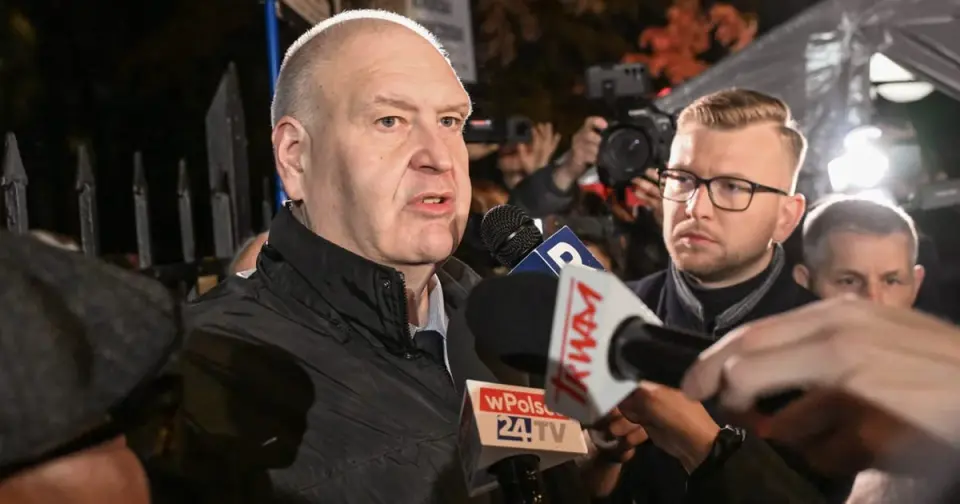
Poland’s Constitutional Tribunal entered a state of crisis on October 30, 2026, after Judge Anna Korwin-Piotrowska suspended President Bogdan Święczkowski and assumed leadership. The move, which Prime Minister Donald Tusk framed as a necessary step to restore judicial independence, was condemned by PiS leaders as a coup. President Karol Nawrocki aborted his trip to Senegal to address the unrest, while police detained three protesters who breached the court’s perimeter in Warsaw.
Key points
- Judge Anna Korwin-Piotrowska suspended Tribunal President Bogdan Święczkowski and his deputy, Bartłomiej Sochański, for one month and assumed temporary charge of the court.
- Święczkowski rejected the suspension, labeling the action a 'coup d’état,' while his deputy was physically barred from entering the tribunal building.
- Justice Minister Waldemar Żurek submitted five requests to strip the immunity of Święczkowski and Sochański, backed by 50 volumes of case files, accusing them of blocking newly elected judges.
- President Karol Nawrocki, a PiS ally, cut short his official visit to Senegal, stating the president must be present in Poland during such a crisis.
- Police deployed riot units to secure the tribunal after protesters threw objects at officers and three individuals were detained for climbing over the court’s fence.
Background
This escalation follows years of conflict between the pro-European government of Donald Tusk and the nationalist Law and Justice (PiS) party, which controlled the judiciary from 2015 to 2023. PiS filled the Constitutional Tribunal with loyalists, including Święczkowski, to challenge EU supremacy and enforce strict social policies, such as a near-total abortion ban. The EU’s top court ruled in December 2025 that the tribunal lacked independence. Tusk’s government has struggled to replace these judges, as President Nawrocki refused to swear in five judges elected by parliament in March 2026, citing procedural flaws. Recent legislative efforts to ease abortion restrictions also faced likely presidential vetoes, highlighting the ongoing power struggle.
How outlets are covering it
Outlets diverge on the legitimacy of the suspension. Politico and AP News frame the event as a decisive, if controversial, step by Tusk to undo PiS-era judicial capture, noting that the government claims the move was initiated by a legally appointed judge. BBC provides a more balanced view, citing legal scholar Marcin Matczak, who argues the suspension has no legal basis and may damage the rule of law for decades. Fox News coverage was limited to live broadcast segments and did not provide detailed textual analysis. All sources agree that PiS leaders, including Jarosław Kaczyński and Zbigniew Ziobro, are framing the incident as a criminal attack on the constitutional order, while Tusk’s camp insists it is a painful but necessary restoration of legal norms.
Why it matters
The standoff threatens to destabilize Poland’s judicial system and deepen its conflict with the EU. If the tribunal’s leadership remains contested, it could further delay the implementation of EU-mandated judicial reforms and potentially trigger additional fines. The incident also signals a high-risk political environment ahead of next year’s parliamentary elections, with both sides accusing the other of undermining democratic institutions.
What to watch
The immediate focus will be on whether the Polish government can successfully prosecute Święczkowski and Sochański or if the courts will uphold their immunity. Nawrocki is expected to issue a formal response to the crisis upon his return. The status of the five judges barred from hearing cases remains uncertain, and further protests are likely as PiS supporters rally against what they view as an illegitimate seizure of power.
- Tusk-Nawrocki battle escalates as chief judge is ousted from Poland’s top court POLITICO.eu
- Polish president turns back from Senegal trip as top court chief suspended Reuters
- Police deployed during stand-off over control of Poland's top court BBC
- Police secure Poland’s Constitutional Tribunal as protests erupt over court chief’s suspension AP News
- Protesters rally outside Poland’s top court amid escalating political crisis Fox News
Want the full story? Read the original reporting
Read on POLITICO.eu