
G20 Cancels Group Photo as European Ministers Refuse to Pose with Lavrov
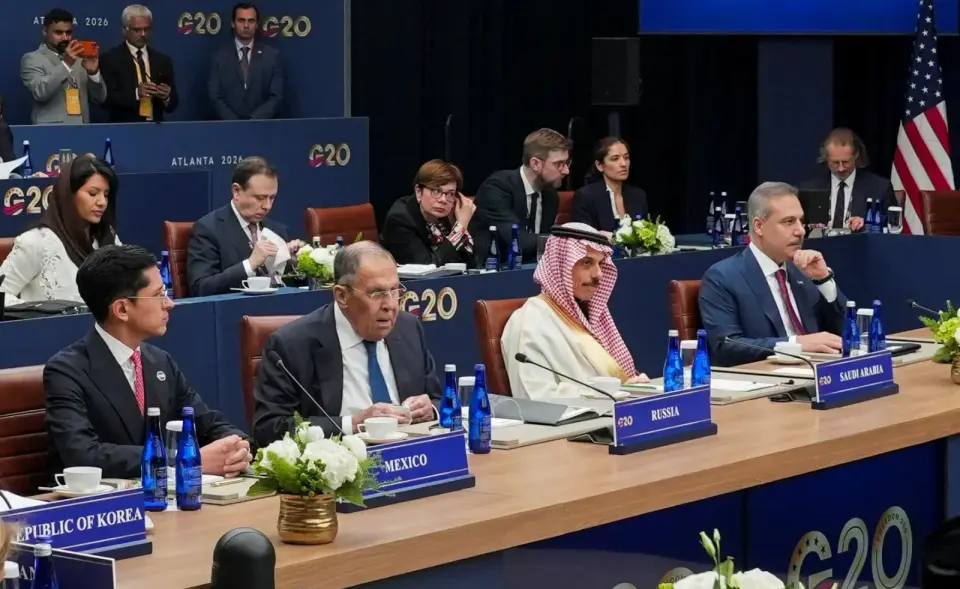
The United States scrapped a traditional group photograph at the G20 foreign ministers meeting in Atlanta after European officials refused to stand alongside Russian Foreign Minister Sergey Lavrov. The decision, made by Secretary of State Marco Rubio, reflects deep divisions within the group over Russia’s presence, ongoing wars in Ukraine and Iran, and conflicting approaches to sanctions. No joint statement is expected, with Washington instead publishing a chair’s summary.
Key points
- US Secretary of State Marco Rubio cancelled the G20 group photo after more than a third of attending officials threatened to walk out rather than pose with Russian Foreign Minister Sergey Lavrov.
- German Foreign Minister Johann Wadephul stated there would be no family photo featuring European partners alongside Lavrov, who remains under Western sanctions for Russia’s 2022 invasion of Ukraine.
- The meeting in Atlanta is overshadowed by the wars in Ukraine and Iran, with Iran having blocked the Strait of Hormuz after US-Israeli strikes in late February, causing sharp rises in global energy prices.
- Ukraine was not invited to the G20 talks, and no joint statement is expected; Washington will instead publish a chair’s summary, as consensus among the 20 members is unlikely.
- UK Foreign Secretary Ed Miliband directly confronted Lavrov, citing a recent Russian drone strike on a Ukrainian railway station that killed at least 14 people, and accused Russia of being the aggressor in the war.
Background
This meeting is the last ministerial gathering of the US G20 presidency before leaders convene in Miami on December 14-15. Tensions have been heightened by recent US sanctions waivers allowing Russia to export diesel to ease fuel prices before the November 3 midterm elections, a move opposed by European allies and Ukraine. In September, Lavrov and Wadephul held their first high-level bilateral talks since 2022 at the UN General Assembly, where Lavrov dismissed the discussions as unproductive and accused Germany of being Ukraine’s 'main sponsor.'
How outlets are covering it
Al Jazeera emphasizes the symbolic rupture within the G20, highlighting that the photo cancellation exposes deep rifts and that a diplomatic source stated Russia’s presence 'in no way legitimises its actions.' CNN provides operational details, noting that the US explored taking two separate photos before Rubio decided to cancel the event entirely to avoid a 'diplomatic distraction.' CNN also reports that Lavrov dismissed the controversy as 'family photo diplomacy' and claimed he had a 'fairly good conversation' with Rubio. While Al Jazeera focuses on the broader geopolitical context of the Iran and Ukraine wars, CNN highlights the specific diplomatic friction between the Trump administration and Europe over sanctions waivers and economic concessions to Moscow. Both sources agree that the G20 is currently unable to reach a consensus statement, but CNN places more weight on the immediate diplomatic maneuvering around the photo, whereas Al Jazeera frames it as a symptom of the group’s broader dysfunction.
Why it matters
The cancellation of the group photo and the lack of a joint statement signal a significant fragmentation within the G20, undermining its role as a forum for global economic and geopolitical coordination. The rift between the US and Europe over Russia’s sanctions and energy deals could have long-term implications for transatlantic relations and the broader strategy to end the war in Ukraine. As global energy prices rise due to the Iran conflict, the inability of the G20 to present a unified front may exacerbate economic instability and weaken international pressure on Russia.
What to watch
The G20 foreign ministers meeting will conclude without a joint statement, with Washington publishing a chair’s summary instead. The next major event is the G20 leaders summit in Miami on December 14-15. US President Donald Trump has indicated a potential return to military action against Iran after the November 3 midterm elections, which could further disrupt global energy markets. European officials, led by EU foreign policy chief Kaja Kallas, will continue to push for stronger support for Ukraine and accountability through a special tribunal, despite US efforts to ease sanctions on Russia.
- G20 drops group photo as Europeans refuse to stand with Lavrov Al Jazeera
- G20 photo scrapped amid tensions over Russian foreign minister’s presence CNN
- Anand says she called out Russian counterpart invited by U.S. to G20 ministerial Toronto Star
- Distaste for Lavrov Forces U.S. to Cancel G20 Photo Session in Atlanta The New York Times
- US scraps G20 photo after European diplomats object to being pictured with Russia's Lavrov Yahoo
Want the full story? Read the original reporting
Read on Al Jazeera