
Police Detain 'Cockroach' Leader Again as Delhi Protests Defy Crackdown
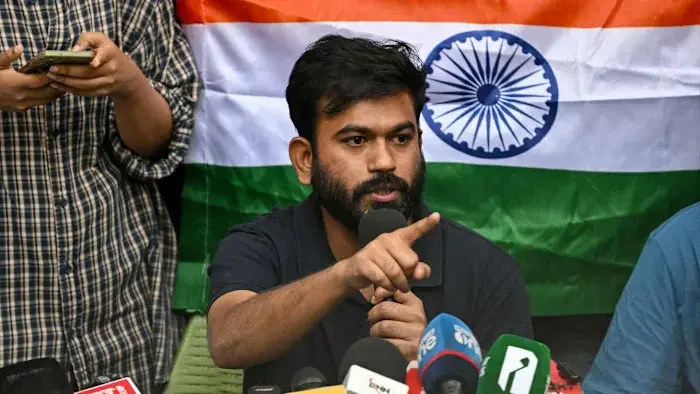
Indian police detained Abhijeet Dipke, founder of the youth-led Cockroach Janta Party (CJP), for the second time in a week as he attempted to reach a protest site in New Delhi. The demonstration, held despite heavy security, demanded the resignation of Chief Election Commissioner Gyanesh Kumar over a controversial voter roll revision. While authorities claim the revision removes duplicates and ineligible voters, critics argue it disenfranchises over 130 million people to favor the ruling Bharatiya Janata Party (BJP).
Key points
- Abhijeet Dipke was detained by police on Friday as he tried to reach Connaught Place in New Delhi, where supporters planned to wave national flags.
- The CJP, which began as an online satire in May, has become a major political challenge to Prime Minister Narendra Modi's government.
- Protesters are demanding the resignation of Chief Election Commissioner Gyanesh Kumar due to the Special Intensive Revision (SIR) of voter lists.
- The SIR has removed over 130 million entries from the draft voter rolls, equivalent to 13% of the registered electorate.
- Two other CJP leaders, Saurav Das and Ashutosh Ranka, were jailed for five days earlier in the week for trespassing into a restricted protest site.
- Despite the detention of key leaders, approximately 2,000 protesters gathered in Delhi, and smaller protests occurred in Mumbai, Bengaluru, and Patna.
Background
The Cockroach Janta Party emerged in May 2026 after India's chief justice compared unemployed youth to cockroaches. The movement gained significant traction in July when protests over a leaked exam scandal forced the resignation of the education minister. Since then, the focus has shifted to the electoral system, with the CJP alleging that the voter roll revision is designed to suppress opposition votes. Previous coverage from October 10 and 11 noted a massive police crackdown that detained thousands of protesters and briefly held CJP leaders on a flight to Delhi, highlighting the escalating tension between the government and the youth movement.
How outlets are covering it
The Financial Times and The Guardian emphasize the scale of the police response, describing it as a 'draconian crackdown' and noting that authorities closed Central Park and deployed thousands of personnel to prevent the gathering. The BBC highlights the physical confrontation, reporting that police used force against some protesters and that Dipke was forced into a police vehicle despite holding a national flag. CNN focuses on the procedural aspect, noting that police had served Dipke a notice earlier in the day warning him against holding the protest. While the government and the Election Commission maintain that the voter roll revision is necessary to remove duplicates and ineligible voters, the CJP and opposition parties argue that the deletions are politically motivated to favor the BJP. The BJP has accused the protesters of attempting to stage a coup and cause anarchy, while the CJP asserts that waving the national flag is a democratic right, not a crime.
Why it matters
The detention of Dipke and the continued protests signal a deepening political crisis in India. The ability of the CJP to mobilize thousands of young people despite heavy police presence suggests that the government's strategy of suppression may not be effective in silencing dissent. The dispute over the voter rolls has the potential to undermine confidence in the integrity of India's electoral system, which is crucial for the country's democratic stability. The government's response, characterized by heavy security and detentions, may further alienate the youth and opposition, potentially leading to more widespread unrest.
What to watch
The CJP has stated that it will continue to protest peacefully even with its three main leaders in custody. The movement has urged supporters in other cities to raise the national flag in their own towns. The government is likely to maintain a heavy security presence to prevent further large-scale gatherings. The legal challenges to the voter roll revision and the detentions of protest leaders may proceed to the courts, potentially setting precedents for the limits of protest in India. The situation remains fluid, with the possibility of further escalations in both protest activity and police response.
- India police detain ‘Cockroach’ leader again to head off new protests Financial Times
- Indian police detain ‘cockroach’ movement founder Dipke ahead of protest, video shows CNN
- CJP, Abhijeet Dipke: 'Cockroach' party founder detained ahead of Central Park Delhi protest BBC
- Crowds throng New Delhi and wave Indian flags amid escalating protests NPR
- India’s Cockroach Janta party leader detained amid crackdown on protests The Guardian
Want the full story? Read the original reporting
Read on Financial Times