
Spain’s conservative leader Feijóo faces far-right alliance in November vote
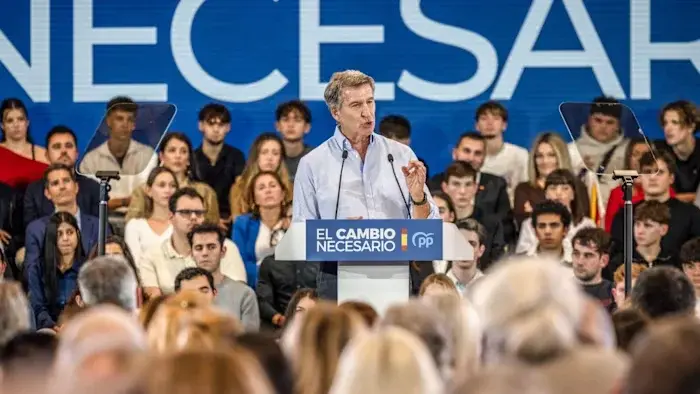
Alberto Núñez Feijóo, leader of Spain’s conservative People’s Party (PP), is poised to become prime minister following the November 29 general election, potentially forming a coalition with the far-right Vox party. Polls indicate the PP may lack an absolute majority, making Vox’s projected 63 seats crucial for a governing alliance of 190 seats. Feijóo’s campaign balances his reputation as a pragmatic administrator with increasingly hardline rhetoric on immigration and corruption to counter Vox’s appeal. A recent televised debate against incumbent Prime Minister Pedro Sánchez boosted Feijóo’s momentum, though he warns against complacency. The outcome could mark the first Spanish government with far-right ministers since the end of the Franco dictatorship, shifting Spain’s foreign policy toward closer US ties and stricter border controls.
Key points
- The November 29 general election is expected to result in a PP-Vox coalition, as the PP is projected to win 127 seats and Vox 63, totaling 190 seats, which exceeds the 176 needed for an absolute majority.
- Feijóo, 65, has shifted the PP’s rhetoric to the right, adopting Vox-like stances on banning full-face veils and opposing mass regularizations of undocumented immigrants, to prevent voter drift to the far right.
- A televised debate against Prime Minister Pedro Sánchez on November 20 was described by PP officials as a decisive victory, boosting Feijóo’s campaign momentum and voter confidence.
- Feijóo’s potential government would likely distance itself from Sánchez’s foreign policy, including his stance on US relations and defense spending, while maintaining support for Ukraine.
- The PP and Vox already govern together in four Spanish regions, normalizing their alliance and providing a template for potential national cooperation, despite ideological differences on gender-based violence laws.
Background
Spain’s political landscape has shifted significantly since the 2023 election, where the PP won the most seats but failed to form a government due to a lack of absolute majority. The current Socialist government under Pedro Sánchez has faced challenges, including a deadly train crash in October and a general strike over housing and wages. The far-left parties failed to form a unified coalition before the November election, weakening the left’s opposition. Feijóo’s rise to national leadership in 2022 was seen as a victory for the PP’s moderates, but he has since adapted his platform to compete with Vox, reflecting a broader trend of center-right parties shifting rightward in Europe.
How outlets are covering it
The Financial Times emphasizes Feijóo’s pragmatic managerial style and his struggle to match the charisma of Sánchez and Vox leader Santiago Abascal, noting his reliance on a coalition with Vox. Al Jazeera highlights the tension between Feijóo’s moderate image and his adoption of far-right rhetoric on immigration, describing him as a 'possibilist' who adapts to circumstances. Demócrata focuses on the PP’s internal optimism after the debate, stressing the need to prevent voter complacency and secure a 'clear mandate.' El Constitucional reports Feijóo’s public satisfaction with the debate but his caution about the final vote, framing the campaign as a 'return match' in a Champions League analogy. All sources agree on the critical importance of the PP-Vox alliance, but differ on the extent of Feijóo’s ideological shift and the stability of his coalition prospects.
Why it matters
The outcome of the November 29 election will determine whether Spain’s government includes far-right ministers for the first time since the Franco era, potentially reversing its role as a left-leaning bastion in the EU. A PP-Vox coalition could lead to stricter immigration policies, increased defense spending, and a more confrontational stance toward the US and EU on border issues. The shift in foreign policy, including distancing from Sánchez’s open-border and anti-Trump rhetoric, could impact Spain’s relationships with the US, Morocco, and the EU. Domestically, the election may repeal recent housing and labor protections, affecting social stability and economic policy. The result also signals the growing influence of far-right parties in European politics, with implications for democratic norms and social progress.
What to watch
The November 29 general election will determine the composition of Spain’s next government. If the PP and Vox form a coalition, Feijóo is expected to become prime minister, potentially implementing policies on immigration, defense, and foreign policy that differ from the current Socialist government. A four-way debate on November 26 will feature Feijóo and Vox leader Santiago Abascal, testing the strength of their alliance. Post-election, the focus will be on forming a stable government, with potential clashes between the PP and Vox on issues like gender-based violence laws. The new government will also face decisions on repealing or maintaining recent housing and labor decrees, and on Spain’s role in NATO and EU defense initiatives.
- The ‘austere’ conservative poised to lead Spain with the far right Financial Times
- Who is Alberto Feijoo, the conservative seeking to become Spain’s new PM? Al Jazeera
- Feijóo will redouble the call for the useful vote in the final week following the boost from the face-to-face debate Demócrata
- Feijóo declares himself "very satisfied" with the debate with Pedro Sánchez, but states that there is still "the return match" and calls not to be overconfident until November 29 El Constitucional
- Feijóo asks the PP not to trust Murcia: "We haven't won anything" Demócrata
Want the full story? Read the original reporting
Read on Financial Times