
Tel Aviv Protests Demand Arab-Jewish Coalition as Israel Faces Government Deadlock
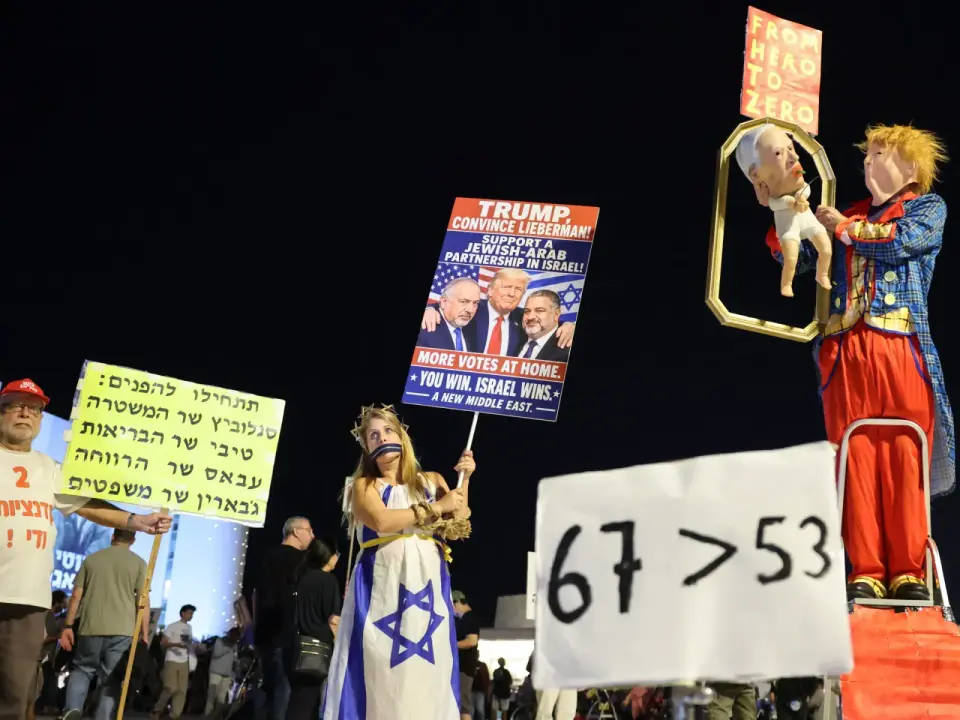
Thousands of Israelis rallied in Tel Aviv on October 31, 2026, demanding that opposition leader Gadi Eisenkot form a coalition with Arab-led parties to oust Prime Minister Benjamin Netanyahu. The recent election resulted in a fragmented Knesset where Netanyahu’s bloc holds 53 seats and Eisenkot’s holds 48, while Arab parties secured a record 19 seats. Although an alliance with Arab parties would give the opposition a 67-seat majority, many Jewish-led leaders refuse such a partnership, citing ideological differences and alleged foreign interference. Netanyahu has accused Arab parties of electoral fraud and Qatari funding, claims denied by Qatar and dismissed by election officials. Counter-protests by Netanyahu supporters rejected the idea of governing with 'terrorists,' highlighting deep societal divisions. Analysts suggest a unity government or minority coalition may be necessary to avoid a second election, though current political egos and past promises make such compromises difficult.
Key points
- Protesters in Tel Aviv urged Eisenkot to ally with Arab parties, calling it the 'last chance for real change' to remove Netanyahu.
- Netanyahu’s bloc won 53 seats, Eisenkot’s won 48, and Arab-led parties won 19, creating a deadlock where no single bloc can form a government alone.
- Arab party support surged by 64% compared to 2022, with nearly 840,000 votes cast for Ra’am and the Joint List.
- Netanyahu accused Arab parties of 'stealing' the election via Qatari funding, a claim Qatar rejected as disinformation.
- Counter-protesters demanded Israel not have a government with 'terrorists,' reflecting strong opposition to Arab-Jewish coalitions.
- The Atlantic noted that Tel Aviv’s liberal base was disappointed by the inconclusive results, which failed to deliver the expected change.
Background
This deadlock follows the October 27, 2026, general elections, which resulted in a fragmented Knesset. Previous coverage highlighted that neither the right-wing nor opposition blocs secured the 61-seat majority needed to govern. The surge in Arab party representation, from 10 to 19 seats, has intensified the political crisis. Netanyahu’s claims of foreign interference and fraud have been widely disputed by election officials and Qatar, but they remain a central tactic to block coalition formation. The current situation builds on months of protests against Netanyahu’s government, particularly in Tel Aviv, which has been a focal point for opposition activism.
How outlets are covering it
Al Jazeera emphasized the grassroots pressure on Eisenkot to form a Jewish-Arab coalition, highlighting the emotional intensity of the protests and the counter-protests by Netanyahu supporters. The Atlantic focused on the cultural and political shock in Tel Aviv, describing the election results as a failure of the liberal 'bubble' and noting the near-impossibility of coalition formation. The Jerusalem Post offered a more pragmatic analysis, arguing that while an Arab coalition is politically unpalatable, a unity government is the only realistic option to prevent a second election. It suggested that Netanyahu must abandon his far-right allies and accept a state commission of inquiry into October 7, while Eisenkot and Bennett must break their promises not to sit with Netanyahu. The outlets differ on the feasibility of an Arab coalition: Al Jazeera presents it as a popular demand, while The Jerusalem Post views it as a non-starter due to ideological divisions within the Arab bloc itself.
Why it matters
The inability to form a government threatens to destabilize Israel’s political landscape, potentially leading to a second election or a fragile minority government. The deadlock highlights deep societal divisions over the role of Arab citizens in Israeli governance and the future of Netanyahu’s leadership. If a coalition cannot be formed, it could exacerbate tensions with regional actors like Iran and Hezbollah, as Netanyahu’s focus on security and foreign policy may be disrupted. The outcome will also determine whether Israel can address internal issues such as judicial reforms and the aftermath of the October 7 attacks, or if it remains paralyzed by political gridlock.
What to watch
Eisenkot is expected to continue coalition negotiations, potentially exploring a minority government supported by Arab parties or a unity government with Netanyahu. Netanyahu may attempt to trigger a second election, hoping for lower turnout and fewer expatriate votes to shift the balance. The Central Election Committee and police will likely continue to investigate claims of foreign interference, though current evidence suggests these claims are unfounded. Public pressure may force leaders to compromise, but the risk of prolonged instability remains high if no agreement is reached within the mandated timeframe.
- Thousands rally in Israel urging ‘Jewish-Arab’ coalition to oust Netanyahu Al Jazeera
- The Bursting of the Tel Aviv Bubble The Atlantic
- Israel needs more courage, less ego after election stalement The Jerusalem Post
- Eisenkot vows to swiftly utilize Knesset majority ‘against Oct. 7 government’ The Times of Israel
- Gadi Eisenkot is the bereaved general trying to outmaneuver Netanyahu The Washington Post
Want the full story? Read the original reporting
Read on Al Jazeera