
Litigation Frenzy Erupts as Attorneys Pivot to Constitutional Challenges After Supreme Court TPS Ruling
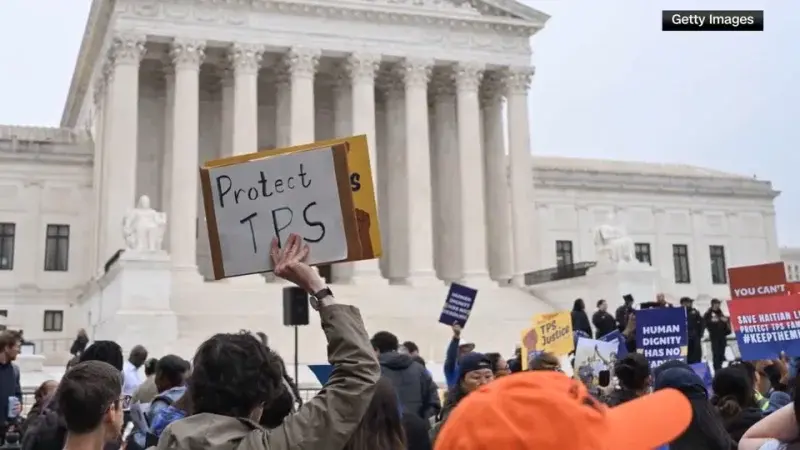
Following the Supreme Court’s June 2026 ruling that barred lower courts from reviewing procedural challenges to the termination of Temporary Protected Status (TPS), legal advocates have launched a new wave of litigation. Attorneys are now arguing that the Department of Homeland Security (DHS) violated the Fifth Amendment’s Due Process Clause and exceeded its statutory authority. While the White House claims the high court’s decision grants 'full authority' to end protections, three federal judges have recently paused revocations for migrants from Ethiopia, South Sudan, and Burma to allow these new claims to proceed. The legal battle now centers on whether DHS Secretary Kristi Noem had the power to revoke TPS or if that authority remains with the Attorney General, a move that could impact nearly 10,000 people from four countries and potentially affect the broader TPS program covering 1.7 million individuals.
Key points
- The Supreme Court ruled in late June 2026 that lower courts cannot review claims that DHS Secretary Kristi Noem failed to follow proper inter-agency consultation procedures when revoking TPS for multiple countries.
- Legal advocates are now filing new lawsuits based on the Fifth Amendment’s Due Process Clause, arguing that revoking TPS without reasoned decision-making unconstitutionally deprives migrants of liberty and property interests.
- Attorneys are also raising 'ultra vires' arguments, claiming that Congress assigned the power to terminate TPS to the Attorney General, not the DHS Secretary, meaning Noem lacked the authority to revoke the designations.
- Three federal judges have issued temporary stays on TPS revocations for migrants from Ethiopia, South Sudan, and Burma to preserve the status quo while these new constitutional and statutory claims are evaluated.
- The Justice Department is aggressively pursuing procedural motions to lift previous injunctions, aiming to begin deportations for migrants from Haiti, Syria, Yemen, and other countries before the new legal challenges are fully adjudicated.
Background
The current legal crisis stems from the Supreme Court’s 6-3 decision in Mullin v. Doe, which upheld the administration’s move to end TPS for Haitians and Syrians. Prior to this ruling, lower courts had blocked the termination, but the high court found the procedural arguments unreviewable. This decision followed a period of intense uncertainty for immigrant communities, particularly in New York and Ohio, where thousands faced potential deportation or loss of work permits. The program, established in 1990, currently protects approximately 1.7 million people across 17 countries, with specific designations for Haiti (330,000 beneficiaries) and Syria (6,100 beneficiaries) having been in place since 2010 and 2015, respectively.
How outlets are covering it
CNN reports that the Supreme Court’s decision has triggered a 'frenzy of litigation' as advocates pivot from procedural to constitutional arguments, noting that the White House interprets the ruling as granting 'full authority' to terminate protections. Baptist News Global frames the ruling as a moral failure, contrasting the legal outcome with Christian teachings on welcoming strangers and criticizing the administration’s rhetoric as racially motivated. While CNN focuses on the technical legal maneuvers and the 'ultra vires' argument regarding DHS authority, BNG emphasizes the ethical implications and the dissenting opinion of Justice Kagan, who argued that the president’s comments regarding Haitians were 'overtly racial.' CNN highlights the immediate legal stays in Boston and Chicago, whereas BNG focuses on the broader precedent for asylum policies and the potential deportation of 350,000 Haitians.
Why it matters
The outcome of these new legal challenges will determine whether the Supreme Court’s procedural ruling effectively ends TPS for thousands of migrants or if constitutional and statutory arguments can preserve the program. If the 'ultra vires' argument succeeds, it could invalidate the authority of the DHS Secretary to manage TPS entirely, potentially affecting the 1.7 million people currently protected. Conversely, if the government succeeds in lifting the recent stays, it could trigger mass deportations and significant economic disruption in sectors reliant on TPS holders, such as healthcare and construction.
What to watch
Federal judges are currently weighing the new Fifth Amendment and ultra vires arguments, with some issuing temporary stays to preserve the status quo. The Justice Department is moving quickly to overturn previous injunctions to begin deportations. Haitian TPS holders are also pursuing discovery to find evidence of discriminatory intent, which could support a separate Equal Protection claim. The next critical step will be the courts' rulings on whether DHS had the statutory authority to revoke TPS, a decision that could either halt the terminations or accelerate the removal of migrants from multiple countries.
- Inside the fights to maintain TPS status for thousands after the Supreme Court sided with Trump CNN
- Supreme Court ruling annuls the idea of ‘Christian America’ Baptist News Global
- United States: TPS Employment Authorization Extended Further for Syria and Somalia Fragomen
- Advocates fight to preserve TPS after Supreme Court limits lower courts Межа. Новини України.
- Attorney advises against making abrupt hiring, firing decisions amid TPS changes The Business Journals
Want the full story? Read the original reporting
Read on CNN