
US Envoys Adopt Russia’s ‘All-or-Nothing’ Strategy, Stalling Ukraine Peace Talks
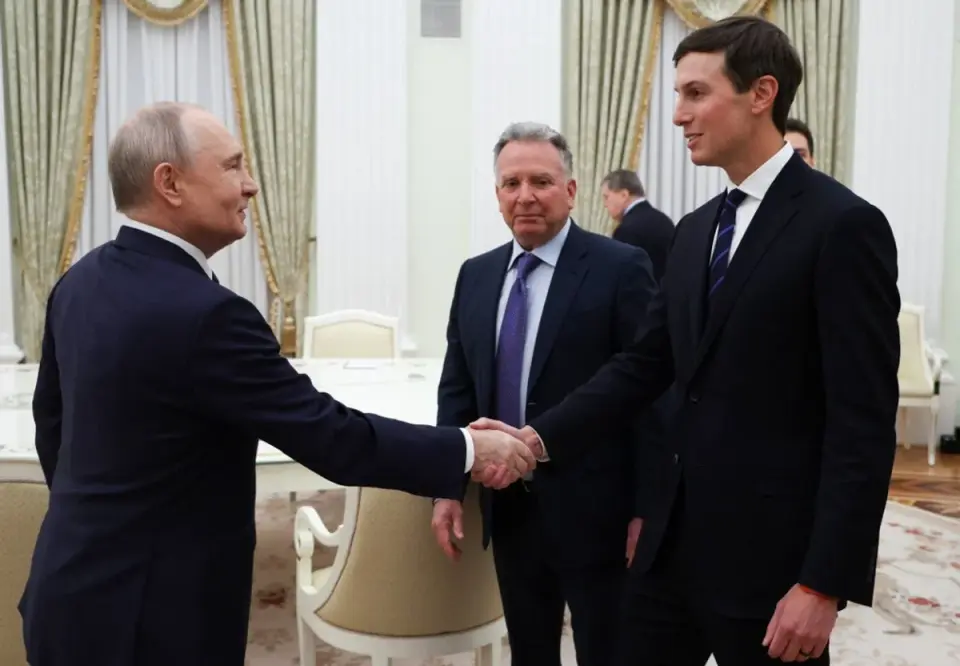
US special envoys Steve Witkoff and Jared Kushner agreed to Moscow’s demand to negotiate all peace issues simultaneously, a move critics say gives Russia leverage to stall. While a large prisoner exchange was agreed, core territorial disputes remain unresolved. European leaders are pushing for inclusion in future talks, but Russia maintains maximalist demands and rejects foreign peacekeepers. Meanwhile, Ukraine faces renewed military setbacks due to speed restrictions on its Starlink satellite network.
Key points
- US envoys accepted Russia’s demand to resolve all contentious issues in a single package, abandoning traditional staged diplomacy.
- A framework for the largest prisoner exchange of the war was agreed, but no breakthrough was reached on territorial or ceasefire issues.
- Russia rejected the deployment of foreign peacekeepers and insisted on full control over four annexed Ukrainian regions.
- European leaders, including the EU and E5 nations, are pushing to join the next round of talks, though Russia remains evasive.
- Ukraine reported new speed restrictions on its Starshield satellite network, hindering its ability to intercept Russian drones.
Background
Recent diplomatic efforts have been marked by stalled peace talks and shifting US-Russia dynamics. In October, a Trump-Putin call yielded a diesel deal but failed to revive negotiations. In early November, US envoys conceded to Russia’s 'all-or-nothing' strategy in Abu Dhabi, while European leaders secured a seat at the table. Prior reports also highlighted Russia’s rejection of European peacekeepers and Ukraine’s struggles with Starlink disruptions.
How outlets are covering it
The Kyiv Post and Politico emphasize that accepting a single-package negotiation format upends traditional diplomatic sequencing, allowing Moscow to avoid concrete decisions and stall talks. CNN and The Guardian highlight Russia’s evasive response to European inclusion, with the Kremlin neither explicitly endorsing nor rejecting a European delegation. The Guardian notes Putin’s hardline stance on territorial demands and foreign troops, while BBC focuses on Zelensky’s welcome for European involvement and the agreed prisoner exchange. All sources agree that core disputes remain unresolved, but they differ on the significance of European participation and the impact of Starlink disruptions on Ukraine’s defense capabilities.
Why it matters
The shift to a single-package negotiation strategy risks prolonging the war by allowing Russia to avoid concrete decisions on ceasefire and territorial issues. European inclusion in talks could reshape the diplomatic landscape, but Russia’s maximalist demands and rejection of peacekeepers suggest limited progress. Starlink disruptions further weaken Ukraine’s defense, potentially affecting the balance of power on the ground. These developments could influence the broader European security architecture and the outcome of the war.
What to watch
A new round of multilateral peace talks, including European representatives, is scheduled within the coming week. Putin and Trump plan to continue discussions at the APEC summit in Shenzhen, China, on Nov. 18-19. European leaders are expected to decide on a single representative for negotiations, though no immediate agreement is anticipated. Ukraine will continue to seek clarification on Starlink restrictions from the US and SpaceX.
- US Envoys Give Putin Leverage to Prolong Negotiations on Ukraine Kyiv Post
- Russia evasive after the US says Europe will join next Ukraine talks CNN
- Politics The Economist
- Putin takes hard line in US talks as Ukraine says Starlink disrupted again The Guardian
- Zelensky welcomes US bringing Europe into Russia-Ukraine peace talks BBC
Want the full story? Read the original reporting
Read on Kyiv Post