
Satellite radar and ground surveys reveal 2,600-year-old mudbrick complex at ancient Buto
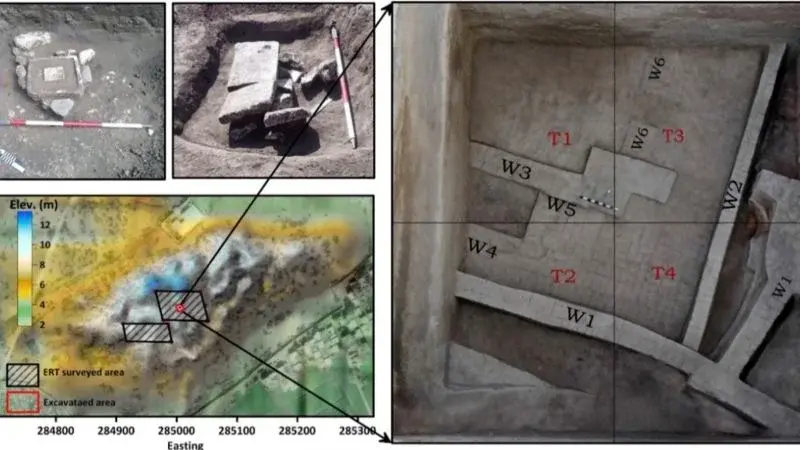
Researchers have identified a significant mudbrick structure buried beneath the ancient city of Buto in Egypt’s Nile Delta, hidden for nearly 2,600 years. By combining satellite radar imagery from the European Space Agency’s Sentinel-1 with electrical resistivity tomography (ERT), the team mapped the site without extensive digging. The structure, dating to the 26th Dynasty (Saite period), measures approximately 82 by 66 feet and lies 10 to 20 feet below the surface. Excavations confirmed the presence of religious artifacts, including an altar and amulets, suggesting the building served a sacred function. A key finding is a layer of sand found 20 to 23 feet underground, which researchers believe was deliberately placed by ancient builders to stabilize the structure against the region’s unstable, clay-rich soil.
Key points
- The discovery was made using non-invasive methods: satellite radar detected a large oval anomaly, while ERT surveys mapped the subsurface architecture across approximately 58,100 square feet.
- The primary structure dates to the Saite period (7th–6th centuries BC) and is located at Kom C, one of Buto’s three main mounds. It is believed to have served a religious or funerary purpose, possibly as a shrine or tomb.
- Excavations guided by the surveys uncovered thick mudbrick walls, a limestone altar with residues suggesting animal offerings, and faience figurines, including a baboon associated with the god Thoth.
- A distinct layer of clean sand found 20 to 23 feet underground is interpreted as an artificial foundation. This layer likely helped distribute weight and manage the Nile Delta’s waterlogged, expanding clay soil.
- The site also contains evidence of later Ptolemaic and Roman settlements, which had accumulated above the older Saite remains, complicating traditional excavation efforts due to high groundwater levels.
Background
Buto, also known as Tell el-Fara’in, was a major religious and political center in ancient Lower Egypt, serving as the cult center for the cobra goddess Wadjet. The site has been studied by international archaeologists since the late 19th century, but its complex layers of occupation and high water table have made deep excavation difficult. Previous coverage in our archive noted that non-invasive technologies were already being used to map the site, but this study provides the first detailed confirmation of a specific Saite-period complex and its foundation engineering. The discovery adds to a broader trend of using advanced geophysical tools to uncover hidden histories in the Nile Delta, where only a small fraction of many sites has been physically excavated.
How outlets are covering it
CNN and Mezha.net focus on the general discovery and the implications for non-invasive archaeology, highlighting the efficiency of combining satellite data with ground surveys. Futura provides more technical detail, specifying the use of the Sentinel-1 satellite and the exact dimensions of the survey area (5,400 square meters). While all sources agree on the Saite dating and the religious nature of the artifacts, Futura emphasizes the engineering aspect of the sand foundation, noting that while the purpose is interpreted as stabilization, it remains a hypothesis pending further proof. CNN and Mezha.net quote external experts like Hussein Bassir and Robert Littman to contextualize the finding within the broader field of archaeology, whereas Futura focuses more on the methodology and the specific historical layers uncovered.
Why it matters
This discovery demonstrates how modern technology can unlock archaeological secrets without the destructive and time-consuming process of traditional excavation. The finding of a deliberate sand foundation offers new insights into ancient Egyptian engineering practices, showing how builders adapted to the challenging environmental conditions of the Nile Delta. It also highlights the potential for similar non-invasive methods to reveal hidden structures at other unexcavated sites, potentially reshaping our understanding of ancient urban planning and religious architecture.
What to watch
Researchers plan to extend their electrical resistivity surveys using wider electrode spacing to investigate deeper occupation levels at Buto. Future studies will also examine ancient plant remains and the changing geology of the Nile Delta to reconstruct the environment during the Saite period. The team suspects another structure may lie beneath a thick layer of clay and intends to investigate this in subsequent research. Additionally, the success of this method may encourage the application of similar satellite and ERT combinations at other archaeological sites in Egypt and beyond.
- Ancient Egyptian structure hidden beneath Nile mud detected from space CNN
- Satellite radar spotted an anomaly under a mound in Egypt’s Nile Delta. Beneath it lay a 2,600-year-old mudbrick complex built on a deliberately laid bed of sand Futura, le média qui explore le monde
- And finally… Ancient Egyptian structures Scottish Construction Now
- Researchers identify Egyptian structure hidden for nearly 2,600 years Mezha.net
Want the full story? Read the original reporting
Read on CNN