Egypt orders earlier closing times in Cairo to conserve electricity as oil costs climb amid a regional conflict involving the US, Israel and Iran, disrupting nightlife and everyday life.
Egypt has imposed temporary energy-saving rules due to rising fuel costs from the Iran conflict, ordering shops, restaurants and cafes to close by 21:00 for a month, dimming street lights, and resuming one-day-a-week home working in April; hotels and tourist sites are exempt, with some venues already installing generators, as the government tries to shield public finances from higher oil prices tied to the Strait of Hormuz disruption.
Researchers in Egypt have identified Masripithecus, a 17–18 million-year-old ape relative found in the Wadi Moghra region, implying that modern apes and possibly the human lineage may have originated in Afro-Arabia rather than exclusively in East Africa; the find expands the geographic scope of early hominoid evolution, though experts caution that more fossils are needed to pinpoint the crown ancestor.
Researchers describe 18-million-year-old fossils from northern Egypt—Masripithecus moghraensis—that may place the origins of all living apes in the Afro-Arabian region, not just East Africa. The fragmentary jaw and teeth place this species on the ancestral line leading to modern apes, a finding that prompts rethinking of early ape evolution, though scientists urge caution and more fossils to confirm the broader implications.
Farrah Abraham posted a photo in a sheer skirt and revealing top at the Egyptian pyramids during a trip with her daughter Sophia, triggering backlash from critics who argued the outfit was disrespectful to a conservative country and urging cultural sensitivity.
Oleksandr Usyk will defend his WBC heavyweight title against kickboxing legend Rico Verhoeven on May 23 at the Pyramids of Giza in Egypt. The fight’s status as a formal world title bout is likely uncertain, withUsyk’s defense framed as a voluntary showcase; The Ring will stage the event, and Verhoeven brings a storied kickboxing record (66-10) and a 1-0 boxing stint, while Usyk remains undefeated (24-0) as boxing’s pound-for-pound elite.
Oleksandr Usyk will defend the WBC heavyweight title against former kickboxing champion Rico Verhoeven on May 23 in Egypt, in a boxing bout headlined as 'Glory in Giza' and streamed on DAZN, marking a rare cross‑sport clash with more ticket and undercard details to be released in the coming weeks.
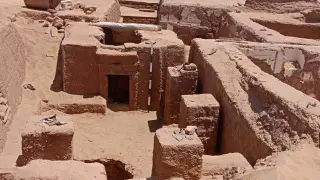
Archaeologists at Qubbet el-Hawa near Aswan uncovered rock-cut tombs from Egypt’s Old Kingdom (c. 2686–2181 BC) that were reused in later eras, including the First Intermediate Period and Middle Kingdom. The digs produced about 160 mostly intact ceramic vessels with hieratic inscriptions, plus copper-alloy mirrors, alabaster cosmetic containers, amulets, and other personal adornments, offering new insights into ancient burial customs and southern Egypt’s enduring funerary significance.
UN data show 2025 international arrivals at about 1.5 billion and a projected 4% global growth in 2026, driven by high-identity destinations such as Brazil, Egypt, Ethiopia, Bhutan and Seychelles rather than just traditional hubs. Egypt benefits from the Grand Egyptian Museum and slower Nile experiences; Brazil expands thanks to air connectivity and major events; Ethiopia is rebuilding demand with improved access and the Visit Ethiopia platform; Bhutan maintains a sustainable, high-value model funded by a nightly development fee. The trend underscores travelers’ preference for distinctive cultures and more sustainable, less crowded experiences while addressing overtourism.
Londoner Chenai Johnson, 23, was paralysed from the waist down after a January crash in Hurghada, Egypt; doctors say she will never walk again, but she remains hopeful and is fundraising for specialist care as her family plans to fly her home to the UK, while stressing the importance of securing travel insurance for expats.
The Rafah border crossing between Gaza and Egypt reopened after a two-day closure, permitting a limited number of Palestinians to travel for medical evacuations (17 evacuees and 27 companions crossing to Egypt, with the same number expected to return). Crossings remain tightly controlled under a brokered deal, with about 50 people allowed to return to Gaza and 50 medical patients leaving per day, amid ongoing U.S.-backed ceasefire talks and Hamas-Israel negotiations. Reports highlighted delays and screening procedures, while EU-led border oversight and continued discussions on security and disarmament framed the broader context.
The Rafah border crossing between Gaza and Egypt reopened this week after two years of war, but only a fraction of those eligible have crossed and delays persist as negotiators cap entries. In four days, 36 Gaza patients and 62 companions left for Egypt, while thousands await medical care; early days saw a mix of approvals and slow transfers, leading to hours-long questioning and transport bottlenecks. Allegations of mistreatment—handcuffing and long interrogations—emerged, though Israeli authorities deny misconduct and UN rights officials warn of a pattern of ill-treatment. The reopening is treated as a pilot and could expand if successful, but it remains tightly controlled and controversial.
During the first week of Rafah’s partial reopening, Palestinians faced confusion and logistical delays as far fewer crossed than expected: Israeli officials had hinted that up to 150 could leave Gaza and 50 could enter, but CNN tallies showed just 12 people crossing in each direction on the reopening day and a high of about 40 the following day. Many medical evacuees with prior approvals could not re-enter Gaza, while thousands more in Gaza await permission to travel for treatment. Rights groups reported mistreatment at checkpoints, and the process remains unsettled as the three-way security checks (Egypt, EU border staff, Israel) and AMA/APRC-guided item restrictions are being worked out. Amid the delays, reunions in Gaza were emotional, but the week underscored a slow, disorganized start to what was framed as a humanitarian reopening two years after the crossing closed.
Egypt has deployed a Turkish-made Bayraktar Akıncı drone to East Oweinat on the Sudan border, signaling a deeper Egyptian role in the Sudanese war by backing the military with air capability and logistics. Satellite imagery shows Akıncıs at the border airstrip, reflecting Cairo’s shift from limited support to direct involvement amid broader regional power dynamics.
Satellite imagery and officials indicate Egypt has secretly used a western Sudan airbase to strike the RSF with drones for at least six months, signaling a more direct Cairo role in the Sudan conflict amid shifting regional alliances.