
Dutch Scientists Transplant Real Salt Marsh into Wave Machine to Test Coastal Resilience
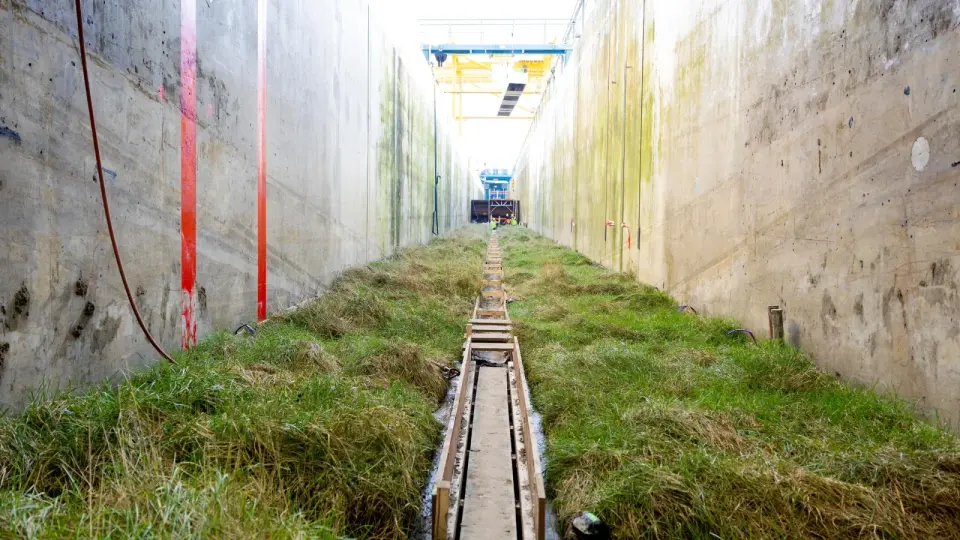
Dutch researchers transplanted 306 square meters of real salt marsh from the Wadden Sea into the Delta Flume, the world's largest wave generator, to test its resilience against extreme storm surges. After 21 hours of waves reaching 2 meters in height, the marsh substrate lost only 7 millimeters of sediment, though above-ground vegetation suffered significant damage. The study, published in Nature, suggests that while salt marshes are less effective at attenuating high-energy waves than low-energy ones, they offer a flexible, self-repairing alternative to static concrete dikes for hybrid coastal defense strategies.
Key points
- Researchers from the Netherlands extracted 306 square meters of salt marsh from the Peazemerlannen nature reserve in the Wadden Sea, including soil and vegetation, and transported them 250 kilometers to the Delta Flume in Delft.
- The transplanted marsh was subjected to 21 hours of continuous storm waves, with heights increasing from 0.75 meters to 2 meters, simulating conditions that occur once every hundred to thousands of years in the field.
- The experiment revealed that while the marsh substrate remained stable with only 7 millimeters of sediment loss, above-ground vegetation lost 33% of its biomass initially, with 20-25% remaining after the full 21-hour exposure.
- Wave attenuation was most effective in low-energy systems (waves up to 1 meter), reducing wave power by up to 50%, but dropped to no more than 10% in high-energy systems (waves over 1 meter).
- The findings support the use of salt marshes as part of hybrid coastal defense systems alongside traditional dikes, offering a flexible and self-repairing barrier that can adapt to changing climate conditions.
Background
The Netherlands, with a quarter of its territory below sea level, relies heavily on the Delta Works, a system of dikes and dams, for flood protection. However, rising sea levels and more frequent storm surges due to climate change are straining these static 'grey' infrastructure solutions. This experiment builds on earlier concerns about the limitations of traditional flood defenses and explores the potential of 'green' infrastructure, such as salt marshes, to complement or reduce the need for hard engineering. The study follows previous observations that while marsh platforms can withstand extreme waves, their protective value diminishes at high-energy coasts, highlighting the need for integrated approaches to coastal resilience.
Why it matters
As climate change intensifies storm surges and sea levels, traditional flood defenses may become insufficient. This experiment demonstrates that salt marshes can serve as a resilient, adaptive barrier, particularly in low-energy environments, and could reduce the long-term costs of maintaining and upgrading hard infrastructure. By integrating natural ecosystems with engineered structures, coastal communities may achieve more sustainable and effective protection against extreme weather events.
What to watch
Researchers will likely expand the study to test different marsh compositions and wave conditions, as well as explore the long-term recovery of vegetation after extreme events. Policy makers in the Netherlands and other coastal regions may consider integrating salt marsh restoration into their flood defense plans, potentially reducing reliance on costly concrete structures. Further studies will also assess the economic viability of hybrid defense systems and their impact on local ecosystems.
Want the full story? Read the original reporting
Read on ScienceAlert