
Salt Marsh Platforms Survive Extreme Storms, but Vegetation Wave Attenuation Fails at High-Energy Coasts
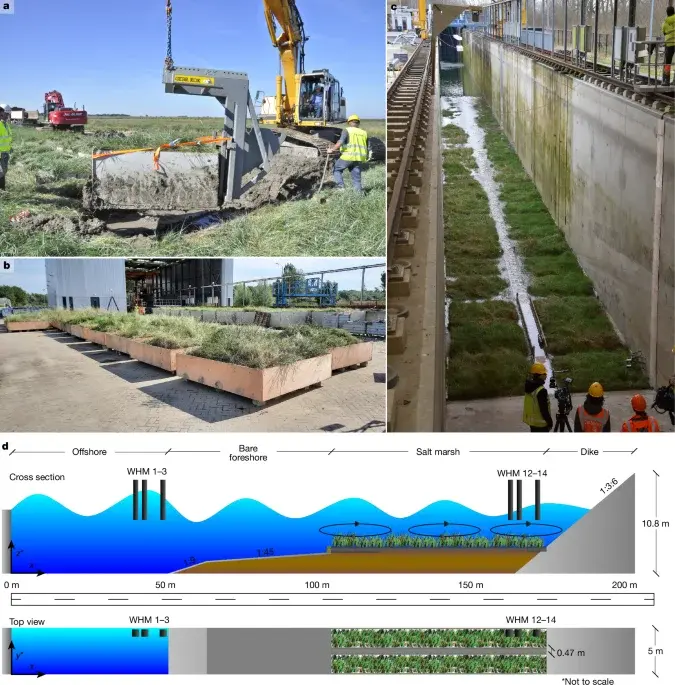
A large-scale experiment in the Netherlands demonstrates that salt marsh substrates remain stable under extreme wave conditions, but above-ground vegetation suffers progressive damage that significantly reduces wave attenuation. While marsh platforms can withstand waves up to 2 meters with negligible erosion, the protective value of vegetation drops sharply at high-energy coasts, limiting the effectiveness of green-grey flood protection strategies in those areas.
Key points
- Researchers transplanted a 306-square-meter intact salt marsh into the Delta Flume in Delft, Netherlands, to test its response to extreme waves.
- The marsh substrate showed negligible erosion, losing only 7 millimeters of surface height over 21 hours of exposure to waves up to 2 meters high.
- Above-ground vegetation, primarily Elymus athericus, experienced a 33% loss in biomass and 19% reduction in stem length after initial exposure.
- Wave attenuation by vegetation exceeded 10% at low-energy coasts (waves under 1 meter) but did not exceed 10% at high-energy coasts (waves over 1 meter).
- Global analysis indicates that while marsh platforms are stable, their wave-attenuating service is limited to low-energy environments, affecting the viability of green-grey infrastructure in high-risk zones.
Background
This study addresses the growing reliance on green-grey flood protection, which combines traditional hard engineering with natural ecosystems like salt marshes. Previous research had established that marshes attenuate waves through elevated beds and vegetation drag, but lacked quantified data on how extreme storms damage these systems. The experiment builds on earlier concerns that future storm surges in regions like the UK, Netherlands, and US Gulf Coast may exceed historical levels, potentially overwhelming natural defenses. While archive coverage focuses on recent heat waves and coastal flooding in Southern California, this research provides a global perspective on the structural limits of coastal wetlands under increasing hydrodynamic stress.
Why it matters
The findings clarify the operational limits of nature-based solutions for coastal defense. While salt marshes are cost-effective for reducing wave energy at low-energy coasts, their ability to attenuate waves diminishes significantly at high-energy sites. This distinction is crucial for policymakers deciding where to prioritize marsh restoration versus hard engineering. The study also highlights that while marsh platforms are physically stable, the loss of vegetation reduces their protective value, potentially accelerating coastal erosion and increasing flood risk in high-energy zones. Understanding these thresholds helps optimize the placement of green-grey infrastructure to maximize flood protection and economic savings.
What to watch
Future research will focus on site-specific assessments of wave attenuation using remote sensing technologies like LiDAR to map vegetation heights. Researchers will also investigate the long-term stability of organic-rich soils and brackish marshes, which may be more prone to erosion than the European soils tested. Additionally, the study suggests that continuous support and maintenance of salt marshes are necessary to prevent long-term erosion and ensure their persistence at high-energy coasts, where their protective value is most limited.
Want the full story? Read the original reporting
Read on Nature