
North Korea's 2017 Nuclear Test Triggered Decades of Seismic Activity at Mount Mantap
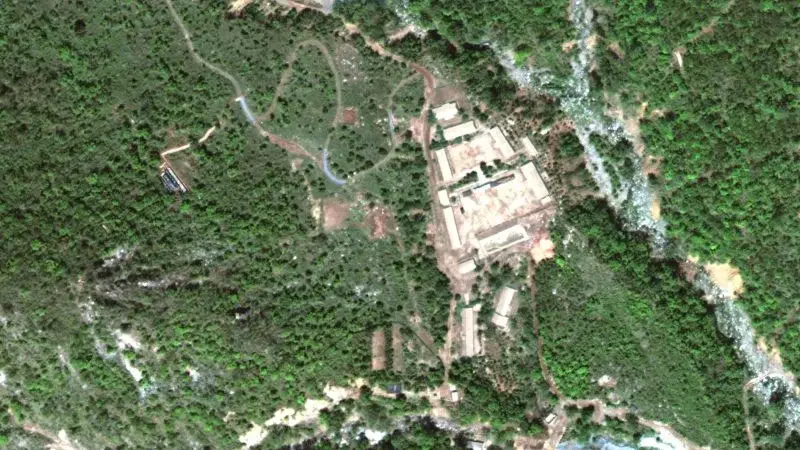
A study published in Science reveals that North Korea's six underground nuclear tests between 2006 and 2017 caused a sustained increase in seismic activity at the Punggye-ri test site. Researchers identified 1,399 earthquakes between 2008 and 2025, with activity intensifying years after the final 2017 detonation rather than fading. The findings suggest that repeated explosions reactivated pre-existing faults, potentially complicating future nuclear monitoring efforts.
Key points
- Researchers from South Korea and China analyzed seismic data from 2008 to 2025, identifying 1,399 earthquakes near Mount Mantap, North Korea's Punggye-ri nuclear test site.
- The final nuclear test in September 2017, estimated at 100 to 250 kilotons, triggered a magnitude 6.3 event and a subsequent cavity collapse, but seismic activity continued to increase for years afterward.
- Unlike typical post-test aftershocks that fade quickly, the seismicity at Mount Mantap intensified over time, suggesting that repeated explosions altered the mechanical balance of pre-existing faults.
- The study maps two fault-like structures running north-northwest from the site, with one potentially capable of producing a magnitude 6.4 earthquake if it ruptures entirely, though this remains a theoretical scenario.
- The findings complicate international monitoring efforts under the Comprehensive Nuclear-Test-Ban Treaty, as distinguishing between tectonic earthquakes and explosion-related seismic events becomes more difficult.
Background
This development follows earlier reports of North Korea restoring its nuclear test tunnels in 2022 and 2025, as noted by the International Atomic Energy Agency and US Defense Intelligence Agency. Recent diplomatic efforts, including South Korean President Lee Jae-myung's proposal to formally end the Korean War, have sought to address Pyongyang's nuclear capabilities, while the IAEA has flagged new uranium enrichment sites, indicating a continued expansion of North Korea's nuclear program.
How outlets are covering it
CNN and Scientific American emphasize the anomaly of the seismic activity, noting that while underground tests typically cause short-lived disturbances, the activity at Mount Mantap has persisted and increased for years. ScienceAlert and Gizmodo highlight the technical details, such as the use of matched-filter detection to identify small earthquakes and the mapping of two distinct fault structures. All sources agree that the findings challenge previous assumptions about the short-term nature of nuclear test impacts, with Columbia University seismologist Paul Richards describing the situation as 'potentially dangerous' due to the possibility of larger future earthquakes.
Why it matters
The discovery that underground nuclear tests can trigger long-term seismic activity has significant implications for global nuclear monitoring and verification. It suggests that the geological consequences of such tests may persist for decades, complicating the ability to distinguish between natural tectonic events and artificial explosions. This could impact the effectiveness of the Comprehensive Nuclear-Test-Ban Treaty and require extended monitoring periods at legacy test sites worldwide.
What to watch
Researchers will continue to monitor seismic activity at Punggye-ri to determine if the trend of increasing earthquakes continues. International bodies may need to adjust their monitoring protocols to account for long-term seismic effects of nuclear tests. Additionally, the findings may influence future diplomatic negotiations regarding North Korea's nuclear program, as the long-term geological impacts of testing could be a factor in discussions about disarmament and verification.
- Area near North Korean nuclear site has experienced nearly 1,400 quakes CNN
- North Korea’s nuclear tests have turned this mountain into an earthquake hot spot Scientific American
- North Korea Stopped Nuclear Testing in 2017 – But Triggered Nearly 1,400 Earthquakes Since ScienceAlert
- North Korea’s Underground Nuclear Tests Are Reactivating Dormant Earthquake Fault Lines Gizmodo
- North Korea’s 2017 Nuclear Test Was Followed by Years of Rising Earthquake Activity | Ukraine news - #Mezha Межа. Новини України.
Want the full story? Read the original reporting
Read on CNN