
UK and Channel Islands witness near-total solar eclipse as Europe sees totality
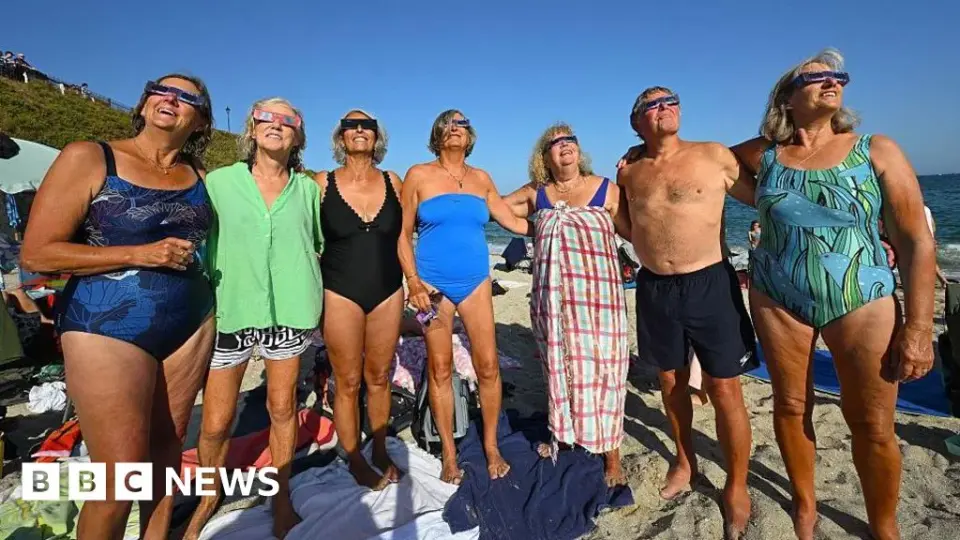
On August 12, 2026, a partial solar eclipse covered 94-96% of the Sun in the UK's South West and Channel Islands, peaking at 19:15 BST. While the UK saw a partial event, parts of Spain, Iceland, and Greenland experienced total darkness. The event coincided with the UK's fifth heatwave, with temperatures exceeding 30C. The next UK total eclipse is not until 2090.
Key points
- The Moon covered 94-96% of the Sun in Devon, Cornwall, Jersey, and Guernsey at peak time of 19:15 BST.
- The eclipse lasted approximately one hour and 50 minutes, beginning around 18:20 and ending by 20:10 BST.
- Crowds gathered in Falmouth, Sidmouth, and Guernsey, with many sharing eclipse glasses due to limited availability.
- The event coincided with the UK's fifth heatwave, with temperatures breaking the 30C threshold.
- The next total solar eclipse visible from the UK is not until 2090, making this a rare event.
Background
This eclipse was anticipated as the UK's most dramatic partial view since 1999, with earlier forecasts predicting 90-96% coverage in the South West. The event was part of a global phenomenon, with total eclipses visible in parts of Europe and North America. Previous archive notes highlighted the importance of using certified eclipse glasses to avoid eye damage and the rarity of such events in the UK.
How outlets are covering it
BBC emphasized the community aspect of the event, noting that many people shared eclipse glasses and described it as a 'lovely community event.' CNN focused on the global scale, highlighting the path of totality across Greenland, Iceland, and Spain, and the scientific aspects of the eclipse, such as shadow bands and the moon's orbit. NPR provided a visual perspective, showcasing photos from various locations across Europe, including Spain, Iceland, and the UK, emphasizing the widespread interest and participation.
Why it matters
This event highlights the rarity and significance of solar eclipses, particularly in the UK, where total eclipses are extremely rare. It also underscores the importance of safety measures, such as using certified eclipse glasses, to prevent eye damage. The event served as a reminder of the moon's gradual movement away from Earth, which will eventually make total solar eclipses impossible.
What to watch
The next partial solar eclipse visible in the UK is not until 2090, and the next total solar eclipse in the contiguous US is in 2044. Scientists continue to study the moon's orbit and the effects of tidal forces on its distance from Earth, which will impact future eclipse visibility.
- Solar eclipse in South West and Channel Islands gets under way BBC
- Live updates: Total solar eclipse sweeps across Europe CNN
- Photos: See the best photos from the solar eclipse : The Picture Show NPR
- Millions in UK and Europe left wowed by once-in-a-generation solar eclipse BBC
- WATCH: Total solar eclipse darkens skies over Spain, Iceland PBS
Want the full story? Read the original reporting
Read on BBC