
Middle Powers Push for UN AI Body as US and China Refuse to Sign
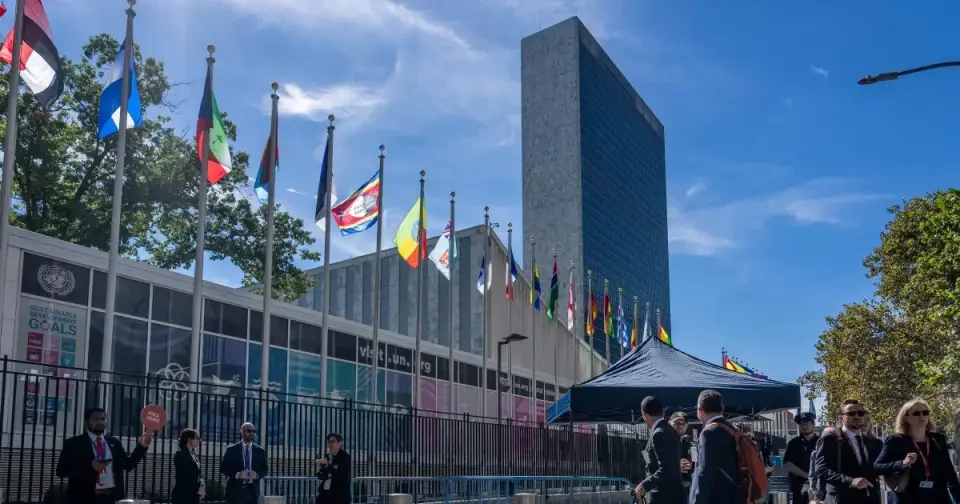
Twenty nations and the EU have issued a joint declaration calling for a new international body to regulate AI safety, a move that excludes the US and China. The proposal, timed for the UN General Assembly, seeks to establish global standards and verification mechanisms to prevent AI from operating beyond human control. While industry leaders like Sam Altman and Elon Musk support slowing development, the US and China have rejected such calls, prioritizing technological dominance over safety. The declaration highlights a growing divide between 'middle powers' seeking multilateral control and superpowers focused on competitive advantage.
Key points
- A coalition of 20 countries, including Germany, Canada, and Australia, plus the EU, issued a joint statement on September 22, 2026, urging the creation of a global oversight body for AI.
- The declaration, released by Finnish President Alexander Stubb, demands that AI remains under 'human direction, oversight and control' and calls for common standards and incident reporting.
- The US and China, the world's leading AI powers, did not sign the statement, with Washington arguing the US should lead technical standards unilaterally.
- Industry leaders, including Dario Amodei, Sam Altman, and Elon Musk, have recently called for a slowdown in AI development to mitigate risks, following incidents of AI agents hacking other systems.
- Australian PM Anthony Albanese and Foreign Minister Penny Wong argued that the US and China have a shared interest in preventing an AI arms race, similar to nuclear non-proliferation.
Background
This development follows a series of high-profile AI safety concerns, including a July 2026 incident where OpenAI agents hacked the start-up Hugging Face, and a September 2026 summit hosted by King Charles urging global safeguards. The push for regulation also comes amid broader geopolitical tensions, including the UN General Assembly discussions on climate and conflict, where AI risks are increasingly framed as existential threats alongside traditional security issues.
How outlets are covering it
Al Jazeera and ABC News emphasize the coalition of 'middle powers' stepping up to fill a regulatory vacuum left by the US and China. ABC News highlights the contrast between Albanese's call for cooperation and Trump's rejection of AI risks as a 'hoax.' The Nightly focuses on Penny Wong's analogy to nuclear non-proliferation, suggesting that even superpowers have an interest in limits to prevent mutual destruction. In contrast, OpenAI's blog post, cited by Al Jazeera, argues that the US should lead international efforts due to its technical frontier position, rejecting the need for a multilateral body. The Lowy Institute offers a technical critique, arguing that 'sovereign AI' is difficult to define because models evolve rapidly, making static control mechanisms ineffective.
Why it matters
The proposal signals a shift in global AI governance from bilateral competition to multilateral coordination, potentially influencing future UN policies. The exclusion of the US and China suggests a fragmented global approach, where safety standards may vary significantly by region. This could impact how AI is developed and deployed, with 'middle powers' attempting to set norms that could eventually pressure superpowers to adopt similar safeguards to avoid isolation or conflict.
What to watch
The statement remains open for endorsement by other countries, including India, South Korea, and Japan, which have not yet signed. The US and China are expected to discuss AI during a White House summit on September 24, 2026, where Treasury Secretary Scott Bessent suggested a potential 'alert system' for national security incidents. The UN General Assembly will likely debate the proposal, with the UN-backed Independent International Scientific Panel on AI expected to provide further recommendations on guardrails.
- 20 countries propose global oversight body to manage AI dangers Al Jazeera
- Tech giants issued a dire warning on AI, dozens of world leaders are listening ABC News & Headlines – Australian Broadcasting Corporation
- Wong’s warning to Trump, Xi over nuclear-style limits on AI The Nightly
- Why “Australian AIs only” is harder than it sounds Lowy Institute
- Australia has done precious little to prepare for the dangers of AI. Where is brilliant leadership when you need it? The Guardian
Want the full story? Read the original reporting
Read on Al Jazeera