
Iran and UAE Signal Thaw at BRICS Summit Amid Ongoing West Asia War
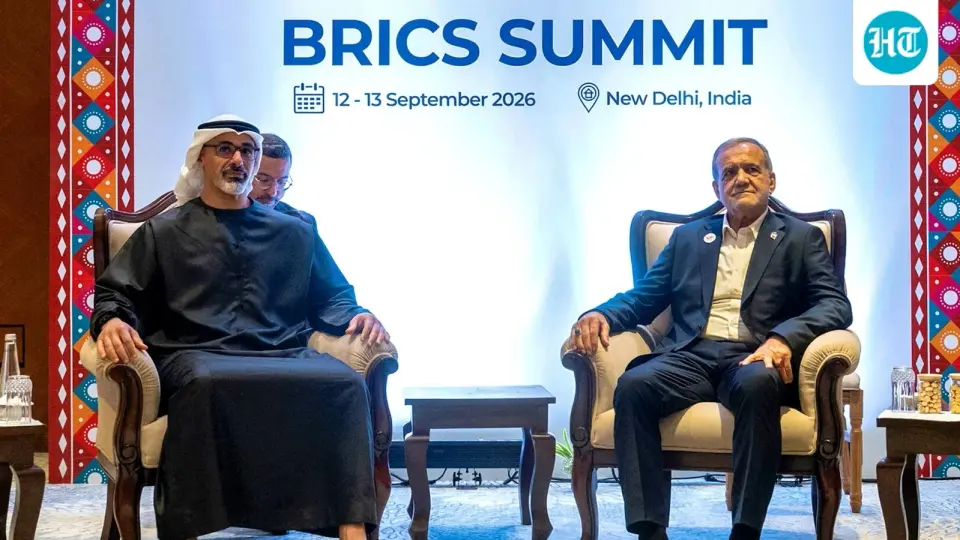
Iranian President Masoud Pezeshkian and UAE Crown Prince Khaled bin Mohamed bin Zayed Al Nahyan met in New Delhi on September 12, 2026, marking the highest-level contact between the two nations since the US-Israeli war with Iran began in February. Pezeshkian stated that both countries aim to 'turn the page' and look to the future, despite the UAE's August suspension of trade and financial ties with Tehran. The meeting occurred on the sidelines of the BRICS Summit, where leaders signed a joint declaration urging maximum restraint in the West Asia conflict. While the UAE emphasized that trust must be rebuilt through actions rather than words, the dialogue suggests a strategic shift toward managing regional risks rather than escalating confrontation. The talks took place amid ongoing tensions over the Strait of Hormuz, where Iran and Oman are preparing to sign a joint shipping route agreement in Muscat on September 14, a move the UAE opposes as it seeks to maintain free international navigation.
Key points
- Iranian President Masoud Pezeshkian and UAE Crown Prince Khaled bin Mohamed bin Zayed Al Nahyan held their first high-level meeting since the February 2026 start of the West Asia war, occurring on September 12, 2026, in New Delhi.
- Pezeshkian stated that both nations agreed to 'turn the page' and build the future together, describing the exchange as constructive despite the UAE's August 19 suspension of all trade and financial transactions with Iran.
- The UAE's diplomatic adviser Anwar Gargash emphasized that trust must be rebuilt through actions, not words, and that the UAE views engagement with Iran as strategic hedging to avoid becoming a frontline state in regional conflicts.
- Both countries backed the BRICS New Delhi Declaration, which called for maximum restraint in the Middle East conflict, protection of civilians, and cooperation to maintain global trade and energy flows.
- Iran and Oman are set to sign an agreement in Muscat on September 14, 2026, establishing a joint shipping route through the Strait of Hormuz, a move the UAE opposes as it insists the strait must remain open to free international navigation.
- US President Donald Trump dismissed the planned Gulf states-Iran meeting in Oman, stating 'I don't care. That's up to them,' during a visit to Ireland, while Iran's President Pezeshkian vowed that Tehran will not surrender to US pressure.
Background
The West Asia conflict began on February 28, 2026, following US-Israeli attacks on Iran, which prompted Tehran to strike US allies in the region, with the UAE facing significant impact. In August 2026, the UAE suspended trade and financial exchanges with Iran, citing regional escalation. Prior to the BRICS Summit, Iranian President Pezeshkian had addressed Indian religious leaders in New Delhi on September 11, 2026, vowing that Iran would not surrender to US and Israeli pressure. The BRICS Summit, chaired by India, focused on reforming global institutions and addressing energy security concerns, particularly for countries like India that import nearly 85% of their fuel needs through the Strait of Hormuz.
How outlets are covering it
Hindustan Times emphasized the symbolic nature of the Iran-UAE meeting, highlighting Pezeshkian's statement that both countries want to 'turn the page' and build the future together, framing it as a potential diplomatic thaw. CNBC focused on Pezeshkian's broader defiance of US pressure, noting his assertion that Iran will not surrender and his meeting with Indian Prime Minister Narendra Modi, who urged dialogue to resolve the Middle East conflict. Euronews provided a more cautious perspective, quoting UAE diplomatic adviser Anwar Gargash, who stressed that trust must be rebuilt through actions and that the UAE views engagement with Iran as strategic hedging rather than a full reconciliation. Euronews also highlighted the UAE's firm position against Iran's proposed joint shipping route with Oman in the Strait of Hormuz, contrasting it with Iran's insistence on controlling the waterway until the US ends its blockade. The three outlets collectively portray a complex diplomatic landscape where Iran and UAE are seeking to manage tensions without fully restoring trust, amid broader BRICS efforts to promote restraint and global trade stability.
Why it matters
The Iran-UAE meeting signals a potential shift in regional dynamics, as both nations seek to mitigate the impact of the West Asia war on their economies and security. The UAE's suspension of trade with Iran in August 2026 had significant implications for Iran's economy, particularly given Dubai's role as an economic lifeline for Tehran. The BRICS Summit's joint declaration urging maximum restraint and cooperation on global trade and energy flows reflects a broader effort by emerging economies to counter unilateral sanctions and maintain stability in critical waterways like the Strait of Hormuz. The planned Iran-Oman shipping route agreement in Muscat could further complicate regional tensions, as the UAE opposes any single state's control of the strait. These developments underscore the ongoing struggle between diplomatic engagement and strategic hedging in the Middle East, with implications for global energy markets and international relations.
What to watch
The next key development will be the signing of the joint Iran-Oman shipping route agreement in Muscat on September 14, 2026, which could further strain Iran-UAE relations if the UAE views it as a violation of free navigation principles. The International Maritime Organisation is expected to be informed of the agreement, potentially leading to international scrutiny. Additionally, the ongoing US-Iran conflict and the US naval blockade of the Strait of Hormuz will continue to shape regional dynamics, with Iran's President Pezeshkian indicating that the strait will reopen only after the US ends its blockade. The BRICS Summit's focus on reforming global institutions and promoting national currencies for trade may also influence future diplomatic and economic strategies in the region.
- Iran wants to ‘turn the page’ with UAE, says Pezeshkian day after meeting Crown Prince during BRICS Summit | World News Hindustan Times
- Tehran won’t surrender to the U.S., Iranian President Pezeshkian says, as India's Modi urges dialogue and peace CNBC
- 'I don't care': Trump on Gulf-Iran talks at Brics Summit The Times of India
- UAE and Iran discuss easing tensions at BRICS summit Euronews.com
- India's Modi stresses need to protect navigation, seafarers in talks with Iran's Pezeshkian Reuters
Want the full story? Read the original reporting
Read on Hindustan Times