
Moscow Patriarchate Sends Medieval Prince's Hand Relic to Ukraine Frontline Amid Heavy Casualties
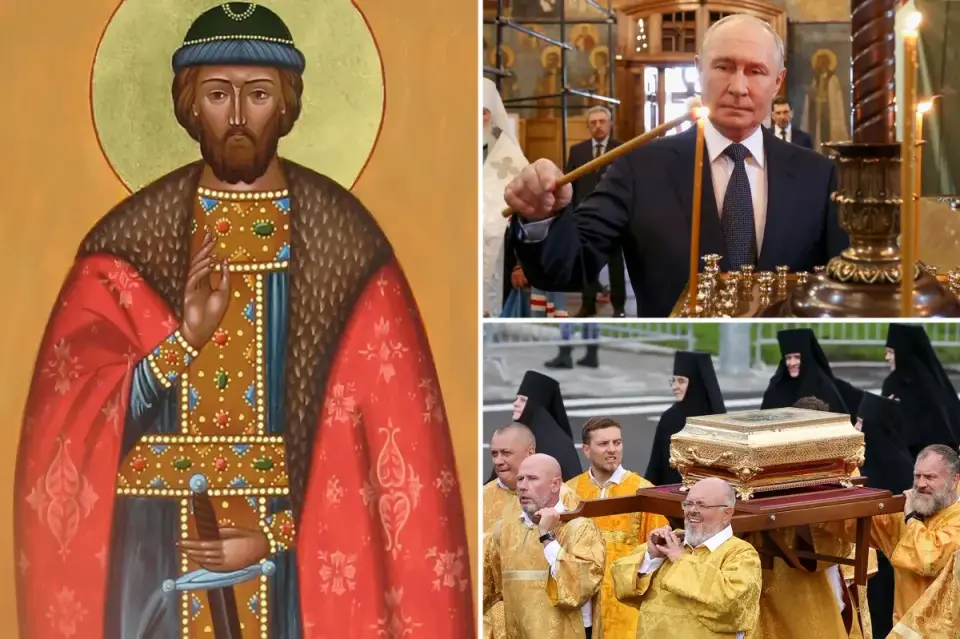
The Moscow Patriarchate has dispatched a fragment of the right hand of 14th-century Grand Prince Dmitry Donskoy to Russian troops in occupied Donetsk, claiming it will provide spiritual strength. The relic, uncovered during Kremlin renovations, was paraded in a massive Moscow procession before being sent to the front. Critics argue this move reflects the church’s deep integration into the war effort as Russia faces high casualties in its fifth year of conflict.
Key points
- The Russian Orthodox Church sent a relic of Grand Prince Dmitry Donskoy’s right hand to the frontline in Donetsk, stating it would 'spiritually strengthen' soldiers.
- Donskoy, canonized in 1988, is revered for defeating the Mongol Golden Horde in 1380; his remains were uncovered during restoration work at the Kremlin’s Archangel Cathedral this summer.
- The relic was first displayed in a citywide Moscow procession on September 6, drawing approximately 100,000 participants, before being transported to the Savur-Mohyla war memorial in occupied Ukraine.
- Ukraine reports over 42,000 Russian battlefield casualties in July alone, prompting critics to view the relic deployment as a desperate morale-boosting tactic amid heavy losses.
- Patriarch Kirill and President Putin have closely linked the church’s role to the war, with the church previously sending priests and icons to support the 'special military operation'.
Background
This development follows earlier reports in September 2026 confirming the relic’s dispatch to the front. It occurs amid ongoing Russian manpower strains, including isolated troops on the Kinburn Peninsula and high casualty rates. The move mirrors previous symbolic actions, such as sending relics of Alexander Nevsky to the front earlier in 2026, and contrasts with Ukrainian efforts to demoralize Russian troops through drone footage and propaganda.
How outlets are covering it
The New York Post and The Guardian emphasize the symbolic and morale-boosting intent of the relic, noting the church’s explicit statement that the prince would 'stand shoulder-to-shoulder' with soldiers. The Independent frames the action as a 'desperate bid' amid heavy casualties, highlighting the church’s 'rabid embrace' of the Kremlin’s war. Novaya Gazeta Europe provides a ground-level perspective, describing the Moscow procession as a blend of religious observance and ultranationalist politics, with participants carrying slogans like 'We won at Kulikovo Field, we’ll win again now.' Critics, including historian Alexander Zanemonets, argue the exhumation and deployment of the relic reflect wartime patriotism overriding religious protocol, while some participants in the procession questioned the fusion of religious and political loyalty, noting that some attendees 'believe in Putin more than God.'
Why it matters
The deployment of a medieval relic to the frontline underscores the deepening intertwining of religious and military institutions in Russia’s war effort. It signals a shift toward symbolic and spiritual morale strategies as Russia faces sustained high casualties and slow battlefield progress. The move also highlights the Kremlin’s use of historical narratives to legitimize the conflict, framing it as a continuation of medieval victories against external threats. For observers, it illustrates the extent to which the Russian Orthodox Church has become embedded in the state’s war machinery, potentially alienating more moderate religious voices and reinforcing the perception of the war as a national-religious crusade.
What to watch
The relic is expected to be displayed among Russian combat units in the Donetsk region, with further religious processions and prayers likely to be organized to sustain morale. The Moscow Patriarchate may continue to leverage historical symbols and relics to support the war effort, while critics may intensify scrutiny of the church’s role in the conflict. The broader impact on troop morale remains uncertain, but the move is likely to be cited in discussions of Russia’s evolving propaganda and religious-military strategies.
- Russian troops gifted dead prince’s hand in bizarre bid to boost morale as Kremlin suffers mass casualties nypost.com
- Orthodox church sends medieval prince’s remains to Russian troops in Ukraine The Guardian
- The Kremlin Tries A New Weapon For Its War: The Relics Of A 14th-Century Saint Radio Free Europe/Radio Liberty
- Putin sends bones of medieval warrior to Ukraine frontline in desperate bid to boost morale The Independent
- ‘We are Russians, and God is with us!’. Moscow’s ultranationalist march is effectively back, rebranded as a religious procession. Here’s what it looked like this year. Новая газета Европа
Want the full story? Read the original reporting
Read on nypost.com