Birth Order Across the Human Phenome: Broad Patterns in Disease Risk
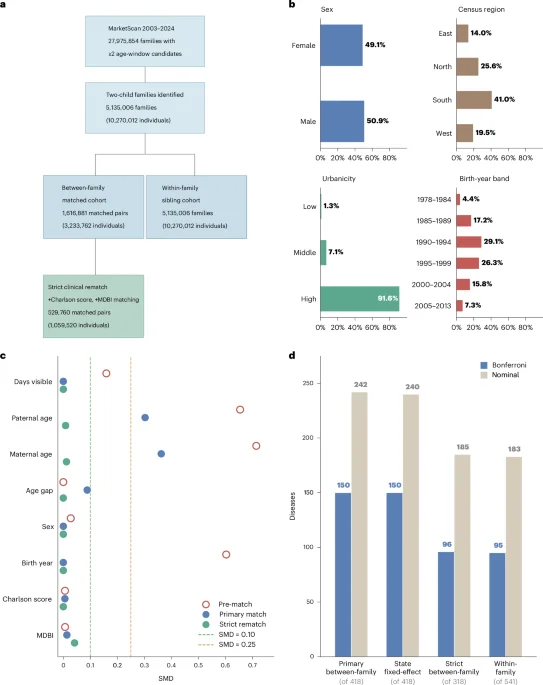
Two designs in over 5 million two‑child families from Merative MarketScan scanned 569 diseases. The primary between‑family matched cohort (1.6 million pairs) and a within‑family sibling comparison (5.1 million families) identified 150 Bonferroni‑significant birth‑order associations among 418 diseases. First‑borns have higher risk for neurodevelopmental and immune/allergic conditions (e.g., other/unspecified PDD, autism, food allergy, allergic rhinitis) while second‑borns show higher odds for substance‑abuse disorders and certain digestive diseases (gastritis/duodenitis). Across designs, effects are broadly concordant (r ≈ 0.66; 74% concordant; 84.7% of Bonferroni hits agree in direction), robust to state fixed effects and full‑sibling restrictions. A phenome‑wide atlas reveals domain‑specific patterns: first‑born excess dominates neuropsychiatric conditions; second‑born excess appears in digestive, musculoskeletal, infectious and some neurological diseases. The study provides a comprehensive, robust map of birth‑order influences on human disease and shows spacing between siblings can modulate several associations.