
Global Night Lights Pulse: Rapid Brightening and Dimming Across the Planet (2014–2022)
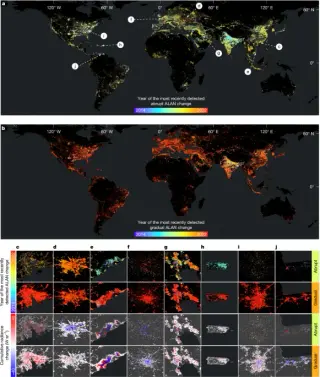
A global analysis using daily NASA Black Marble night-time lights and continuous change detection (2014–2022) shows that artificial illumination is highly volatile, with locations undergoing multiple abrupt or gradual changes. The study finds 2.05 million km2 of abrupt ALAN changes and 19.04 million km2 of gradual changes, totaling far more area affected by changes than previously thought. Net radiance rose about 16% since 2014, driven by brightening (34% of the 2014 baseline) that outpaced dimming (−18%). Regions experience both directions of change, driven by factors such as urban expansion, rural electrification, gas-flaring reductions, and energy access disruptions. Asia (notably China and India) accounts for the largest cumulative change, Europe shows pronounced dimming linked to regulations, and some regions (e.g., Venezuela) dim due to economic collapse. The work challenges the view that night-time lights only steadily intensify and highlights the need to consider bidirectional, high-frequency dynamics for policy, energy transitions, and ecological implications. Open datasets and code accompany the work for global ALAN change mapping and analysis.