Tag

Authentication Bypass

All articles tagged with #authentication bypass

Xen Orchestra Critical Flaw Allows Unauthenticated Admin Access via Empty JSON Cookie
cybersecurity5 hours ago

Xen Orchestra Critical Flaw Allows Unauthenticated Admin Access via Empty JSON Cookie

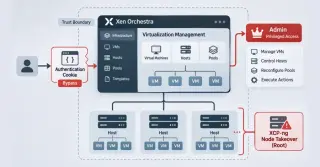
A critical vulnerability in Xen Orchestra, a management tool for XCP-ng and XenServer infrastructure, has been identified and is actively exploited in the wild. The flaw, designated CVE-2026-133469, stems from improper handling of REST cookie parsing, where an empty JSON object is accepted as a valid authentication token. This allows attackers to bypass login requirements and assume the identity of any unexpired user token, granting full administrative control. The issue affects versions prior to 6.9.2 and 6.10.1, with patches released to mitigate the risk. The vulnerability carries a CVSS score of 9.8, indicating severe impact on confidentiality, integrity, and availability.
MISP 2.5.52 Patch Fixes Unicode and NUL-Byte Flaws in Login Lockout
security6 hours ago

MISP 2.5.52 Patch Fixes Unicode and NUL-Byte Flaws in Login Lockout

MISP has released version 2.5.52 to address CVE-2026-135261, a medium-severity vulnerability that allowed attackers to bypass login and OTP lockout mechanisms. The flaw stemmed from inconsistent Unicode case-folding and improper handling of NUL bytes, enabling unlimited authentication attempts and user enumeration. The fix canonicalizes email addresses and strips NUL bytes from passwords to ensure consistent error responses.

MISP 2.5.51 and earlier expose login lockout bypass via Unicode and NUL-byte flaws
security6 hours ago

MISP 2.5.51 and earlier expose login lockout bypass via Unicode and NUL-byte flaws

MISP versions prior to 2.5.52 contain multiple flaws in its authentication lockout mechanism that allow unauthenticated attackers to bypass brute-force protections, enumerate usernames, and potentially take over accounts. The vulnerabilities stem from improper handling of Unicode case folding, database collation, and NUL bytes in password fields. CIRCL has assigned a CVSS 4.0 score of 6.9 (Medium) to the issue, which has been patched in version 2.5.52.

MISP Type Confusion Flaw Lets Users Steal API Keys of Adjacent Accounts
security6 hours ago

MISP Type Confusion Flaw Lets Users Steal API Keys of Adjacent Accounts

A medium-severity vulnerability in MISP allows authenticated users to generate API keys for other users by exploiting a type confusion error in the authentication key creation endpoint. The flaw occurs when a floating-point value is submitted as a user identifier; the authorization check truncates the value to match the attacker’s account, while the persistence layer rounds it to the next sequential account. This discrepancy grants the attacker unauthorized access to the target user’s data and operations. The issue affects MISP versions prior to 2.5.52 and has been assigned CVSS score 5.3. A patch is available that enforces strict type validation, rejecting non-integer inputs before they reach the storage layer.

Devolutions Server Flaw Allows Replay of Emergency Admin Codes
security7 hours ago

Devolutions Server Flaw Allows Replay of Emergency Admin Codes

A vulnerability in Devolutions Server versions prior to 2026.3.15 allows attackers to create persistent administrator sessions by replaying single-use emergency login codes. The flaw, identified as CVE-2026-133229, stems from improper authentication on the scripting login endpoint. Users are advised to update to version 2026.3.15 or later to mitigate the risk.

Future AGI patches cross-tenant SAML flaw in 1.51.0 release
cybersecurity7 hours ago

Future AGI patches cross-tenant SAML flaw in 1.51.0 release

Future AGI has released version 1.51.0 to fix CVE-2026-135157, a high-severity authentication bypass in its SAML implementation. The flaw allowed authenticated users to hijack accounts in other organizations by asserting arbitrary email addresses via the ACSView endpoint. The vulnerability, rated 8.6 on the CVSS 4.0 scale, also permitted attackers to modify or delete identity provider configurations for other tenants. The fix is available in the latest release, and no active exploitation has been reported.

Gradio 6.32.0 Patch Closes Host Header Spoofing Flaw in History Module
cybersecurity23 hours ago

Gradio 6.32.0 Patch Closes Host Header Spoofing Flaw in History Module

A medium-severity vulnerability in Gradio versions 6.27.0 through 6.31.0 allows remote attackers to bypass authentication by sending a forged Host header. The flaw, located in the history module, enables unauthorized access to Hugging Face tokens when server-side rendering is enabled. A patch is available in version 6.32.0.

MemberPress Plugin Flaw Lets Attackers Bypass WordPress Private Site Mode
cybersecurity1 day ago

MemberPress Plugin Flaw Lets Attackers Bypass WordPress Private Site Mode

A medium-severity authentication bypass vulnerability, identified as CVE-2026-134748, affects the Members WordPress plugin by MemberPress in versions 3.2.28 through 3.3.1. The flaw allows unauthenticated attackers to evade Private Site mode by exploiting a login page exemption, enabling them to view hidden published content or the full blog index. A patch is available in version 3.3.2.

Cockpit-HQ ignores report on auth bypass flaw in cron.php
cybersecurity2 days ago

Cockpit-HQ ignores report on auth bypass flaw in cron.php

A medium-severity vulnerability, CVE-2026-133990, has been identified in Cockpit-HQ Cockpit versions up to 2.14.1. The flaw, located in the Web Worker component's cron.php file, allows remote attackers to bypass authentication by manipulating the 'token' argument. Although the exploit is publicly available, exploitation is considered difficult due to high complexity requirements. The vendor has not responded to the disclosure.

Broadcom Patches Critical VMware vCenter Auth Bypass Flaw
security4 days ago

Broadcom Patches Critical VMware vCenter Auth Bypass Flaw

Broadcom has released patches for a critical authentication bypass vulnerability in VMware vCenter, rated 9.8 on the CVSS scale. The flaw, identified by Mandiant, allows attackers with network access to bypass login controls in the VMware Directory Service. Fixed versions are available for vCenter 8.0, 9.0, and 9.1, as well as related cloud foundation products. No public exploit code or active attacks have been reported, but Broadcom advises immediate updates as no workarounds are provided.

Citrix patches 12 NetScaler flaws, including critical authentication bypass
security11 days ago

Citrix patches 12 NetScaler flaws, including critical authentication bypass

Citrix has released security updates for 12 vulnerabilities affecting NetScaler ADC, Gateway, Console, and Secure Access Client. The most severe issue, CVE-2026-120869, allows unauthenticated attackers to bypass authentication controls on NetScaler Console. Other critical flaws involve memory corruption in various protocols, leading to denial-of-service risks. Citrix states no active exploitation has been observed but urges immediate patching.

Active Exploitation of Xen Orchestra Auth Bypass Flaw Enables Root Takeover
cybersecurity13 days ago

Active Exploitation of Xen Orchestra Auth Bypass Flaw Enables Root Takeover

Vates VMS warns that a critical authentication bypass vulnerability in Xen Orchestra is being actively exploited in the wild. The flaw, tracked as VSA-2026-062, allows attackers to bypass login requirements by sending a specially crafted cookie containing an empty JSON object. This grants the attacker administrative privileges, enabling arbitrary code execution on managed pools and full root access to XCP-ng nodes. The vendor has identified specific indicators of compromise, including a RedLine Stealer command-and-control server, and has released patches in versions 6.9.1 and 6.10.0.

OpenSSH 10.6p2 Patches Decade-Old 'SSHole' Flaw in Alpine Linux
security17 days ago

OpenSSH 10.6p2 Patches Decade-Old 'SSHole' Flaw in Alpine Linux

A critical vulnerability dubbed 'SSHole' allows attackers to bypass password authentication on certain Linux systems by submitting an overly long password. The flaw, present since 2016, affects systems using the musl C library without Pluggable Authentication Modules (PAM). OpenSSH released version 10.6p2 on November 5, 2026, to fix the issue, while Alpine Linux issued patches for all supported branches. No active exploitation has been reported, but administrators are urged to update immediately or disable password authentication.

security1 month ago

MongoDB C# Driver Patch Fixes Critical Auth Bypass in Shared Cluster Cache

MongoDB resolved a high-severity vulnerability in its C# driver that allowed attackers to bypass client certificate authentication by exploiting weak equality checks in the shared cluster cache. The flaw, fixed in version 3.13.0, enabled a malicious client to hijack another user's authenticated connection by matching only public certificate metadata, specifically the issuer and serial number, while ignoring the private key. This issue affected applications using the .NET driver where multiple clients shared a process-wide cluster registry, potentially allowing unauthorized database reads and writes under a victim's identity. The fix ensures that certificate comparisons now include private key validation, preventing credential-distinct clients from merging into a single authenticated pool.

Citrix NetScaler Flaws Trigger Urgent Patching as Active Exploitation Confirmed
cybersecurity3 months ago

Citrix NetScaler Flaws Trigger Urgent Patching as Active Exploitation Confirmed

Citrix has issued urgent patches for two critical vulnerabilities in NetScaler ADC and Gateway appliances, with the most severe flaw, CVE-2026-19490, now confirmed as actively exploited. The authentication bypass allows unauthenticated attackers to bypass security controls on specific configurations, prompting CISA to add it to its Known Exploited Vulnerabilities list. While initial reports indicated no active exploitation, subsequent telemetry from threat intelligence firms confirmed attempts, and CISA has mandated immediate remediation for federal agencies. Administrators are advised to upgrade to specific fixed versions and verify configurations for SAML and SIP ALG settings to mitigate risks.