Tag

Big G

All articles tagged with #big g

Gravity’s oldest constant remains unsolved after 340 years
science5 hours ago

Gravity’s oldest constant remains unsolved after 340 years

Space.com reports that the gravitational constant Big G—the oldest fundamental constant in physics—remains the least precisely known after 340 years. A decade-long effort led by NIST’s Stephan Schlamminger used a refined torsion‑balance experiment with an envelope bias to avoid “intellectual phase locking,” producing a Big G value slightly lower than CODATA’s standard. The result, among 17 measurements, suggests a possible revision to Earth's mass if correct, but the persistent discrepancies between experiments mean the fundamental mystery of gravity’s strength is not solved.

NIST's decade-long hunt keeps Big G from settling on a single precise value
science1 month ago

NIST's decade-long hunt keeps Big G from settling on a single precise value

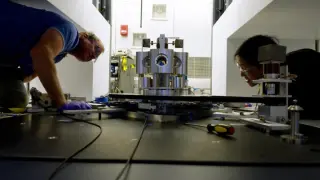
NIST researchers spent a decade replicating a Cavendish-style experiment to measure Big G, testing copper and sapphire masses with an electrostatic twist, and report G = 6.67387×10^-11 m^3/kg/s^2—about 0.0235% lower than the BIPM value. The result adds another data point but does not resolve the long-standing discrepancy, highlighting gravity’s weakness and Earth’s background noise as ongoing challenges — while advancing precision instrumentation and metrology.

A Decade-Long Hunt Keeps Gravity’s Constant Unsettled
science1 month ago

A Decade-Long Hunt Keeps Gravity’s Constant Unsettled

A decade-long effort by NIST to measure the universal gravitational constant G, using a torsion-balance setup and multiple test masses, produced a value of 6.67387×10^-11 m^3/(kg·s^2) that is 0.0235% lower than the BIPM's result, sustaining a small but persistent discrepancy among precision measurements. An unusual blinding step— a colleague secretly altered some data to hide the true result until the envelope reveal—meant Schlamminger only learned the outcome at the end. Although the difference is too small to affect everyday life, it keeps G as an open question and underscores the need for further, careful measurements.