Tag

Bipm

All articles tagged with #bipm

Global Timekeepers Abolish Leap Seconds, Replacing Them with a Distant Leap Hour
science1 month ago

Global Timekeepers Abolish Leap Seconds, Replacing Them with a Distant Leap Hour

The International Bureau of Weights and Measures (BIPM) has officially voted to abolish the leap second, a practice used since 1972 to synchronize atomic clocks with Earth's rotation. The change takes effect in May 2027, replacing the mechanism with a 'leap hour' that is unlikely to be needed for millennia. This decision aims to prevent catastrophic failures in global digital infrastructure, particularly the untested risk of a 'negative' leap second caused by recent changes in Earth's rotational speed.


Global timekeepers vote to replace leap seconds with rare leap hours
science1 month ago

Global timekeepers vote to replace leap seconds with rare leap hours

Delegates from 69 countries voted at the International Bureau of Weights and Measures (BIPM) in Versailles to abolish the leap second, replacing it with a 'leap hour' system effective May 2027. This move aims to prevent catastrophic failures in digital infrastructure caused by irregular time adjustments, particularly the unprecedented risk of a 'negative' leap second. While atomic clocks will now drift from Earth's rotation, the new system allows up to one hour of discrepancy before a correction is needed, a scenario unlikely to occur for thousands of years.

Versailles Summit: Global Powers Vote to Abandon Leap Seconds by 2027
science-and-technology1 month ago

Versailles Summit: Global Powers Vote to Abandon Leap Seconds by 2027

The International Bureau of Weights and Measures (BIPM) is holding a critical vote in Versailles to abolish the leap second, a mechanism used since 1972 to synchronize atomic clocks with Earth’s rotation. If approved, the change takes effect in May 2027, allowing Coordinated Universal Time (UTC) to drift from astronomical time. The move aims to prevent system crashes caused by irregular time adjustments and the unprecedented risk of a 'negative' leap second, potentially replacing it with a 'leap hour' correction in the distant future.

BIPM to vote on scrapping leap seconds to prevent digital chaos
technology1 month ago

BIPM to vote on scrapping leap seconds to prevent digital chaos

The International Bureau of Weights and Measures (BIPM) is voting this week in Versailles to eliminate the leap second, a mechanism used since 1972 to synchronize atomic clocks with Earth's rotation. If approved, the change takes effect in May 2027, allowing Coordinated Universal Time (UTC) to drift from astronomical time. The move aims to prevent system crashes caused by irregular time adjustments and the unprecedented risk of a 'negative' leap second, potentially replacing it with a 'leap hour' correction in over 3,000 years.

Global Timekeepers Vote to Abandon Leap Seconds, Risking a Future 'Leap Hour'
science1 month ago

Global Timekeepers Vote to Abandon Leap Seconds, Risking a Future 'Leap Hour'

International timekeepers are voting this week in Versailles to eliminate the leap second, a mechanism used since 1972 to synchronize atomic clocks with Earth's rotation. If approved, the change takes effect in May 2027, allowing Coordinated Universal Time (UTC) to drift from astronomical time. The move aims to prevent system crashes caused by irregular time adjustments and the unprecedented risk of a 'negative' leap second, potentially replacing it with a 'leap hour' correction in over 3,000 years.

Global timekeepers vote to abolish leap seconds, risking a future 'leap hour'
science1 month ago

Global timekeepers vote to abolish leap seconds, risking a future 'leap hour'

The International Bureau of Weights and Measures (BIPM) is voting this week in Versailles to eliminate the leap second, a mechanism used since 1972 to synchronize atomic clocks with Earth’s rotation. If approved, the change takes effect in May 2027, allowing Coordinated Universal Time (UTC) to drift from astronomical time. The move aims to prevent system crashes caused by irregular time adjustments and the unprecedented risk of a 'negative' leap second, potentially replacing it with a 'leap hour' correction in over 3,000 years.

Global Timekeepers Vote in Versailles to Abandon Leap Seconds
science-and-technology1 month ago

Global Timekeepers Vote in Versailles to Abandon Leap Seconds

The International Bureau of Weights and Measures (BIPM) is voting in Versailles to abolish leap seconds, which have been added 27 times since 1972 to align atomic clocks with Earth’s rotation. The move aims to prevent system crashes caused by time adjustments and avoid the unprecedented risk of a 'negative' leap second. If approved, Coordinated Universal Time (UTC) may drift from Earth’s rotation for centuries, potentially requiring a single 'leap hour' correction in the distant future.

BIPM to Vote on Establishing a Universal Lunar Time Standard
science3 months ago

BIPM to Vote on Establishing a Universal Lunar Time Standard

World powers are voting in October on a proposal to have the International Bureau for Weights and Measures (BIPM) establish a standard time for the Moon. This is necessary because lunar clocks tick 57 microseconds faster per day than Earth clocks due to gravitational time dilation, a discrepancy that threatens navigation and communication systems for upcoming US and Chinese lunar missions.

Big G Remains Elusive as a Decade of Gravity Tests Clash with CODATA
physics7 months ago

Big G Remains Elusive as a Decade of Gravity Tests Clash with CODATA

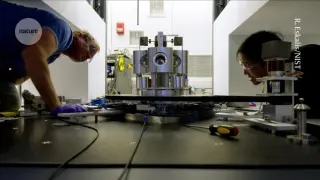
After a decade of cross‑Atlantic replication led by NIST, the new measurement of the gravitational constant G disagrees with both the 2013 BIPM result and CODATA’s current value, highlighting that Big G is still the least precisely known fundamental constant and that the true value remains unresolved despite improved methods (including a blinded measurement to reduce bias).

A Decade-Long Hunt Keeps Gravity’s Constant Unsettled
science7 months ago

A Decade-Long Hunt Keeps Gravity’s Constant Unsettled

A decade-long effort by NIST to measure the universal gravitational constant G, using a torsion-balance setup and multiple test masses, produced a value of 6.67387×10^-11 m^3/(kg·s^2) that is 0.0235% lower than the BIPM's result, sustaining a small but persistent discrepancy among precision measurements. An unusual blinding step— a colleague secretly altered some data to hide the true result until the envelope reveal—meant Schlamminger only learned the outcome at the end. Although the difference is too small to affect everyday life, it keeps G as an open question and underscores the need for further, careful measurements.