
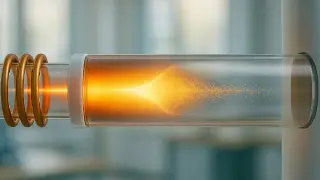
Lab Fireball Experiments Unravel Fallout Particle Chemistry
Lawrence Livermore researchers used a one-meter plasma flow reactor to heat uranium, cesium, and cerium (a plutonium stand-in) to about 5,000 K and observe how these elements condense as a simulated nuclear fireball cools under two cooling histories. Uranium and cerium condensed early in both scenarios, while cesium condensed later and formed more complex compounds when cooling was slower. These results could improve models for interpreting nuclear debris and help infer past conditions from fallout, though the setup is simplified and does not reproduce actual nuclear reactions. The work, published by Dhaoui et al. in Analytical Chemistry (2026), suggests moving beyond equilibrium models to capture cooling-rate effects and could extend to other high-temperature environments.