
Mouse brain areas resolve conflicts via dynamic consensus in visual cortex
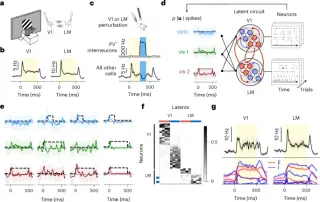
Researchers have identified a mechanism by which distinct areas of the mouse neocortex reconcile conflicting information to form coherent decisions. By analyzing simultaneous recordings from primary visual area (V1) and higher-order lateromedial (LM) areas, the study reveals that reciprocal excitatory connections create a 'line attractor' dynamic. This mechanism slows the decay of consistent activity patterns while accelerating the decay of inconsistent ones, allowing the brain to reach a consensus. The findings suggest that dynamic consensus building is a general principle of distributed cortical computation, resolving how specialized regions integrate into a unified percept.