
Tag

Colibre

All articles tagged with #colibre

Synthetic Cosmos Echoes Our Own in a Groundbreaking Computer Simulation
space1 month ago

Synthetic Cosmos Echoes Our Own in a Groundbreaking Computer Simulation

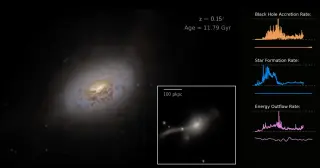
Astronomers have built COLIBRE, a large-volume synthetic universe that reproduces many properties of the real cosmos, including galaxy formation and dust/gas physics, by solving cosmological equations on the COSMA8 supercomputer over about 72 million CPU hours. The decade-long project supports the standard cosmological model by aligning with observations across eras, though it doesn't yet explain the JWST-detected “Little Red Dots” seen in the early universe.
Synthetic universe lets scientists hear galaxies' birth and growth across cosmic time
space1 month ago

Synthetic universe lets scientists hear galaxies' birth and growth across cosmic time

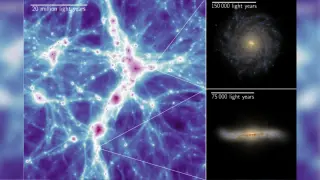
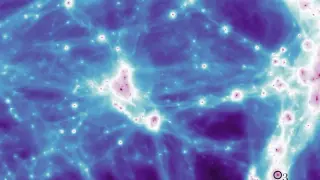
Scientists behind the COLIBRE project created synthetic universes that simulate galaxy formation from the first billion years after the Big Bang, modeling cold gas and dust physics on Durham’s COSMA8 supercomputer. The virtual galaxies reproduce many properties seen by the James Webb Space Telescope and reinforce the Lambda Cold Dark Matter cosmology, while also offering new audio-visual ways to explore cosmic evolution. The work, published in Monthly Notices of the Royal Astronomical Society, highlights progress and also ongoing mysteries JWST has revealed, such as enigmatic faint red dots that COLIBRE can’t yet explain.

Cosmic Dawn Simulations Reproduce Early Galaxies with Realistic Dust and Gas
science1 month ago

Cosmic Dawn Simulations Reproduce Early Galaxies with Realistic Dust and Gas

New COLIBRE cosmological simulations include detailed physics for cold gas, dust (three grain types in two sizes), and powerful star/black hole outflows to model the early universe. The virtual universe produced by these high‑fidelity models resembles real JWST observations, suggesting that the presence of large early galaxies can fit standard cosmology when richer physics is included. The work, which required vast compute (about 72 million CPU hours), also highlights ongoing puzzles like the Little Red Dots. The study is published in Monthly Notices of the Royal Astronomical Society.