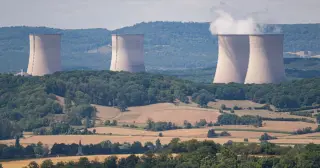
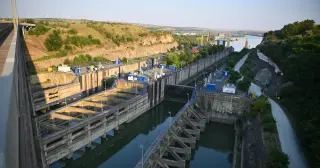
Climate change is making Europe’s nuclear expansion riskier: heatwaves and droughts are limiting cooling water, triggering reactor outages and forcing governments to rethink where and how new plants are built, while industry pushes resilience investments and coastal siting to cope with warming conditions.
Record heat and shrinking river levels across Europe are forcing nuclear plants to throttle or shut down, with Hungary’s Paks near the Danube at risk, Romania facing possible shutdown of its last reactor after water-diversion attempts, and France seeing a 20% drop in production due to drought and jellyfish, highlighting climate-driven risks to electricity supply.
Hungary will shut down its only nuclear plant, the Paks facility, after record-low Danube water levels left insufficient cooling for its reactors; output has fallen far below the usual level (about 2,000 MW) to 965 MW on Friday and 240 MW overnight, prompting water-use restrictions and drawing regional monitoring as climate-driven heat and drought disrupts energy, shipping, and industry.
Ukraine's Zaporizhzhya Nuclear Power Plant is planning to resume pumping water that still remains accessible despite a major loss of water in the Kakhovka reservoir caused by the destruction of the downstream dam earlier this month. The IAEA has increased its presence at the ZNPP in order to monitor compliance with the five basic principles for protecting the plant during the military conflict that were established by Director General Grossi at the United Nations Security Council in late May. The nuclear safety and security situation at the Zaporizhzhya Nuclear Power Plant is extremely fragile.
The Zaporizhzhya Nuclear Power Plant in Ukraine is still pumping cooling water from the Kakhovka reservoir, despite the water level dropping to a critical point due to a breached dam. The International Atomic Energy Agency (IAEA) has assessed that the pumps can still operate even if the water level drops to around 11 metres or possibly lower. The IAEA experts have requested access to the location where the reservoir’s water level is measured and the Zaporizhzhya Thermal Power Plant discharge channel adjoining the ZNPP to independently verify the status of the cooling water systems.
The International Atomic Energy Agency (IAEA) has reported that work is ongoing at Ukraine’s Zaporizhzhya Nuclear Power Plant (ZNPP) to ensure it has maximum amounts of cooling water in reserve, in case it can no longer access the nearby Kakhovka reservoir which is continuing to drop after its downstream dam was damaged earlier this week. The hourly loss rate has slowed slightly, but if the current drop rate were to continue, the 12.7 metre level could be reached within the next two days. The possible lack of access to the Kakhovka reservoir has underlined the need to keep the ZNPP’s other water sources intact, particularly the large cooling pond near the site, as well as the discharge channel of the nearby Zaporizhzhya Thermal Power Plant (ZTPP) which is used to bring water from the reservoir to the ZNPP site.