Tag

Diffusion

All articles tagged with #diffusion

Why Sunlight Takes 170,000 Years to Reach Earth
space22 days ago

Why Sunlight Takes 170,000 Years to Reach Earth

Sunlight that reaches Earth today began its journey deep inside the Sun. In the dense core and radiative zone, photons propagate by a random walk, with a mean free path of about 0.09 cm and billions of absorptions/re-emissions that prevent a straight path. This diffusion takes roughly 170,000 years on average, and only when photons reach the photosphere do they escape into space, taking about eight minutes and twenty seconds to reach Earth. Separately, astronomers measured extragalactic background light and estimate that about 10 billion ancient photons from distant galaxies strike your skin each second outdoors, underscoring that much light comes from far beyond the Sun.


Sunlight’s Hidden Odyssey: 170,000 Years to Escape the Sun
science1 month ago

Sunlight’s Hidden Odyssey: 170,000 Years to Escape the Sun

Sunlight takes about 8 minutes to reach Earth, but the energy moves outward from the Sun’s core via a random-walk diffusion process. A 1992 study showed the journey is much longer than straight-line travel, and a density‑varying model revealed the photon step length is under 0.1 cm for most of the Sun’s interior, pushing the diffusion time from tens of thousands of years to roughly 170,000 years before the photons reach the surface and head to Earth.

Light as a Nanoscale Brake: Quantum Friction Slows Nanotubes in Water
science1 month ago

Light as a Nanoscale Brake: Quantum Friction Slows Nanotubes in Water

Scientists report that shining light on fluorescent carbon-mesh nanotubes suspended in water slows their diffusion due to light-induced quantum friction: excited electrons (excitons) couple with nearby water and transfer momentum, effectively acting as a nanoscale brake. The slowdown grows with light intensity and vanishes when exciton mobility is hindered by defects, a finding confirmed by terahertz spectroscopy. This reveals a blurred boundary between solid and liquid behavior at the nanoscale and could enable light-controlled nanorobots and reaction tuning.

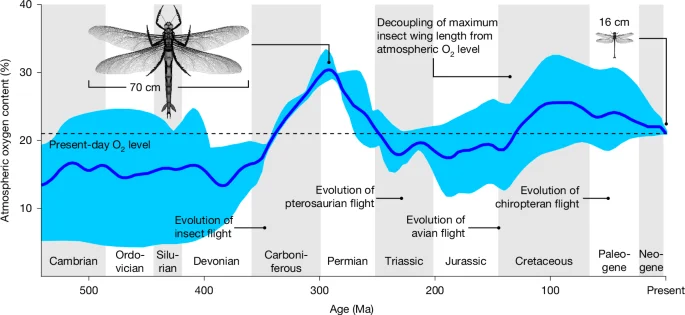
Insect giants escape oxygen-diffusion limits in flight muscles
science5 months ago

Insect giants escape oxygen-diffusion limits in flight muscles

A cross-species analysis of 44 insect species across 10 orders (plus the 100 g Meganeuropsis permiana) shows the tracheolar space in flight muscles rises only about 1.8-fold over a 10,000‑fold range in body mass and is typically 1% or less. This argues that diffusion of oxygen through the tracheolar–muscle system does not constrain maximum insect size, including gigantism. The study highlights that even a threefold increase in tracheolar space would markedly affect oxygen delivery but have only modest effects on flight, challenging the long-held view that atmospheric oxygen limits insect gigantism and pointing to other factors shaping their evolution.

Bow and Arrow Arrive in North America About 1,400 Years Ago, Study Finds
science5 months ago

Bow and Arrow Arrive in North America About 1,400 Years Ago, Study Finds

Radiocarbon dating of carefully selected North American weapons places the bow and arrow’s emergence at roughly 1,400 years ago. Adoption was rapid in the south, where the bow quickly supplanted the atlatl, while in the north the bow coexisted with the atlatl for centuries, implying a single origin with regionally varying diffusion. The study highlights a context-dependent pattern of technological evolution influenced by environment and social networks, with faster replacement in some regions and prolonged toolkit diversity in others.