
Ancient genomes reveal broad directional selection across West Eurasia
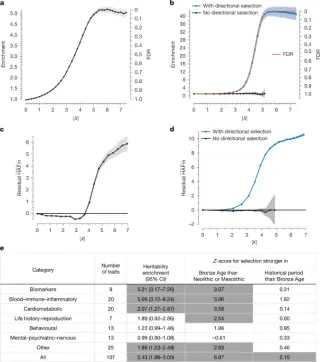
A new method applied to 15,836 West Eurasian ancient genomes (10,016 newly reported) finds hundreds of alleles with consistent frequency changes over the last ~10,000 years, indicating pervasive directional selection rather than just migrations. The study shows polygenic shifts affecting modern trait predictions—lower body fat and schizophrenia risk, higher cognitive performance—measured in industrialized contexts, with selection coefficients estimated across about 9.7 million variants, revealing that selection on complex traits helped shape the genetic architecture of present-day populations.